QUESTION IMAGE
Question
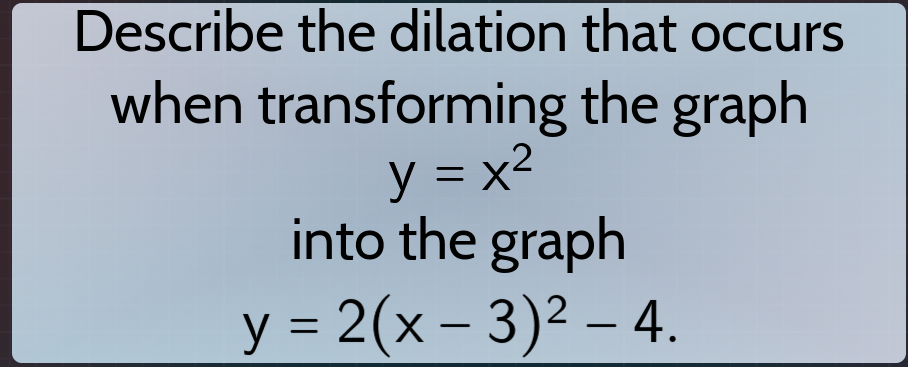
describe the dilation that occurs when transforming the graph y = x² into the graph y = 2(x − 3)² − 4.
planation:
Step1: Recall Dilation Rule
For a quadratic function in the form \( y = a(x - h)^2 + k \), the coefficient \( a \) determines the vertical dilation. If \( |a|>1 \), it's a vertical stretch; if \( 0<|a|<1 \), it's a vertical compression.
Step2: Identify 'a' in the New Function
In the function \( y = 2(x - 3)^2 - 4 \), the value of \( a \) is 2. Since \( |2| = 2>1 \), we compare it to the original function \( y = x^2 \) (where \( a = 1 \)).

Snap & solve any problem in the app
Get step-by-step solutions on Sovi AI
Photo-based solutions with guided steps
Explore more problems and detailed explanations
The graph of \( y = x^2 \) undergoes a vertical stretch by a factor of 2 to transform into the graph of \( y = 2(x - 3)^2 - 4 \).