QUESTION IMAGE
Question
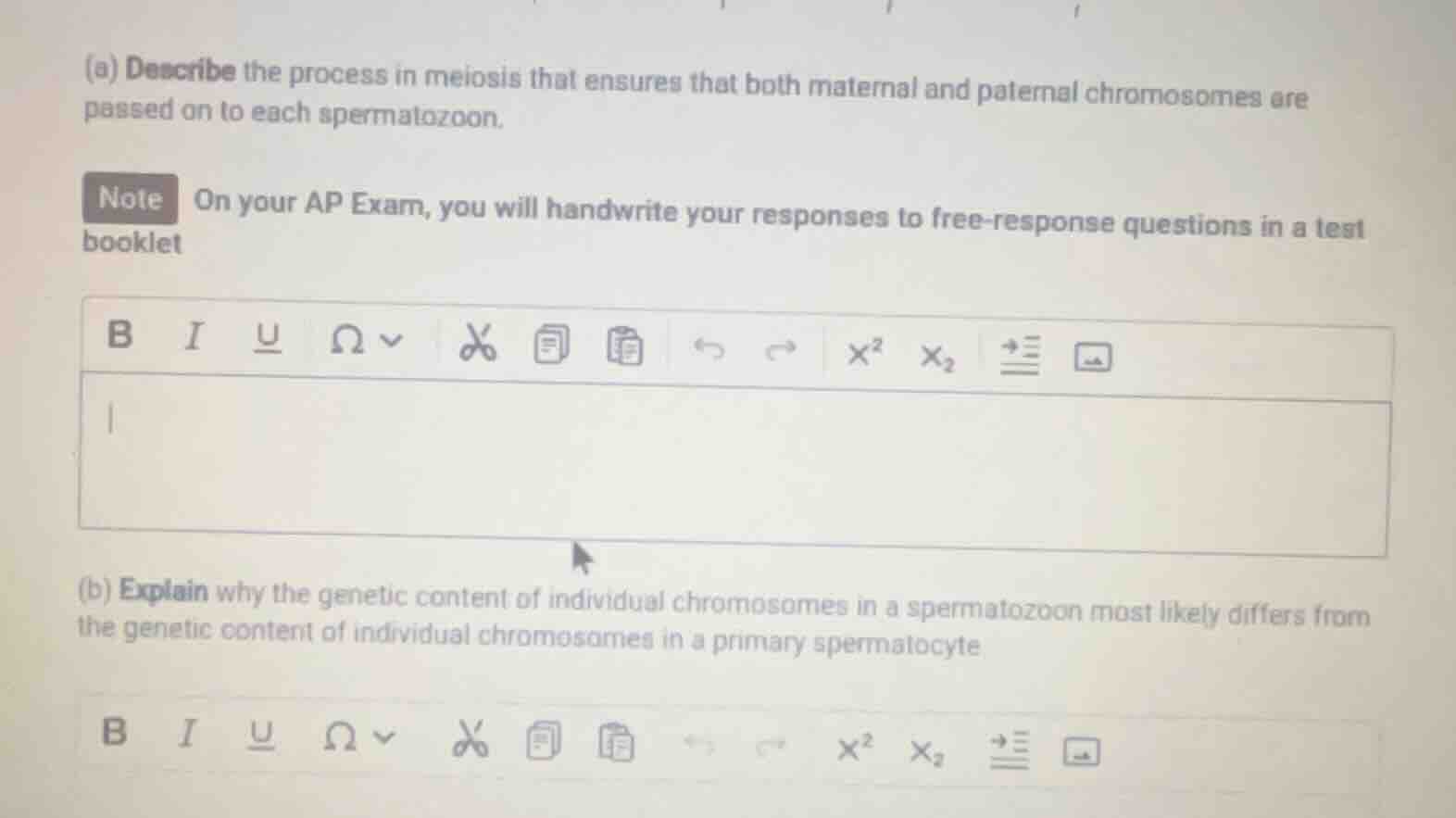
(a) describe the process in meiosis that ensures that both maternal and paternal chromosomes are passed on to each spermatozoon.
note on your ap exam, you will handwrite your responses to free - response questions in a test booklet
(b) explain why the genetic content of individual chromosomes in a spermatozoon most likely differs from the genetic content of individual chromosomes in a primary spermatocyte.
Part (a)
During meiosis I, homologous chromosomes (one maternal, one paternal) pair up (synapsis) and then undergo independent assortment. Independent assortment means that the maternal and paternal chromosomes are randomly distributed to the daughter cells (secondary spermatocytes) during anaphase I. Then, meiosis II separates sister chromatids, and eventually, four spermatids (which mature into spermatozoa) are formed. Each spermatozoon gets a haploid set of chromosomes, with a mix of maternal and paternal chromosomes due to independent assortment and, also, crossing over (which shuffles genetic material between maternal and paternal homologs during prophase I) ensures genetic diversity but also that both maternal and paternal genetic material is included.
A primary spermatocyte is diploid (has 2n chromosomes) and contains homologous chromosome pairs (each chromosome is a double - stranded DNA molecule, sister chromatids). In meiosis I, homologous chromosomes separate, and in meiosis II, sister chromatids separate. Also, crossing over during prophase I of meiosis exchanges genetic material between non - sister chromatids of homologous chromosomes. So, in a spermatozoon (haploid, n chromosomes), each chromosome is a single - stranded (after meiosis II) and has undergone genetic recombination (due to crossing over) and is part of a haploid set, while a primary spermatocyte's chromosomes are diploid, with each chromosome being a double - stranded sister chromatid pair (before meiosis) and no recombination has occurred yet (or at least not the final recombination that leads to the sperm's chromosomes). Specifically, during meiosis, crossing over (prophase I) creates new combinations of alleles on chromosomes, and meiosis reduces the chromosome number from diploid to haploid. So a primary spermatocyte has unrecombined, diploid chromosomes (sister chromatids intact, homologous pairs present), while a spermatozoon has recombined (due to crossing over), haploid chromosomes (single chromatid, after meiosis II) with unique genetic content.

Snap & solve any problem in the app
Get step-by-step solutions on Sovi AI
Photo-based solutions with guided steps
Explore more problems and detailed explanations
In meiosis, during prophase I, homologous chromosomes (maternal and paternal) undergo synapsis (pairing) and crossing over (exchange of genetic material between maternal and paternal chromatids), shuffling genetic information. During anaphase I, these homologous pairs undergo independent assortment—maternal and paternal chromosomes are randomly sorted into daughter cells (secondary spermatocytes). Meiosis II then divides sister chromatids, resulting in spermatids (maturing into spermatozoa) with a haploid set containing both maternal and paternal - derived genetic material (due to crossing over and independent assortment).