QUESTION IMAGE
Question
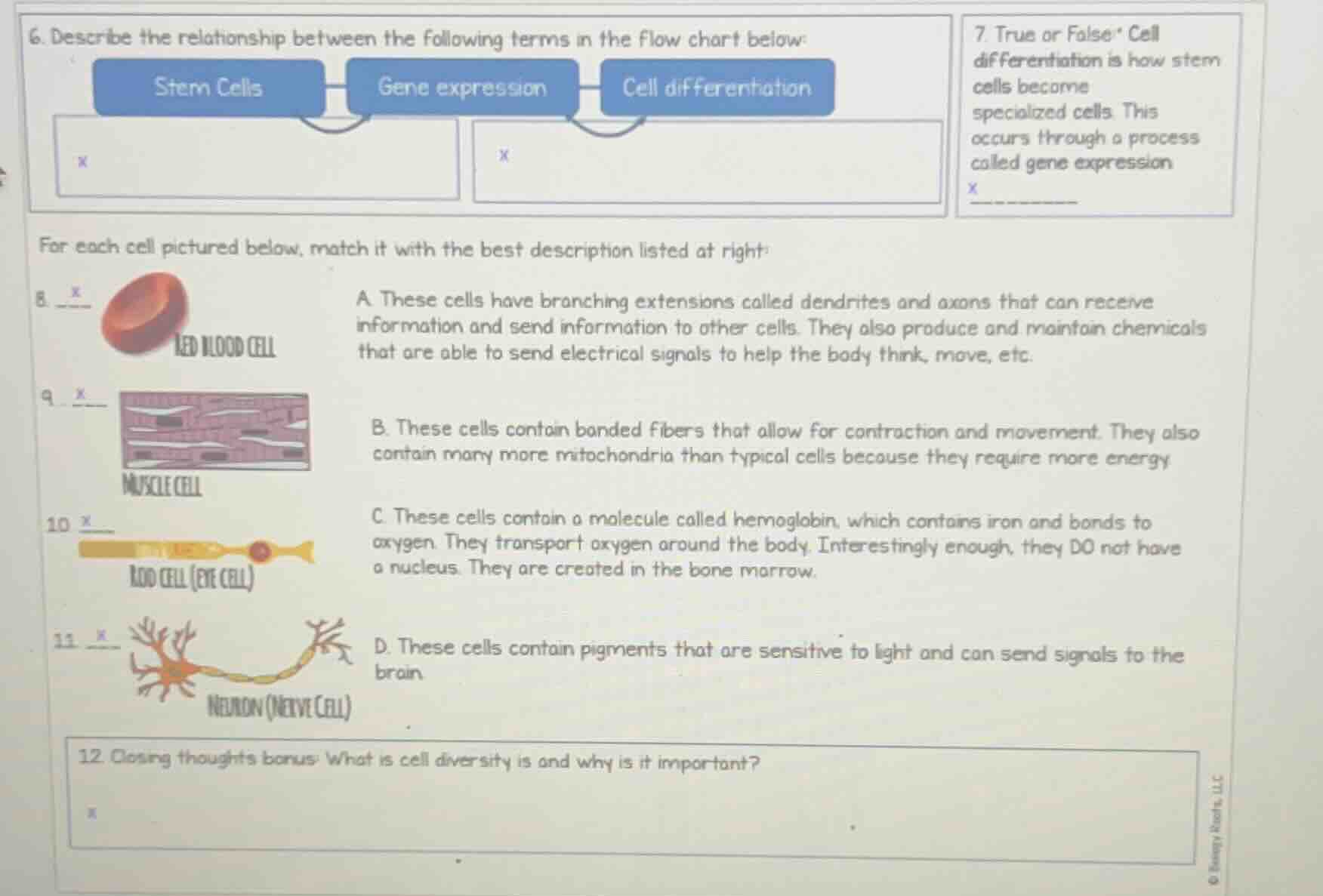
- describe the relationship between the following terms in the flow chart below: stem cells gene expression cell differentiation x x 7. true or false* cell differentiation is how stem cells become specialized cells. this occurs through a process called gene expression x ____ for each cell pictured below, match it with the best description listed at right: 8. _ red blood cell 9. _ muscle cell 10 _ rod cell (eye cell) 11 ___ neuron (nerve cell) a. these cells have branching extensions called dendrites and axons that can receive information and send information to other cells. they also produce and maintain chemicals that are able to send electrical signals to help the body think, move, etc. b. these cells contain banded fibers that allow for contraction and movement. they also contain many more mitochondria than typical cells because they require more energy c. these cells contain a molecule called hemoglobin, which contains iron and bonds to oxygen. they transport oxygen around the body. interestingly enough, they do not have a nucleus. they are created in the bone marrow. d. these cells contain pigments that are sensitive to light and can send signals to the brain 12. closing thoughts bonus: what is cell diversity is and why is it important? x
Question 6:
Stem cells are the starting unspecialized cells. Gene expression is the mechanism that controls which genes are active in stem cells, leading to cell differentiation, the process where stem cells develop into specialized cell types.
- Relationship 1 (Stem Cells → Gene expression): Stem cells are the source cells where selective gene expression is initiated to drive specialization.
- Relationship 2 (Gene expression → Cell differentiation): Regulated gene expression is the molecular process that directs stem cells to undergo cell differentiation, resulting in specialized cells.
Question 7:
The statement correctly describes that cell differentiation (specialization of stem cells) occurs via gene expression, so it is true.
Questions 8-11:
Match each cell to its defining functional and structural traits:
- Red blood cells use hemoglobin to carry oxygen and lack a nucleus.
- Muscle cells have banded fibers, many mitochondria, and enable movement.
- Rod cells (eye cells) are light-sensitive and send signals to the brain.
- Neurons have dendrites/axons for electrical signaling.
Question 12:
Cell diversity refers to the many specialized cell types in a multicellular organism, each with unique structures and functions. It is critical because specialized cells perform distinct, essential tasks that allow the organism to carry out complex biological processes (like oxygen transport, movement, sensory perception) that a single cell type could not accomplish alone, supporting overall organism survival and function.

Snap & solve any problem in the app
Get step-by-step solutions on Sovi AI
Photo-based solutions with guided steps
Explore more problems and detailed explanations
6.
- Stem Cells to Gene expression: Stem cells are the precursor cells where selective gene expression is activated to start the specialization process.
- Gene expression to Cell differentiation: Regulated gene expression is the molecular driver that causes stem cells to undergo cell differentiation, developing into specialized cell types.
- True
- C. These cells contain a molecule called hemoglobin, which contains iron and bonds to oxygen. They transport oxygen around the body. Interestingly enough, they DO not have a nucleus. They are created in the bone marrow.
- B. These cells contain banded fibers that allow for contraction and movement. They also contain many more mitochondria than typical cells because they require more energy
- D. These cells contain pigments that are sensitive to light and can send signals to the brain
- A. These cells have branching extensions called dendrites and axons that can receive information and send information to other cells. They also produce and maintain chemicals that are able to send electrical signals to help the body think, move, etc.
- Cell diversity is the variety of specialized cell types in a multicellular organism, each with unique structures and functions. It is important because specialized cells perform distinct, essential biological tasks (e.g., oxygen transport, movement, sensory processing) that enable complex organism survival and function, which a single cell type cannot support alone.