QUESTION IMAGE
Question
details
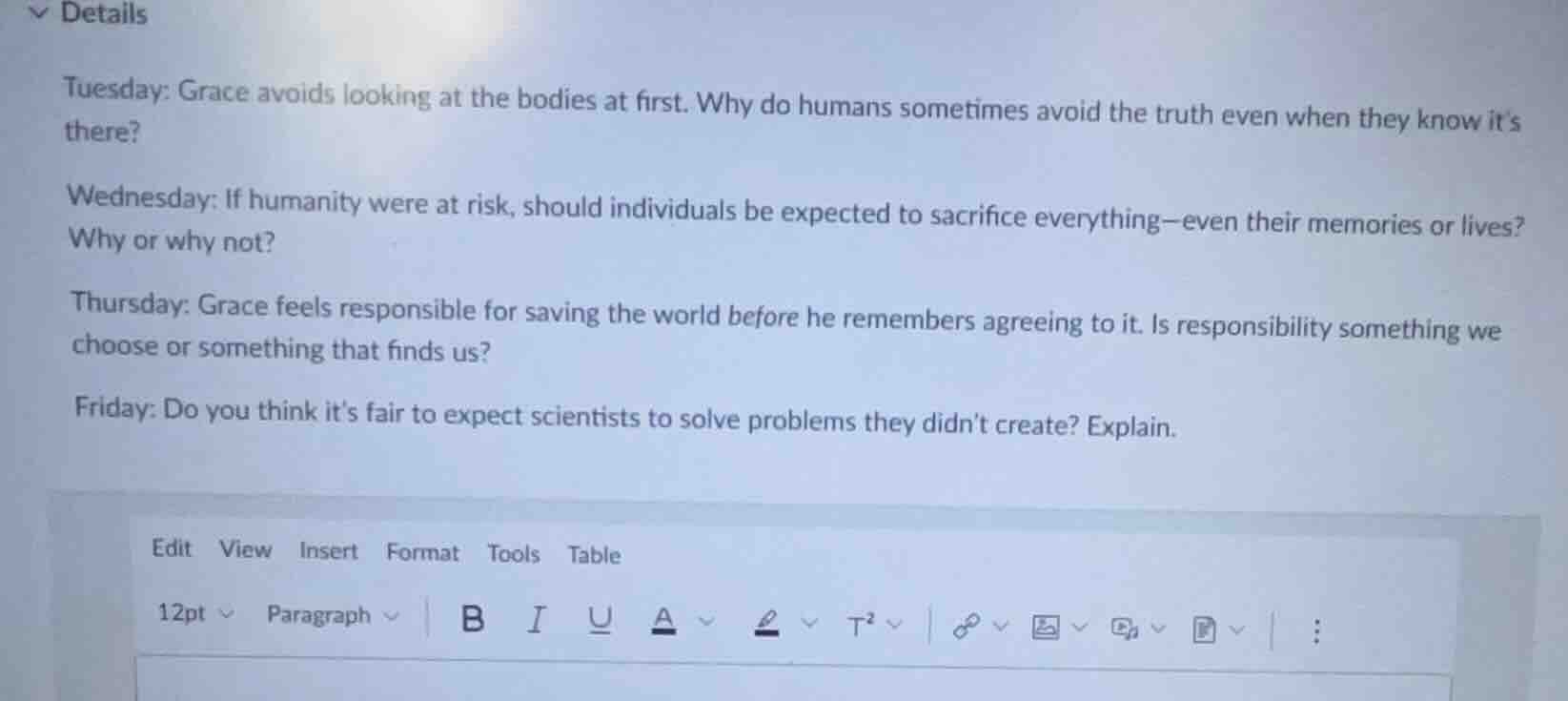
tuesday: grace avoids looking at the bodies at first. why do humans sometimes avoid the truth even when they know it’s there?
wednesday: if humanity were at risk, should individuals be expected to sacrifice everything—even their memories or lives? why or why not?
thursday: grace feels responsible for saving the world before he remembers agreeing to it. is responsibility something we choose or something that finds us?
friday: do you think it’s fair to expect scientists to solve problems they didn’t create? explain.
Brief Explanations
- Tuesday: Humans avoid known truth due to psychological defense mechanisms like denial, which protects against overwhelming distress, guilt, or fear of the consequences of confronting that truth.
- Wednesday: There is no universal answer. Some argue individuals should sacrifice for collective survival (utilitarian perspective, prioritizing the greater good), while others argue individual autonomy and inherent human value mean such a sacrifice cannot be ethically demanded.
- Thursday: Responsibility is both chosen and assigned. We can choose to take on responsibilities (e.g., a job), but unchosen responsibilities can also arise from circumstances, relationships, or societal roles that are imposed on us without explicit consent.
- Friday: It is not inherently fair, as scientists are not responsible for systemic or human-caused problems they did not contribute to. However, scientists often have unique expertise to address these issues, so while expectation is unfair, voluntary, supported engagement to solve them can be a moral and practical choice for the public good.

Snap & solve any problem in the app
Get step-by-step solutions on Sovi AI
Photo-based solutions with guided steps
Explore more problems and detailed explanations
- Tuesday: Humans avoid known truth to protect themselves from overwhelming negative emotions or consequences via psychological defenses like denial.
- Wednesday: This depends on ethical perspective. Utilitarians may say yes (prioritize collective survival), while those focused on individual autonomy may say no (sacrifice cannot be demanded).
- Thursday: Responsibility is both chosen (e.g., voluntary roles) and something that finds us (e.g., unchosen relational/societal duties).
- Friday: No, it is not fair, but scientists' unique expertise may make voluntary, supported action to solve such problems a moral, practical option.