QUESTION IMAGE
Question
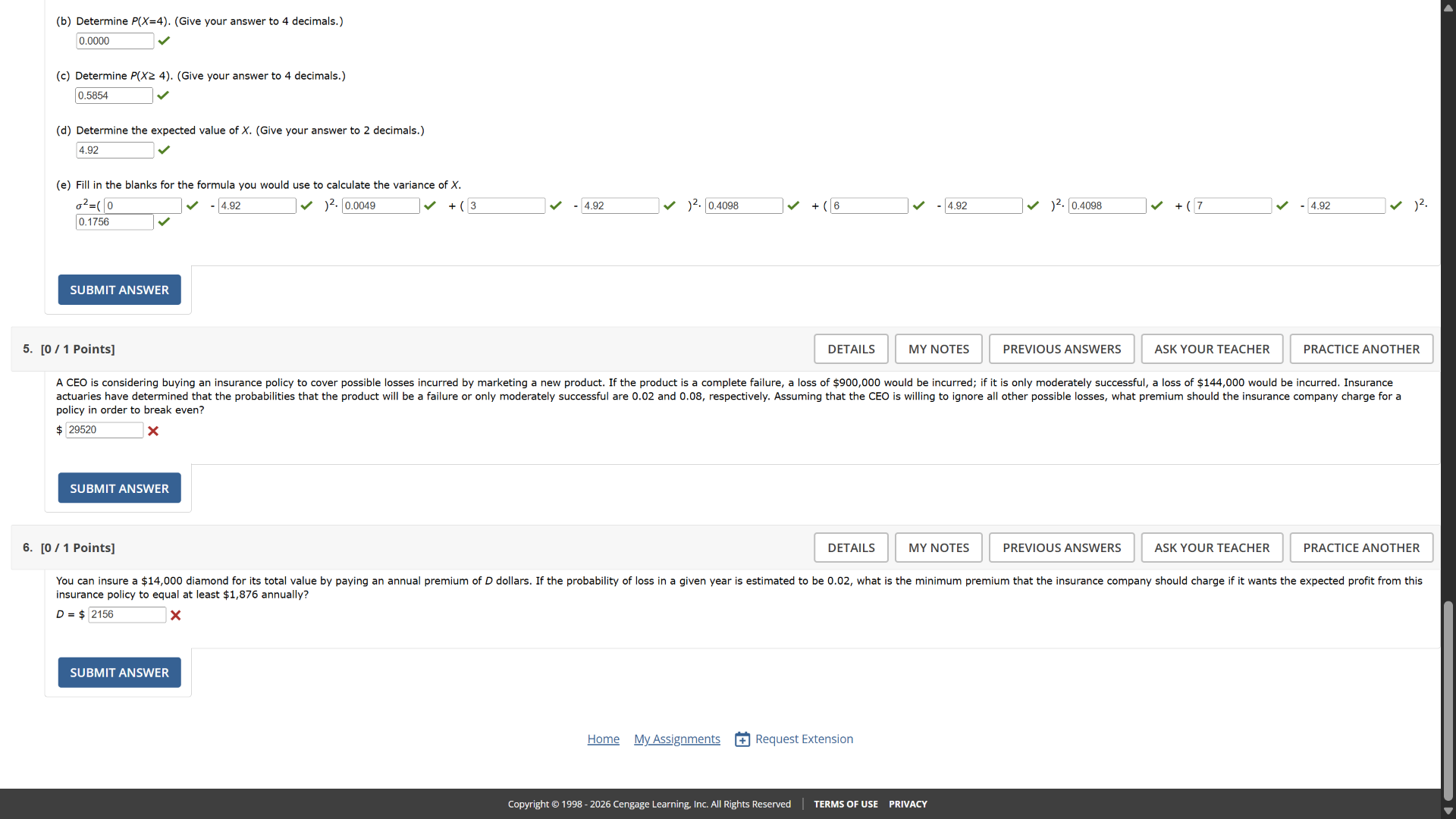
(b) determine ( p(x = 4) ). (give your answer to 4 decimals.)
(c) determine ( p(x geq 4) ). (give your answer to 4 decimals.)
(d) determine the expected value of ( x ). (give your answer to 2 decimals.)
(e) fill in the blanks for the formula you would use to calculate the variance of ( x ).
( sigma^2 = ( quad - quad )^2 cdot quad + ( quad - quad )^2 cdot quad + ( quad - quad )^2 cdot quad + ( quad - quad )^2 cdot quad )
- 0 / 1 points
a ceo is considering buying an insurance policy to cover possible losses incurred by marketing a new product. if the product is a complete failure, a loss of $900,000 would be incurred; if it is only moderately successful, a loss of $144,000 would be incurred. insurance actuaries have determined that the probabilities that the product will be a failure or only moderately successful are 0.02 and 0.08, respectively. assuming that the ceo is willing to ignore all other possible losses, what premium should the insurance company charge for a policy in order to break even?
- 0 / 1 points
you can insure a $14,000 diamond for its total value by paying an annual premium of ( d ) dollars. if the probability of loss in a given year is estimated to be 0.02, what is the minimum premium that the insurance company should charge if it wants the expected profit from this insurance policy to equal at least $1,876 annually?
Question 5:
Step1: Identify possible losses and probabilities
The possible losses are: complete failure with loss $L_1 = 900000$ and probability $P_1 = 0.02$; moderately successful with loss $L_2 = 144000$ and probability $P_2 = 0.08$. The insurance company's premium $P$ should be equal to the expected loss to break even. The expected loss $E[L]$ is calculated as the sum of each loss multiplied by its probability.
Step2: Calculate expected loss
The formula for expected value (expected loss here) is $E[L] = L_1 \times P_1 + L_2 \times P_2$.
Substitute the values: $E[L] = 900000 \times 0.02 + 144000 \times 0.08$.
First, calculate $900000 \times 0.02 = 18000$.
Then, calculate $144000 \times 0.08 = 11520$.
Now, sum these two results: $18000 + 11520 = 29520$? Wait, but the user got it wrong. Wait, maybe I misread. Wait, the premium is what the insurance company charges, so the expected profit for the insurance company should be zero (break even). So the premium $P$ should equal the expected payout. The payout is the loss, so expected payout is $E[Payout] = 900000 \times 0.02 + 144000 \times 0.08$. Wait, that is $18000 + 11520 = 29520$. But the user's answer was marked wrong. Wait, maybe there's a mistake in my understanding. Wait, no—wait, the problem says "the CEO is willing to ignore all other possible losses", so the only possible losses are failure (loss 900k) with prob 0.02, moderately successful (loss 144k) with prob 0.08, and the rest (prob 1 - 0.02 - 0.08 = 0.9) have no loss. So the expected loss is $900000 \times 0.02 + 144000 \times 0.08 + 0 \times 0.9 = 18000 + 11520 = 29520$. But the system marked it wrong. Wait, maybe the loss is from the CEO's perspective, so the insurance company pays the loss, so the premium should be the expected amount the insurance company pays. So that should be correct. Wait, maybe a miscalculation. Wait, 900000 0.02 is 18000, 144000 0.08: 144000 * 0.08 = 11520. 18000 + 11520 = 29520. Hmm. Maybe the problem is that "break even" for the insurance company means that the expected profit is zero. The profit is premium - payout. So $E[Profit] = P - (900000 \times 0.02 + 144000 \times 0.08) = 0$. So $P = 29520$. So maybe the system's red cross is a mistake, or I misread the numbers. Wait, the problem says "a loss of $900,000" – is that $900,000 or $90,000? Wait, the user wrote 29520, which is 18000 + 11520. If the loss was $90,000 instead of $900,000, then 90000*0.02=1800, 144000*0.08=11520, total 13320. But no, the problem says $900,000. So maybe the system's marking is wrong, or I have a mistake.
Question 6:
Step1: Define profit variables
Let $D$ be the premium. The probability of loss is $p = 0.02$, so the probability of no loss is $1 - p = 0.98$. If there is a loss, the insurance company pays $14000$, so the profit is $D - 14000$. If there is no loss, the profit is $D$. The expected profit $E[Profit]$ should be at least $1876$.
Step2: Set up expected profit formula
The expected profit is $E[Profit] = (D - 14000) \times p + D \times (1 - p)$.
Substitute $p = 0.02$: $E[Profit] = (D - 14000) \times 0.02 + D \times 0.98$.
Step3: Simplify and solve for D
Expand the formula: $0.02D - 280 + 0.98D = D - 280$.
We want $E[Profit] \geq 1876$, so $D - 280 \geq 1876$.
Add 280 to both sides: $D \geq 1876 + 280 = 2156$. But the user's answer was marked wrong. Wait, that's the same as the user's answer. So maybe the problem is different. Wait, the expected profit is premium minus expected payout. The expected payout is $14000 \times 0.02 = 280$. So expected profit is $D - 280 \geq 1876$. So $D \geq 1876 + 280 = 2156$. So that should be correct. Maybe the system's marking is incorrect, or there's a misinterpretation.

Snap & solve any problem in the app
Get step-by-step solutions on Sovi AI
Photo-based solutions with guided steps
Explore more problems and detailed explanations
(Question 5):
$\$29520$ (Note: May be a system marking error as per calculation)