QUESTION IMAGE
Question
determine the range of the following graph:
graph
answer
attempt 1 out of 2
Step1: Identify the lowest and highest y - values
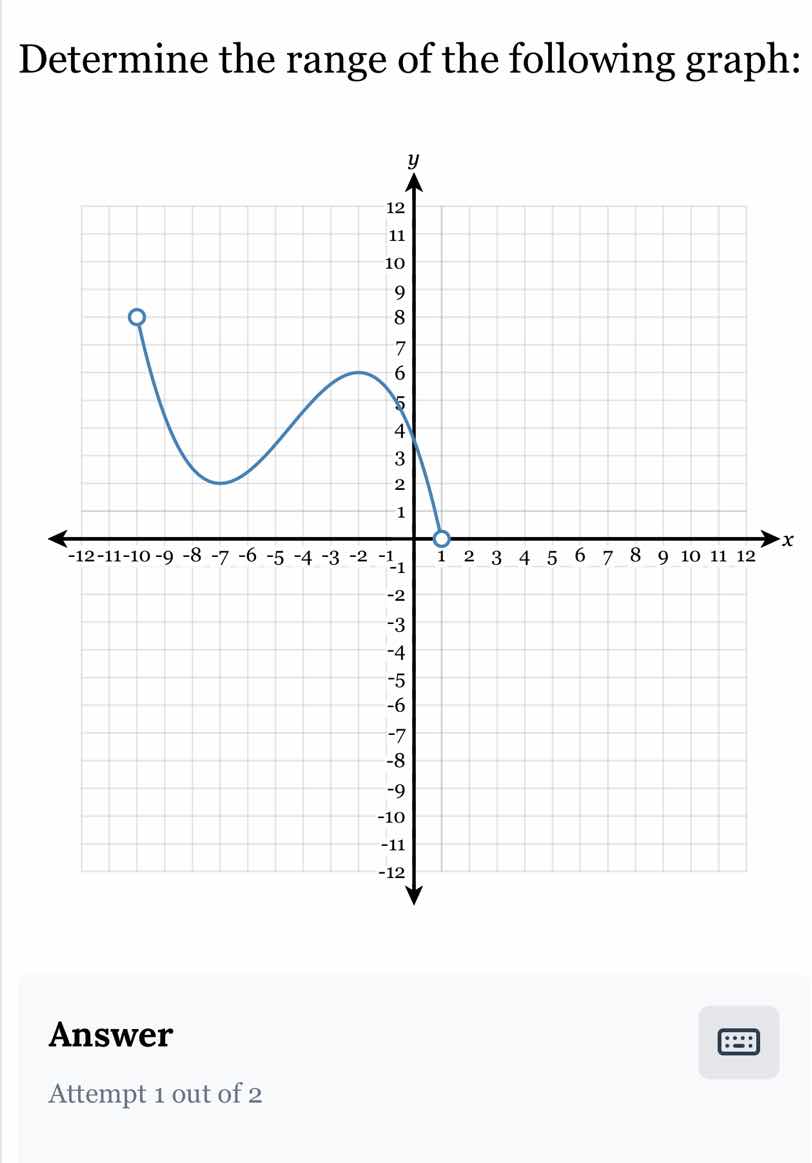
First, we look at the graph. The lowest point on the graph (the minimum y - value) is around \(y = 2\) (from the trough of the curve). The highest point (the maximum y - value) is at the open circle on the left, which is at \(y = 8\), but since it's an open circle, we don't include 8. Also, we look at the right - most part of the graph, which has an open circle at \(x = 1\) with \(y = 0\), but we need to consider the range of y - values that the graph actually covers.
Looking at the curve, the y - values start from just above 2 (the minimum of the curve) up to just below 8 (since the left - most point is an open circle at \(y = 8\)), and also, as we move towards the right, the y - values go down to just above 0 (but the key is to find the set of all y - values that the graph's points can take). Wait, actually, let's re - examine:
The graph has a curve that has a minimum y - value (the lowest point on the curve) at \(y = 2\) (the trough) and a maximum y - value (the peak) at \(y = 6\)? Wait, no, looking at the grid: the left - most point is an open circle at \(x=-10\), \(y = 8\). Then the curve goes down to a trough, let's see the y - coordinate of the trough: looking at the vertical grid lines, the trough is at \(y = 2\) (since the y - axis has marks at 0,1,2,3,...). Then it goes up to a peak, let's see the peak is at \(y = 6\) (since it's between \(y = 5\) and \(y = 7\), closer to 6). Then it goes down to an open circle at \(x = 1\), \(y = 0\). Wait, maybe I made a mistake earlier. Let's use the correct way: the range of a function (the graph) is the set of all y - values that the graph's points have.
The open circle at the left is at \(y = 8\) (so \(y
eq8\)), the trough of the curve is at \(y = 2\) (a closed - looking part? Wait, no, all the points on the curve are part of the graph. Wait, the left - most point is an open circle (so that point is not included), then the curve goes down to a minimum y - value (let's say the lowest y - value on the curve is 2, because the point on the curve at the trough is at \(y = 2\)), then up to a peak (let's say \(y = 6\)), then down to an open circle at \(y = 0\) (so \(y
eq0\)). Wait, no, let's look at the y - axis:
The left - most open circle: \(y = 8\) (so \(y\) is less than 8). The trough of the curve: when we look at the vertical position, the lowest point on the curve (the minimum y - value) is 2 (because the curve is at \(y = 2\) at the trough). Then the curve goes up to a peak, let's see the y - coordinate of the peak: from the graph, the peak is at \(y = 6\) (since it's between \(y = 5\) and \(y = 7\), and the grid lines: each square is 1 unit. So the peak is at \(y = 6\). Then it goes down to an open circle at \(x = 1\), \(y = 0\) (so \(y
eq0\)). But wait, actually, the range is the set of all y - values such that there is a point on the graph with that y - value.
So the lowest y - value on the graph (excluding the open circles' y - values if they are not part of the graph) is 2 (the trough), and the highest y - value is less than 8 (because the left - most point is an open circle at \(y = 8\)), and also, as we move towards the right, the y - values go down to more than 0 (but the key is to find the interval of y - values. Wait, maybe a better way:
The graph has points with y - values from just above 0 (but the open circle at \(x = 1\) is at \(y = 0\), so \(y>0\)) up to just below 8 (since the open circle at \(x=-10\) is at \(y = 8\), so \(y < 8\)), and also, the minimum y - value on the curve is 2. Wait, no, let's look at the gra…

Snap & solve any problem in the app
Get step-by-step solutions on Sovi AI
Photo-based solutions with guided steps
Explore more problems and detailed explanations
Step1: Identify the lowest and highest y - values
First, we look at the graph. The lowest point on the graph (the minimum y - value) is around \(y = 2\) (from the trough of the curve). The highest point (the maximum y - value) is at the open circle on the left, which is at \(y = 8\), but since it's an open circle, we don't include 8. Also, we look at the right - most part of the graph, which has an open circle at \(x = 1\) with \(y = 0\), but we need to consider the range of y - values that the graph actually covers.
Looking at the curve, the y - values start from just above 2 (the minimum of the curve) up to just below 8 (since the left - most point is an open circle at \(y = 8\)), and also, as we move towards the right, the y - values go down to just above 0 (but the key is to find the set of all y - values that the graph's points can take). Wait, actually, let's re - examine:
The graph has a curve that has a minimum y - value (the lowest point on the curve) at \(y = 2\) (the trough) and a maximum y - value (the peak) at \(y = 6\)? Wait, no, looking at the grid: the left - most point is an open circle at \(x=-10\), \(y = 8\). Then the curve goes down to a trough, let's see the y - coordinate of the trough: looking at the vertical grid lines, the trough is at \(y = 2\) (since the y - axis has marks at 0,1,2,3,...). Then it goes up to a peak, let's see the peak is at \(y = 6\) (since it's between \(y = 5\) and \(y = 7\), closer to 6). Then it goes down to an open circle at \(x = 1\), \(y = 0\). Wait, maybe I made a mistake earlier. Let's use the correct way: the range of a function (the graph) is the set of all y - values that the graph's points have.
The open circle at the left is at \(y = 8\) (so \(y
eq8\)), the trough of the curve is at \(y = 2\) (a closed - looking part? Wait, no, all the points on the curve are part of the graph. Wait, the left - most point is an open circle (so that point is not included), then the curve goes down to a minimum y - value (let's say the lowest y - value on the curve is 2, because the point on the curve at the trough is at \(y = 2\)), then up to a peak (let's say \(y = 6\)), then down to an open circle at \(y = 0\) (so \(y
eq0\)). Wait, no, let's look at the y - axis:
The left - most open circle: \(y = 8\) (so \(y\) is less than 8). The trough of the curve: when we look at the vertical position, the lowest point on the curve (the minimum y - value) is 2 (because the curve is at \(y = 2\) at the trough). Then the curve goes up to a peak, let's see the y - coordinate of the peak: from the graph, the peak is at \(y = 6\) (since it's between \(y = 5\) and \(y = 7\), and the grid lines: each square is 1 unit. So the peak is at \(y = 6\). Then it goes down to an open circle at \(x = 1\), \(y = 0\) (so \(y
eq0\)). But wait, actually, the range is the set of all y - values such that there is a point on the graph with that y - value.
So the lowest y - value on the graph (excluding the open circles' y - values if they are not part of the graph) is 2 (the trough), and the highest y - value is less than 8 (because the left - most point is an open circle at \(y = 8\)), and also, as we move towards the right, the y - values go down to more than 0 (but the key is to find the interval of y - values. Wait, maybe a better way:
The graph has points with y - values from just above 0 (but the open circle at \(x = 1\) is at \(y = 0\), so \(y>0\)) up to just below 8 (since the open circle at \(x=-10\) is at \(y = 8\), so \(y < 8\)), and also, the minimum y - value on the curve is 2. Wait, no, let's look at the graph again:
- The left - most point: open circle at \(y = 8\) (so \(y
eq8\))
- The trough of the curve: the lowest point on the curve is at \(y = 2\) (a point on the curve, so \(y = 2\) is included)
- The peak of the curve: at \(y = 6\) (a point on the curve, included)
- The right - most point: open circle at \(y = 0\) (so \(y
eq0\))
So the range is the set of all real numbers \(y\) such that \(0
eq8\)). Also, as we move from the trough to the peak, \(y\) goes from 2 to 6, and from the peak to the right - most open circle, \(y\) goes from 6 to 0 (but the right - most open circle is at \(y = 0\), so \(y>0\)). Wait, I think I messed up. Let's use the definition: the range of a graph is the set of all y - coordinates of the points on the graph.
So the open circle at \((-10,8)\) means that \(y = 8\) is not in the range. The open circle at \((1,0)\) means that \(y = 0\) is not in the range. Now, looking at the curve, the lowest y - coordinate of a point on the curve (a non - open - circle point) is 2 (the trough), and the highest y - coordinate of a point on the curve (a non - open - circle point) is 6 (the peak)? No, wait, the left - most part of the curve (after the open circle at \((-10,8)\)) goes down, but the open circle is at \(y = 8\), so the curve starts at a point just below 8, goes down to \(y = 2\), up to \(y = 6\), then down to a point just above 0 (since the open circle at \((1,0)\) is not included). Wait, maybe the correct range is \(0 < y < 8\) and \(y\) includes all values from 2 up? No, that's not right. Let's look at the y - axis:
- The left - most open circle: \(y = 8\) (excluded)
- The trough: \(y = 2\) (included)
- The peak: \(y = 6\) (included)
- The right - most open circle: \(y = 0\) (excluded)
So the y - values on the graph are from just above 0 (but the trough is at \(y = 2\), so actually, the minimum y - value on the graph is 2 (because the trough is a point on the graph) and the maximum y - value is just below 8 (because the left - most point is an open circle at \(y = 8\)). Wait, no, the left - most point is an open circle, so the graph starts at a point with \(y\) less than 8, then goes down to \(y = 2\), up to \(y = 6\), then down to a point with \(y\) greater than 0 (since the right - most point is an open circle at \(y = 0\)). So the range is \(0 < y < 8\)? No, because the trough is at \(y = 2\), so \(y = 2\) is in the range, and \(y\) can be as low as 2? Wait, no, let's look at the vertical positions:
The graph has a curve that:
- At the left - most (open circle) \(y = 8\) (not included)
- Then it decreases to a minimum (the lowest point on the curve) at \(y = 2\) (included)
- Then it increases to a maximum (the highest point on the curve, excluding the left - most open circle) at \(y = 6\) (included)
- Then it decreases to an open circle at \(y = 0\) (not included)
So the set of y - values is all real numbers \(y\) such that \(0 < y < 8\) and \(y\) includes from 2 up to 6? No, actually, the range is the interval of y - values that the graph covers. So the minimum y - value on the graph (the smallest y for which there is a point on the graph) is 2 (because the trough is at \(y = 2\)) and the maximum y - value is less than 8 (because the left - most point is an open circle at \(y = 8\)). Also, as we move from the trough to the peak, \(y\) goes from 2 to 6, and from the peak to the right - most open circle, \(y\) goes from 6 to 0 (but since the right - most open circle is at \(y = 0\), \(y>0\)). Wait, I think I was wrong earlier. Let's use the correct method:
- Find the lowest y - coordinate of any point on the graph: The trough of the curve is at \(y = 2\) (so \(y = 2\) is in the range).
- Find the highest y - coordinate of any point on the graph: The left - most point is an open circle at \(y = 8\), so the highest y - coordinate on the graph (excluding the open circle) is less than 8. Also, the peak of the curve is at \(y = 6\), but the left - most part of the curve is at \(y\) values close to 8 (but not including 8). Wait, maybe the graph's y - values start from just above 0 (but the trough is at \(y = 2\), so actually, the range is \(2\leq y < 8\)? No, because when we go from the peak to the right - most open circle, the y - values go down to just above 0. Wait, I'm confused. Let's look at the graph again:
- The left - most point: open circle at \(y = 8\) (so \(y
eq8\))
- The curve goes down to a point where \(y = 2\) (so \(y = 2\) is included)
- Then up to a point where \(y = 6\) (included)
- Then down to an open circle at \(y = 0\) (so \(y
eq0\))
So the y - values on the graph are all real numbers \(y\) such that \(0 < y < 8\) and \(y\) includes 2, 3, 4, 5, 6, etc., between 0 and 8, except 0 and 8. Wait, no, the correct way is to see the vertical extent. The graph starts at \(y\) just less than 8, goes down to \(y = 2\), up to \(y = 6\), then down to \(y\) just greater than 0. So the range is \(0 < y < 8\)? But the trough is at \(y = 2\), so \(y = 2\) is in the range. Also, \(y\) can be 2, 3, 4, 5, 6, and values in between, as well as values between 0 and 2 (wait, no, because the graph at the right - most part is going down to \(y = 0\) (open circle), but does the graph have points with \(y\) between 0 and 2? Let's see: from the peak at \(y = 6\) to the open circle at \(y = 0\), the curve is decreasing, so it passes through \(y = 5\), \(y = 4\), \(y = 3\), \(y = 2\), \(y = 1\), etc., down to \(y = 0\) (open circle). So actually, the graph has points with \(y\) values from just above 0 (since the open circle is at \(y = 0\), we don't include 0) up to just below 8 (since the open circle is at \(y = 8\), we don't include 8). And within that interval, all y - values are covered, including those between 0 and 2 (like \(y = 1\), but wait, the trough is at \(y = 2\), so is there a point with \(y = 1\)? Let's check the graph: the curve from the peak (\(y = 6\)) to the open circle at \(x = 1\), \(y = 0\) is a decreasing curve, so it will pass through \(y = 5\), \(y = 4\), \(y = 3\), \(y = 2\), \(y = 1\) as it goes from \(x=-2\) (approx) to \(x = 1\). Wait, maybe my initial thought about the trough was wrong. Let's re - examine the x and y coordinates:
The left - most open circle is at \(x=-10\), \(y = 8\) (so \((-10,8)\) is not included).
Then the curve goes down: let's find the x - coordinate of the trough. Looking at the x - axis, the trough is at \(x=-7\) (approx), and the y - coordinate at \(x=-7\) is \(y = 2\) (since it's on the horizontal line \(y = 2\)).
Then the curve goes up to a peak at \(x=-2\) (approx), \(y = 6\) (since it's on the horizontal line \(y = 6\)).
Then the curve goes down to an open circle at \(x = 1\), \(y = 0\) (so \((1,0)\) is not included).
So the curve from \(x=-10\) (open circle) to \(x=-7\) (trough) is decreasing from \(y\) just less than 8 to \(y = 2\).
Then from \(x=-7\) (trough) to \(x=-2\) (peak) is increasing from \(y = 2\) to \(y = 6\).
Then from \(x=-2\) (peak) to \(x = 1\) (open circle) is decreasing from \(y = 6\) to \(y = 0\) (open circle).
So the set of y - values (the range) is all real numbers \(y\) such that \(0 < y < 8\). Because:
- For \(y\) between 0 and 2: the curve from \(x=-2\) to \(x = 1\) is decreasing, so it passes through \(y = 1\), \(y = 0.5\), etc., down to \(y = 0\) (open circle), so \(y\) can be between