QUESTION IMAGE
Question
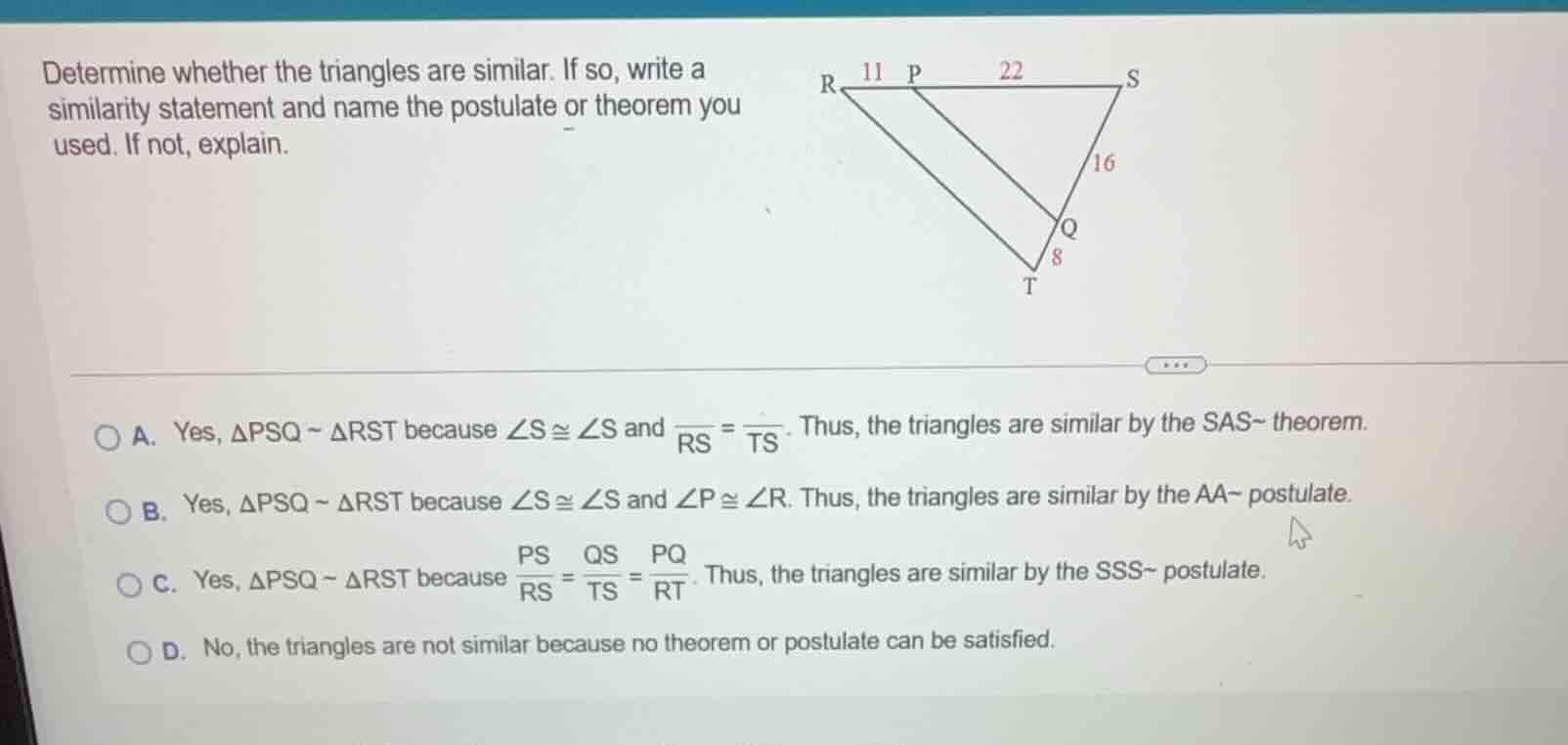
determine whether the triangles are similar. if so, write a similarity statement and name the postulate or theorem you used. if not, explain. a. yes, δpsq ~ δrst because ∠s ≅ ∠s and (rs/ps) = (ts/qs). thus, the triangles are similar by the sas~ theorem. b. yes, δpsq ~ δrst because ∠s ≅ ∠s and ∠p ≅ ∠r. thus, the triangles are similar by the aa~ postulate. c. yes, δpsq ~ δrst because (ps/rs) = (qs/ts) = (pq/rt). thus, the triangles are similar by the sss~ postulate. d. no, the triangles are not similar because no theorem or postulate can be satisfied.
Step1: Analyze Option A
First, find the lengths of the sides. \( RS = RP + PS = 11 + 22 = 33 \), \( TS = TQ + QS = 8 + 16 = 24 \). Now, check the ratios: \( \frac{PS}{RS}=\frac{22}{33}=\frac{2}{3} \), \( \frac{QS}{TS}=\frac{16}{24}=\frac{2}{3} \). Also, \( \angle S \) is common to both \( \triangle PSQ \) and \( \triangle RST \). By the SAS (Side - Angle - Side) similarity theorem, if two sides of one triangle are proportional to two sides of another triangle and the included angles are equal, the triangles are similar. Here, \( \frac{PS}{RS}=\frac{QS}{TS} \) and \( \angle S\cong\angle S \), so this satisfies SAS similarity.
Step2: Analyze Option B
\( \angle P \) and \( \angle R \): \( \angle P \) is in \( \triangle PSQ \) and \( \angle R \) is in \( \triangle RST \). Since \( PQ \) is a line segment inside \( \triangle RST \), \( PQ\parallel RT \)? Wait, no, actually, to use AA (Angle - Angle) similarity, we need two pairs of congruent angles. But we can't say \( \angle P\cong\angle R \) just by looking at the diagram. The first analysis for SAS is more valid.
Step3: Analyze Option C
We need to check the ratio of all three sides. \( PQ \) length is not given, and \( RT \) length is not given. We only know two sides' ratios, so we can't apply SSS (Side - Side - Side) similarity as we don't have all three side ratios.
Step4: Analyze Option D
From Step 1, we saw that the triangles do satisfy SAS similarity, so this option is incorrect.

Snap & solve any problem in the app
Get step-by-step solutions on Sovi AI
Photo-based solutions with guided steps
Explore more problems and detailed explanations
A. Yes, \( \triangle PSQ \sim \triangle RST \) because \( \angle S\cong\angle S \) and \( \frac{PS}{RS}=\frac{QS}{TS} \). Thus, the triangles are similar by the SAS - theorem.