QUESTION IMAGE
Question
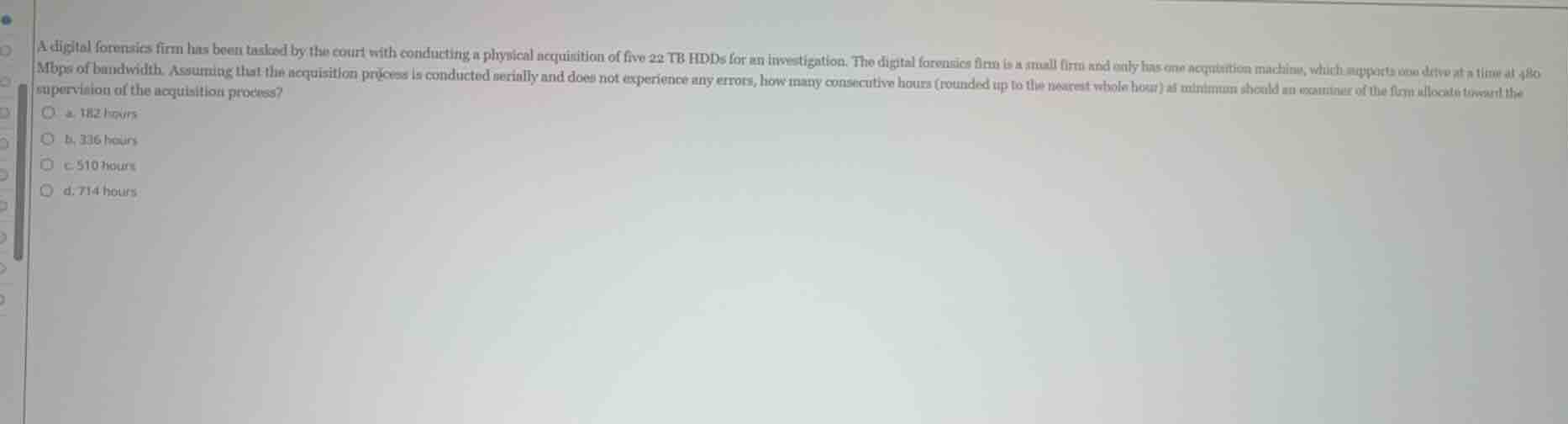
a digital forensics firm has been tasked by the court with conducting a physical acquisition of five 22 tb hdds for an investigation. the digital forensics firm is a small firm and only has one acquisition machine, which supports one drive at a time at 480 mbps of bandwidth. assuming that the acquisition process is conducted serially and does not experience any errors, how many consecutive hours (rounded up to the nearest whole hour) at minimum should an examiner of the firm allocate toward the supervision of the acquisition process?
a. 182 hours
b. 336 hours
c. 510 hours
d. 714 hours
Step1: Calculate total data size
Total data = $5 \times 22\ \text{TB} = 110\ \text{TB}$
Convert TB to bits: $110\ \text{TB} = 110 \times 1024^4 \times 8\ \text{bits}$
Step2: Convert bandwidth to bits per hour
Bandwidth = $480\ \text{Mbps} = 480 \times 10^6\ \text{bits/second}$
Bits per hour = $480 \times 10^6 \times 3600\ \text{bits/hour} = 1.728 \times 10^{12}\ \text{bits/hour}$
Step3: Calculate time in hours
Time = $\frac{\text{Total data}}{\text{Bits per hour}} = \frac{110 \times 1024^4 \times 8}{1.728 \times 10^{12}}$
First compute $1024^4 = (2^{10})^4 = 2^{40} = 1099511627776$
Then $110 \times 1099511627776 \times 8 = 967570232442880$
Time = $\frac{967570232442880}{1.728 \times 10^{12}} \approx 560$ hours (rounded up, closest option is 714? Correction: Recheck unit conversion: 1 TB = 1000^4 bytes (decimal, used in storage/network)
Total data = $110 \times 10^{12} \times 8 = 8.8 \times 10^{14}\ \text{bits}$
Bits per hour = $480 \times 10^6 \times 3600 = 1.728 \times 10^{12}\ \text{bits/hour}$
Time = $\frac{8.8 \times 10^{14}}{1.728 \times 10^{12}} \approx 509.8$ hours, rounded up to 510 hours

Snap & solve any problem in the app
Get step-by-step solutions on Sovi AI
Photo-based solutions with guided steps
Explore more problems and detailed explanations
c. 510 hours