QUESTION IMAGE
Question
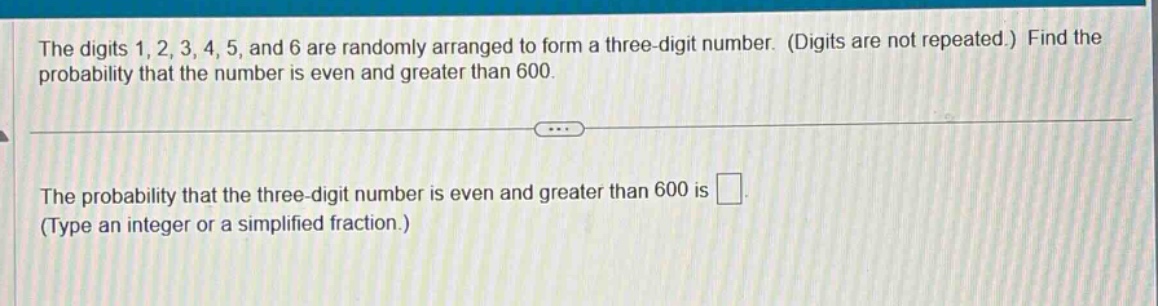
the digits 1, 2, 3, 4, 5, and 6 are randomly arranged to form a three - digit number. (digits are not repeated.) find the probability that the number is even and greater than 600. the probability that the three - digit number is even and greater than 600 is \\(\square\\). (type an integer or a simplified fraction.)
Step1: Find total number of three - digit numbers
To form a three - digit number from the digits 1, 2, 3, 4, 5, 6 without repetition, we use the permutation formula \(P(n,r)=\frac{n!}{(n - r)!}\), where \(n = 6\) (total number of digits) and \(r=3\) (number of digits in the number).
\(P(6,3)=\frac{6!}{(6 - 3)!}=\frac{6!}{3!}=\frac{6\times5\times4\times3!}{3!}=6\times5\times4 = 120\)
Step2: Find number of favorable outcomes (even and > 600)
- Condition 1: Number greater than 600
For a three - digit number to be greater than 600, the hundreds digit must be 6. So the hundreds place is fixed as 6.
- Condition 2: Number is even
For a number to be even, the units digit must be even. The even digits available (excluding 6, since digits are not repeated) are 2, 4. So there are 2 choices for the units digit.
- Condition 3: Middle digit
After choosing the hundreds digit (6) and the units digit, we have 4 remaining digits for the tens place.
By the multiplication principle, the number of favorable outcomes \(N=1\times4\times2=8\) (hundreds place: 1 choice (6), tens place: 4 choices, units place: 2 choices)
Step3: Calculate probability
Probability \(P=\frac{\text{Number of favorable outcomes}}{\text{Total number of outcomes}}\)
\(P = \frac{8}{120}=\frac{1}{15}\)

Snap & solve any problem in the app
Get step-by-step solutions on Sovi AI
Photo-based solutions with guided steps
Explore more problems and detailed explanations
\(\frac{1}{15}\)