QUESTION IMAGE
Question
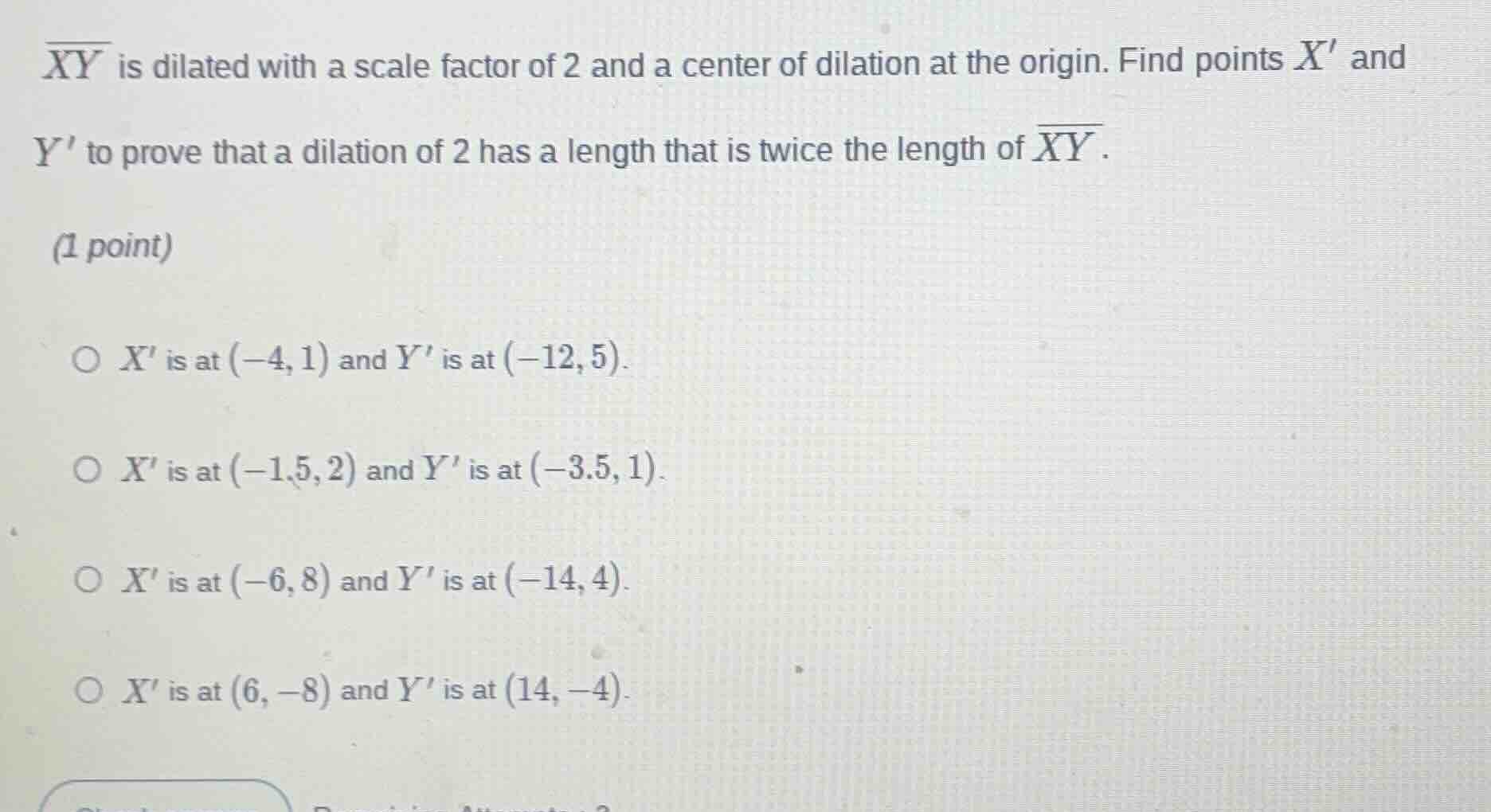
$\overline{xy}$ is dilated with a scale factor of 2 and a center of dilation at the origin. find points $x$ and $y$ to prove that a dilation of 2 has a length that is twice the length of $\overline{xy}$.
(1 point)
\\(\circ\\) $x$ is at $(-4, 1)$ and $y$ is at $(-12, 5)$.
\\(\circ\\) $x$ is at $(-1.5, 2)$ and $y$ is at $(-3.5, 1)$.
\\(\circ\\) $x$ is at $(-6, 8)$ and $y$ is at $(-14, 4)$.
\\(\circ\\) $x$ is at $(6, -8)$ and $y$ is at $(14, -4)$.
To solve this, we need to recall the rule for dilation about the origin with a scale factor \(k\): if a point \((x,y)\) is dilated with a scale factor \(k\) about the origin, the new point \((x',y')\) is given by \((kx,ky)\). Also, we can check the distance between the original and dilated points.
First, let's assume the original points \(X\) and \(Y\) (even though they are not given, we can work with the options). For a dilation with scale factor \(2\), the coordinates of \(X'\) and \(Y'\) should be twice the coordinates of \(X\) and \(Y\) (since center is origin).
Let's analyze each option:
- Option 1: \(X'(-4,1)\), \(Y'(-12,5)\) – These don't seem to be double of any reasonable original points (e.g., if \(X\) were \((-2, 0.5)\), \(Y\) would be \((-6, 2.5)\), but the y - coordinates don't follow a consistent scale factor of 2).
- Option 2: \(X'(-1.5,2)\), \(Y'(-3.5,1)\) – These are not double of any integer or simple fractional points (scale factor here would be less than 2, not 2).
- Option 3: \(X'(-6,8)\), \(Y'(-14,4)\) – Let's check the scale factor. If we assume original \(X\) is \((-3,4)\) and original \(Y\) is \((-7,2)\), then dilating with scale factor 2: \(X' = 2\times(-3,4)=(-6,8)\) and \(Y' = 2\times(-7,2)=(-14,4)\). Now, let's check the distance formula. The distance between two points \((x_1,y_1)\) and \((x_2,y_2)\) is \(d=\sqrt{(x_2 - x_1)^2+(y_2 - y_1)^2}\).
Original distance between \(X(-3,4)\) and \(Y(-7,2)\):
\(d_{XY}=\sqrt{(-7 + 3)^2+(2 - 4)^2}=\sqrt{(-4)^2+(-2)^2}=\sqrt{16 + 4}=\sqrt{20}=2\sqrt{5}\)
Dilated distance between \(X'(-6,8)\) and \(Y'(-14,4)\):
\(d_{X'Y'}=\sqrt{(-14 + 6)^2+(4 - 8)^2}=\sqrt{(-8)^2+(-4)^2}=\sqrt{64 + 16}=\sqrt{80}=4\sqrt{5}\)
And \(4\sqrt{5}=2\times(2\sqrt{5})\), so the length of \(X'Y'\) is twice the length of \(XY\).
- Option 4: \(X'(6,-8)\), \(Y'(14,-4)\) – The signs are positive, while if we consider the original points (from option 3) as negative, this would be a reflection, not a dilation with scale factor 2 (since the original points in option 3 are negative, and this is positive, so it's a reflection over the origin, not just dilation).

Snap & solve any problem in the app
Get step-by-step solutions on Sovi AI
Photo-based solutions with guided steps
Explore more problems and detailed explanations
\(X'\) is at \((-6, 8)\) and \(Y'\) is at \((-14, 4)\) (the third option: \(X'\) is at \((-6,8)\) and \(Y'\) is at \((-14,4)\))