QUESTION IMAGE
Question
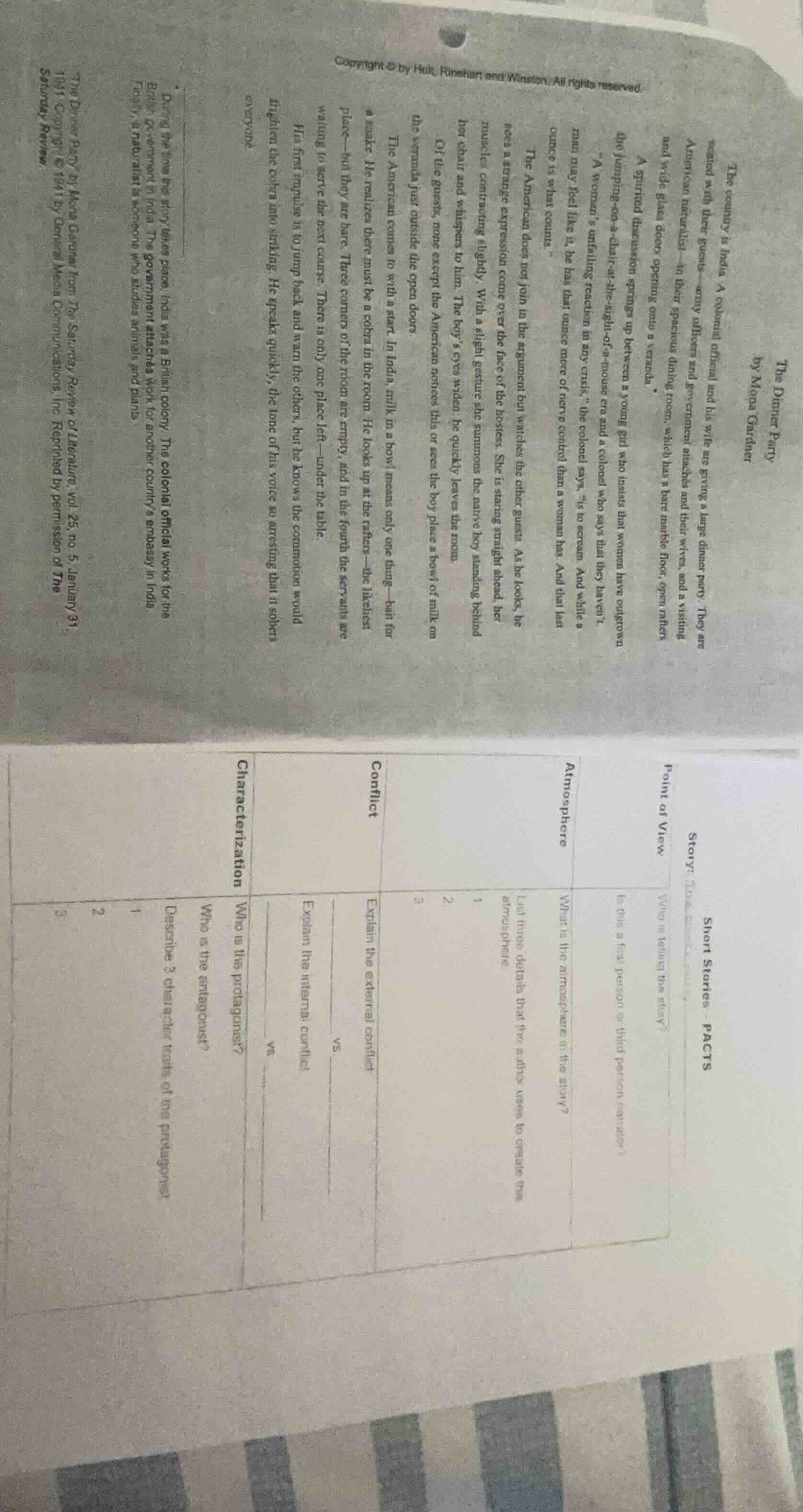
the dinner party by mona gardner the country is india. a colonial official and his wife are giving a large dinner party. they are seated with their guests—army officers and government attachés and their wives, and a visiting american naturalist—in their spacious dining room, which has a bare marble floor, open rafters and wide glass doors opening onto a veranda. a spirited discussion springs up between a young girl who insists that women have outgrown the jumping-on-a-chair-at-the-sight-of-a-mouse era and a colonel who says that they haven’t. “a woman’s unfailing reaction in any crisis,” the colonel says, “is to scream. and while a man may feel like it, he has that ounce more of nerve control than a woman has. and that last ounce is what counts.” the american does not join in the argument but watches the other guests. as he looks, he sees a strange expression come over the face of the hostess. she is staring straight ahead, her muscles contracting slightly. with a slight gesture she summons the native boy standing behind her chair and whispers to him. the boy’s eyes widen: he quickly leaves the room. of the guests, none except the american notices this or sees the boy place a bowl of milk on the veranda just outside the open doors. the american comes to with a start. in india, milk in a bowl means only one thing—bait for a snake. he realizes there must be a cobra in the room. he looks up at the rafters—the likeliest place—but they are bare. three corners of the room are empty, and in the fourth the servants are waiting to serve the next course. there is only one place left—under the table. his first impulse is to jump back and warn the others, but he knows the commotion would frighten the cobra into striking. he speaks quickly, the tone of his voice so arresting that it sobers everyone. during the time his story takes place, india was a british colony. the colonial official works for the british government in india. the government attaches work for another country’s embassy in india. finally, a naturalist is someone who studies animals and plants. the dinner party by mona gardner from the saturday review of literature, vol. 25, no. 5, january 31, 1941. copyright © 1941 by general media communications, inc. reprinted by permission of the saturday review. short stories - pacts story: the dinner party point of view who is telling the story? is this a first person or third person narrator? atmosphere what is the atmosphere of the story? list three details that the author uses to create the atmosphere. 1 2 3 conflict explain the external conflict vs explain the internal conflict vs characterization who is the protagonist? who is the antagonist? describe 3 character traits of the protagonist? 1 2 3
Point of View
- The story is told by an unnamed, outside narrator who is not a character in the text.
- This is a third-person narrator, as the narrator uses third-person pronouns (he, she, they) to refer to all characters and does not use first-person pronouns (I, me) to insert themselves into the story.
Atmosphere
- The atmosphere starts as formal, sophisticated, and tense from the polite but heated debate about gender and crisis reactions among upper-class dinner guests. It shifts to quietly, intensely suspenseful when the cobra is present.
- - The formal setting of a colonial Indian dinner party with elite guests (army officers, government attachés)
- The tense, spirited debate between the young girl and colonel about gendered crisis responses
- The hostess's still, strained expression and subtle, urgent gesture to the servant, which signals an unspoken threat
Conflict
- External conflict: The dinner party guests (and hostess) vs. the cobra hiding under the dinner table, as the snake poses a physical danger to everyone in the room.
- Internal conflict: The American naturalist vs. his own instinct to panic. He wants to jump back and warn others, but he fights this urge to avoid frightening the cobra into striking.
Characterization
- Protagonist: The American naturalist.
- Antagonist: The cobra (the external threat) and the underlying tension of the gendered debate (the social conflict that sets up the story's stakes).
- Character traits of the American naturalist:
- Observant: He notices the hostess's strange, tense expression and the significance of the bowl of milk.
- Calm under pressure: He suppresses his instinct to panic and uses a calm, commanding tone to keep everyone still.
- Quick-thinking: He immediately devises a plan to get everyone to stand slowly, avoiding provoking the cobra.

Snap & solve any problem in the app
Get step-by-step solutions on Sovi AI
Photo-based solutions with guided steps
Explore more problems and detailed explanations
Point of View
- An unnamed, outside narrator
- Third-person narrator
Atmosphere
- The atmosphere is initially formal and tense from the gendered debate, then shifts to quiet, intense suspense when the cobra is present.
- - Formal colonial dinner party setting with elite guests
- Heated debate about gender and crisis reactions
- Hostess's strained, still expression and urgent silent gesture
Conflict
- External conflict: Dinner party guests vs. the cobra under the table
- Internal conflict: American naturalist vs. his instinct to panic
Characterization
- Protagonist: The American naturalist
- Antagonist: The cobra (and the social tension of the gender debate)
- Protagonist traits: Observant, calm under pressure, quick-thinking