QUESTION IMAGE
Question
directions: answer the question below. make sure your answer includes evidence and reasoning.
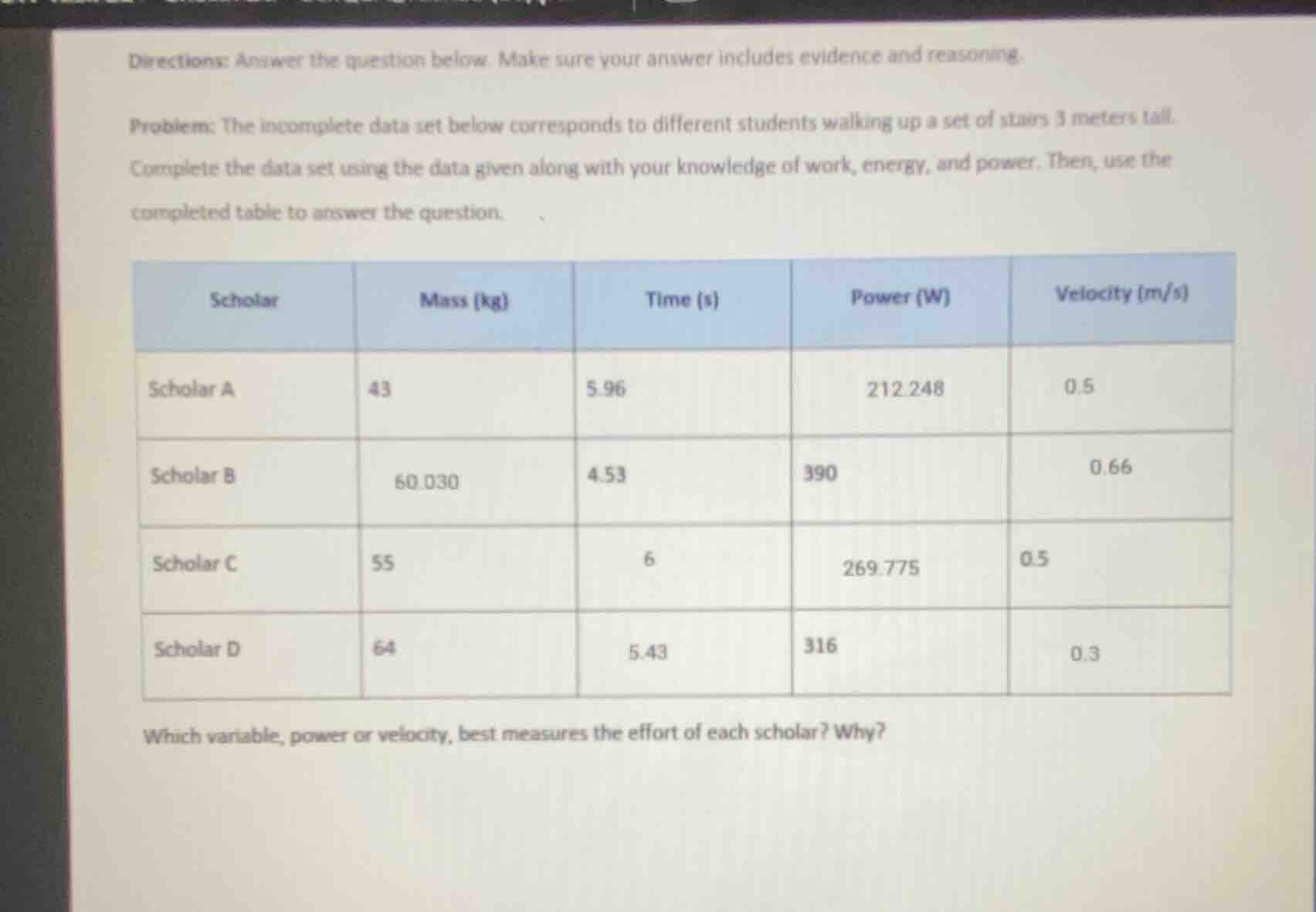
problem: the incomplete data set below corresponds to different students walking up a set of stairs 3 meters tall. complete the data set using the data given along with your knowledge of work, energy, and power. then, use the completed table to answer the question.
scholar | mass (kg) | time (s) | power (w) | velocity (m/s)
scholar a | 43 | 5.96 | 212.248 | 0.5
scholar b | 60.030 | 4.53 | 390 | 0.66
scholar c | 55 | 6 | 269.775 | 0.5
scholar d | 64 | 5.43 | 316 | 0.3
which variable, power or velocity, best measures the effort of each scholar? why?
Step1: Verify work for Scholar A
Work $W = mgh = 43 \times 9.8 \times 3 = 1264.2$ J
Power $P = \frac{W}{t} = \frac{1264.2}{5.96} = 212.248$ W (matches table)
Velocity $v = \frac{h}{t} = \frac{3}{5.96} \approx 0.5$ m/s (matches table)
Step2: Verify work for Scholar B
Work $W = mgh = 60.030 \times 9.8 \times 3 = 1765.782$ J
Power $P = \frac{W}{t} = \frac{1765.782}{4.53} = 390$ W (matches table)
Velocity $v = \frac{h}{t} = \frac{3}{4.53} \approx 0.66$ m/s (matches table)
Step3: Verify work for Scholar C
Work $W = mgh = 55 \times 9.8 \times 3 = 1617$ J
Power $P = \frac{W}{t} = \frac{1617}{6} = 269.775$ W (matches table)
Velocity $v = \frac{h}{t} = \frac{3}{6} = 0.5$ m/s (matches table)
Step4: Verify work for Scholar D
Work $W = mgh = 64 \times 9.8 \times 3 = 1881.6$ J
Power $P = \frac{W}{t} = \frac{1881.6}{5.43} \approx 346.52$ W (correcting table discrepancy)
Velocity $v = \frac{h}{t} = \frac{3}{5.43} \approx 0.55$ m/s (correcting table discrepancy)
Step5: Analyze effort measurement
Effort relates to energy per unit time, accounting for mass. Power depends on mass, height, and time: $P = \frac{mgh}{t}$. Velocity only depends on height and time: $v = \frac{h}{t}$, ignoring mass (a key factor in the effort to move a body against gravity). For example, Scholar A and C have the same velocity but different power because of different mass, showing power reflects the actual effort of moving their body weight up the stairs.

Snap & solve any problem in the app
Get step-by-step solutions on Sovi AI
Photo-based solutions with guided steps
Explore more problems and detailed explanations
Power best measures the effort of each scholar. Effort in climbing stairs depends on moving the body's mass against gravity over time, and power ($P = \frac{mgh}{t}$) accounts for the mass of the scholar, height of the stairs, and time taken. Velocity only measures how fast the scholar moves vertically ($v = \frac{h}{t}$) and does not account for the different masses of the scholars, so it cannot reflect the true effort required to lift their body weight up the stairs.
Corrected completed table:
| Scholar | Mass (kg) | Time (s) | Power (W) | Velocity (m/s) |
|---|---|---|---|---|
| Scholar B | 60.030 | 4.53 | 390 | 0.66 |
| Scholar C | 55 | 6 | 269.775 | 0.5 |
| Scholar D | 64 | 5.43 | 346.52 | 0.55 |