QUESTION IMAGE
Question
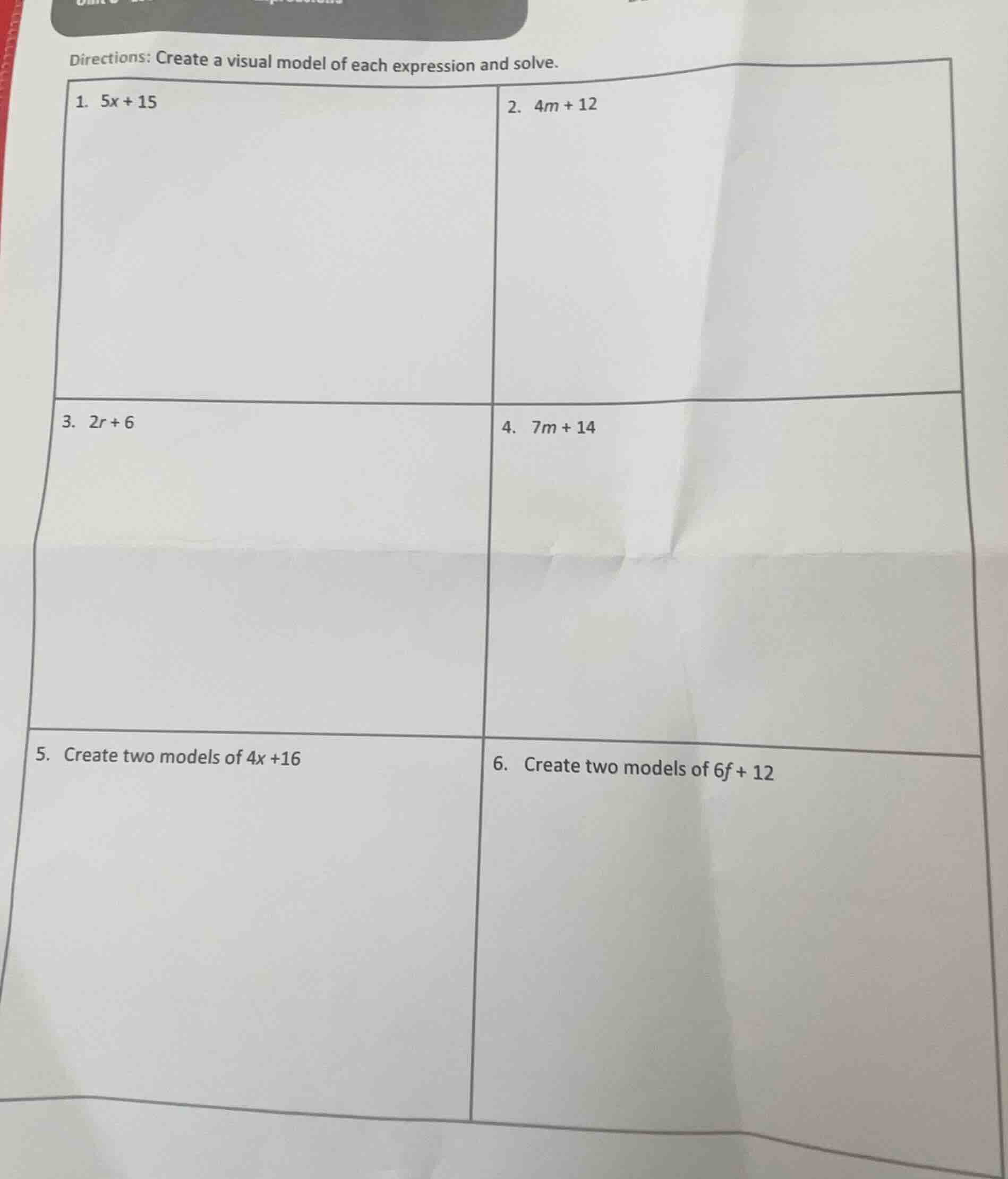
directions: create a visual model of each expression and solve.
- $5x + 15$
- $4m + 12$
- $2r + 6$
- $7m + 14$
- create two models of $4x + 16$
- create two models of $6f + 12$
Step1: Factor out GCF of 5x+15
Identify GCF = 5, factor:
$5x + 15 = 5(x + 3)$
Visual model: 5 rectangles labeled $x$ and 15 unit squares, grouped into 5 sets each with 1 $x$ rectangle and 3 unit squares.
Step2: Factor out GCF of 4m+12
Identify GCF = 4, factor:
$4m + 12 = 4(m + 3)$
Visual model: 4 rectangles labeled $m$ and 12 unit squares, grouped into 4 sets each with 1 $m$ rectangle and 3 unit squares.
Step3: Factor out GCF of 2r+6
Identify GCF = 2, factor:
$2r + 6 = 2(r + 3)$
Visual model: 2 rectangles labeled $r$ and 6 unit squares, grouped into 2 sets each with 1 $r$ rectangle and 3 unit squares.
Step4: Factor out GCF of 7m+14
Identify GCF = 7, factor:
$7m + 14 = 7(m + 2)$
Visual model: 7 rectangles labeled $m$ and 14 unit squares, grouped into 7 sets each with 1 $m$ rectangle and 2 unit squares.
Step5: Factor 4x+16 (Model 1)
Identify GCF = 4, factor:
$4x + 16 = 4(x + 4)$
Visual model 1: 4 rectangles labeled $x$ and 16 unit squares, grouped into 4 sets each with 1 $x$ rectangle and 4 unit squares.
Model 2 for 4x+16
Rewrite as $2(2x + 8)$
Visual model 2: 4 $x$ rectangles paired into 2 groups of 2 $x$ rectangles, plus 16 unit squares paired into 2 groups of 8 unit squares, making 2 sets of $(2x + 8)$.
Step6: Factor 6f+12 (Model 1)
Identify GCF = 6, factor:
$6f + 12 = 6(f + 2)$
Visual model 1: 6 rectangles labeled $f$ and 12 unit squares, grouped into 6 sets each with 1 $f$ rectangle and 2 unit squares.
Model 2 for 6f+12
Rewrite as $3(2f + 4)$
Visual model 2: 6 $f$ rectangles paired into 3 groups of 2 $f$ rectangles, plus 12 unit squares paired into 3 groups of 4 unit squares, making 3 sets of $(2f + 4)$.

Snap & solve any problem in the app
Get step-by-step solutions on Sovi AI
Photo-based solutions with guided steps
Explore more problems and detailed explanations
- $5(x + 3)$
- $4(m + 3)$
- $2(r + 3)$
- $7(m + 2)$
- Model 1: $4(x + 4)$; Model 2: $2(2x + 8)$
- Model 1: $6(f + 2)$; Model 2: $3(2f + 4)$