QUESTION IMAGE
Question
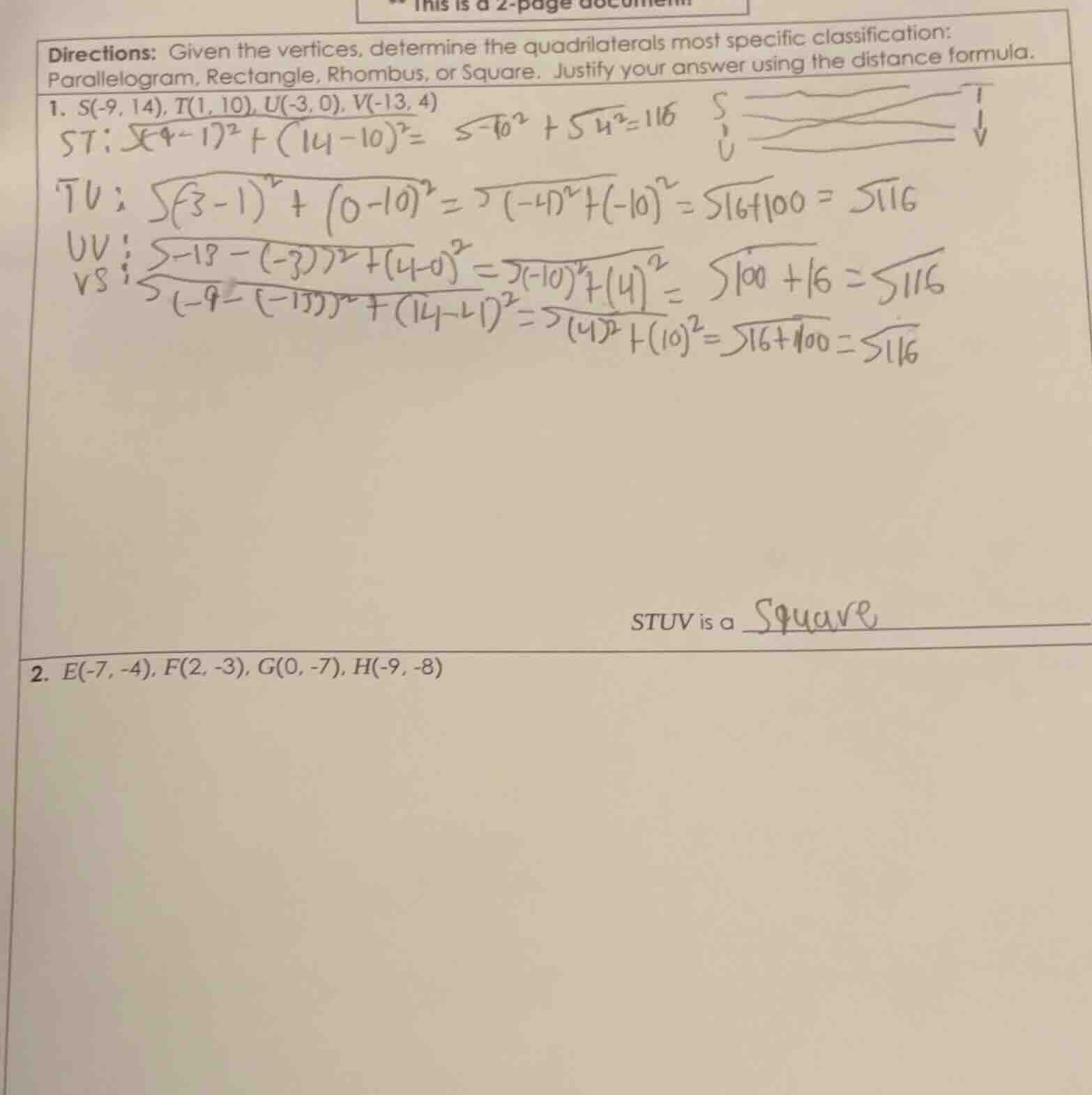
directions: given the vertices, determine the quadrilaterals most specific classification: parallelogram, rectangle, rhombus, or square. justify your answer using the distance formula.
- s(-9, 14), t(1, 10), u(-3, 0), v(-13, 4)
stuv is a
- e(-7, -4), f(2, -3), g(0, -7), h(-9, -8)
Step1: Recall distance formula
The distance between two points $(x_1,y_1)$ and $(x_2,y_2)$ is $d=\sqrt{(x_2-x_1)^2+(y_2-y_1)^2}$.
Step2: Calculate length of $EF$
Substitute $E(-7,-4), F(2,-3)$:
$$EF=\sqrt{(2-(-7))^2+(-3-(-4))^2}=\sqrt{9^2+1^2}=\sqrt{81+1}=\sqrt{82}$$
Step3: Calculate length of $FG$
Substitute $F(2,-3), G(0,-7)$:
$$FG=\sqrt{(0-2)^2+(-7-(-3))^2}=\sqrt{(-2)^2+(-4)^2}=\sqrt{4+16}=\sqrt{20}$$
Step4: Calculate length of $GH$
Substitute $G(0,-7), H(-9,-8)$:
$$GH=\sqrt{(-9-0)^2+(-8-(-7))^2}=\sqrt{(-9)^2+(-1)^2}=\sqrt{81+1}=\sqrt{82}$$
Step5: Calculate length of $HE$
Substitute $H(-9,-8), E(-7,-4)$:
$$HE=\sqrt{(-7-(-9))^2+(-4-(-8))^2}=\sqrt{2^2+4^2}=\sqrt{4+16}=\sqrt{20}$$
Step6: Calculate length of diagonal $EG$
Substitute $E(-7,-4), G(0,-7)$:
$$EG=\sqrt{(0-(-7))^2+(-7-(-4))^2}=\sqrt{7^2+(-3)^2}=\sqrt{49+9}=\sqrt{58}$$
Step7: Calculate length of diagonal $FH$
Substitute $F(2,-3), H(-9,-8)$:
$$FH=\sqrt{(-9-2)^2+(-8-(-3))^2}=\sqrt{(-11)^2+(-5)^2}=\sqrt{121+25}=\sqrt{146}$$
Step8: Classify the quadrilateral
Opposite sides are equal ($EF=GH$, $FG=HE$), and diagonals are not equal, so it is a parallelogram.

Snap & solve any problem in the app
Get step-by-step solutions on Sovi AI
Photo-based solutions with guided steps
Explore more problems and detailed explanations
EFGH is a Parallelogram
---
For the first quadrilateral STUV (verification):
Step1: Verify side lengths
All sides: $ST=TU=UV=VS=\sqrt{116}$, so all sides are equal.
Step2: Calculate diagonals $SU$ and $TV$
$$SU=\sqrt{(-3-(-9))^2+(0-14)^2}=\sqrt{6^2+(-14)^2}=\sqrt{36+196}=\sqrt{232}$$
$$TV=\sqrt{(-13-1)^2+(4-10)^2}=\sqrt{(-14)^2+(-6)^2}=\sqrt{196+36}=\sqrt{232}$$
Step3: Final classification
All sides equal and diagonals equal, so STUV is a Square.