QUESTION IMAGE
Question
directions: study the information. then read the item, and fill in your responses in the boxes.
parasitism
symbiosis is a situation in which two organisms from different species interact closely. there are different types of symbiotic relationships. one type is parasitism. in a parasitic relationship, one organism, the parasite, benefits from and harms another organism, the host. for example, an adult tapeworm lives in the intestines of an animal, getting food by eating the animal’s partly digested food. in this situation, the animal is unable to obtain all the nutrients available in the food it ingests.
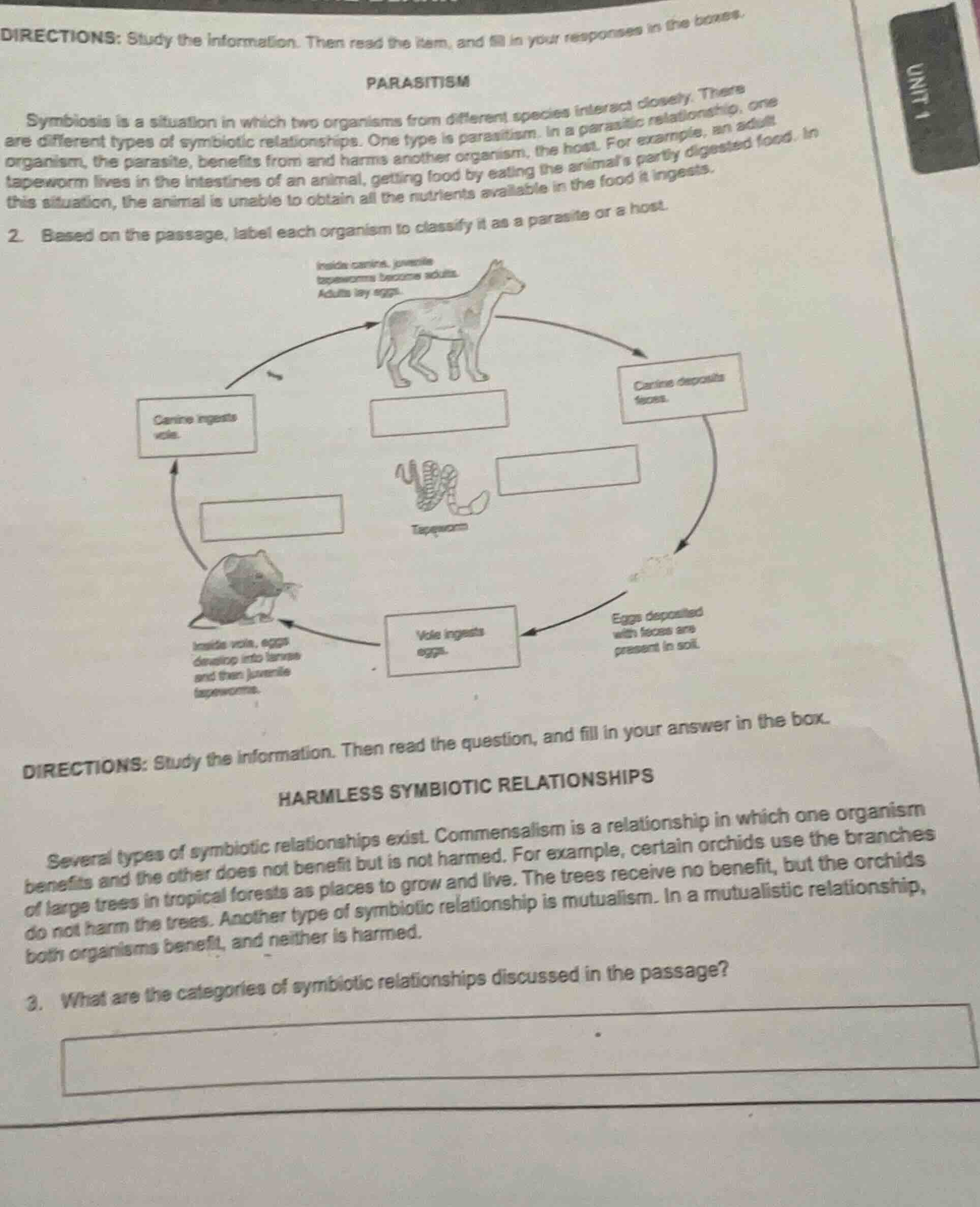
- based on the passage, label each organism to classify it as a parasite or a host.
image of a life cycle involving canine, tapeworm, vole with text boxes to label
directions: study the information. then read the question, and fill in your answer in the box.
harmless symbiotic relationships
several types of symbiotic relationships exist. commensalism is a relationship in which one organism benefits and the other does not benefit but is not harmed. for example, certain orchids use the branches of large trees in tropical forests as places to grow and live. the trees receive no benefit, but the orchids do not harm the trees. another type of symbiotic relationship is mutualism. in a mutualistic relationship, both organisms benefit, and neither is harmed.
- what are the categories of symbiotic relationships discussed in the passage?
Question 2 (Labeling Organisms as Parasite or Host)
- Identify the Host and Parasite Definitions: From the passage, a parasite benefits and harms the host.
- Analyze the Canine (Dog): The tapeworm lives inside the canine, harms it by taking nutrients. So the canine is the host.
- Analyze the Tapeworm: The tapeworm benefits by getting food from the canine, harms the canine. So tapeworm is the parasite.
- Analyze the Vole: The tapeworm larvae develop inside the vole, harming it (as per parasite - host dynamics in the passage's example). So vole is a host.
For the boxes:
- The box above the dog (canine): Host (since the tapeworm lives in it, harming it)
- The box next to the tapeworm: Parasite (since it benefits at the host's expense)
- The box above the vole: Host (since tapeworm larvae develop in it, harming it)
Question 3 (Categories of Symbiotic Relationships)
- Scan the Passage for Symbiotic Relationship Types: The passage under "HARMLESS SYMBIOTIC RELATIONSHIPS" mentions commensalism and mutualism. Also, the first passage mentions parasitism (though the second question's passage is about harmless, but the question is about the passage (the second one here? Wait, the passage for question 3 is "HARMLESS SYMBIOTIC RELATIONSHIPS" which discusses commensalism (one benefits, other not harmed) and mutualism (both benefit, neither harmed). Wait, but also, the first passage was about parasitism, but the question 3's passage is the "HARMLESS..." one? Wait, the question says "discussed in the passage" (the one for question 3: "HARMLESS SYMBIOTIC RELATIONSHIPS"). So in that passage, it says "Commensalism is a relationship..." and "Another type... is mutualism". Also, wait, the first passage was about parasitism, but the question 3's passage is the second one. Wait, let's re - read:
The "HARMLESS SYMBIOTIC RELATIONSHIPS" passage: "Several types of symbiotic relationships exist. Commensalism is... Another type of symbiotic relationship is mutualism." Also, the first passage (PARASITISM) is a type of symbiotic relationship too, but the question is about the passage (the one with "HARMLESS...")? Wait, the question 3 is under the "HARMLESS SYMBIOTIC RELATIONSHIPS" section. Wait, no, the user's image: the first part is PARASITISM (question 2), then HARMLESS SYMBIOTIC RELATIONSHIPS (question 3). So the passage for question 3 is the "HARMLESS..." one. But wait, the question is "What are the categories of symbiotic relationships discussed in the passage?" (the passage for question 3: "HARMLESS SYMBIOTIC RELATIONSHIPS"). In that passage, it discusses commensalism and mutualism. But also, the first passage (PARASITISM) is a symbiotic relationship, but the question is about the passage (the one with question 3). Wait, maybe the passage for question 3 includes that? No, the "HARMLESS..." passage is separate. Wait, let's check the text:
"HARMLESS SYMBIOTIC RELATIONSHIPS
Several types of symbiotic relationships exist. Commensalism is a relationship in which one organism benefits and the other does not benefit but is not harmed. For example, certain orchids use the branches of large trees in tropical forests as places to grow and live. The trees receive no benefit, but the orchids do not harm the trees. Another type of symbiotic relationship is mutualism. In a mutualistic relationship, both organisms benefit, and neither is harmed."
So the passage for question 3 (the "HARMLESS..." one) discusses commensalism and mutualism. But also, the first passage (PARASITISM) is a symbiotic relationship, but the question is about the passage (the one with question 3). Wait, maybe the question is about all the passages? But the question is under the "HARMLESS..." section. Wait, the user's question 3: "What are the categories of symbiotic relationships discussed in the passage?" (the passage for question 3 is the "HARMLESS SYMBIOTIC RELATIONSHIPS" passage). So in that passage, the types are commensalism and mutualism. But wait, the first passage (PARASITISM) is also a symbiotic relationship. Maybe the question is about all the passages? Let's check the original problem again. The user's image:
First, PARASITISM passage (question 2), then HARMLESS SYMBIOTIC RELATIONSHIPS passage (question 3). So the question 3 is about the "HARMLESS SYMBIOTIC RELATIONSHIPS" passage. So in that passage, the symbiotic relationships discussed are commensalism and mutualism. But also, parasitism is a symbiotic relationship (from the first pa…
The passage "HARMLESS SYMBIOTIC RELATIONSHIPS" discusses two categories of symbiotic relationships: commensalism (one organism benefits, the other neither benefits nor is harmed) and mutualism (both organisms benefit, and neither is harmed).

Snap & solve any problem in the app
Get step-by-step solutions on Sovi AI
Photo-based solutions with guided steps
Explore more problems and detailed explanations
Commensalism and mutualism (and also parasitism if we consider the first passage, but based on the "HARMLESS SYMBIOTIC RELATIONSHIPS" passage, it's commensalism and mutualism)