QUESTION IMAGE
Question
discussion topic
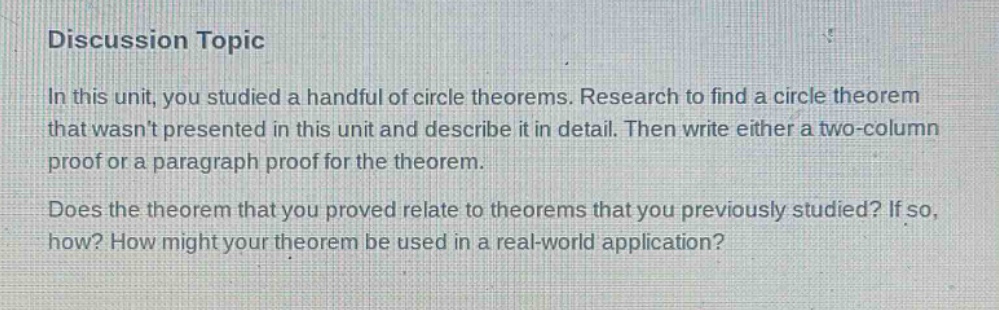
in this unit, you studied a handful of circle theorems. research to find a circle theorem
that wasnt presented in this unit and describe it in detail. then write either a two - column
proof or a paragraph proof for the theorem.
does the theorem that you proved relate to theorems that you previously studied? if so,
how? how might your theorem be used in a real - world application?
To address this, we'll choose the Alternate Segment Theorem (a circle theorem not always covered initially) and follow the requirements:
Step 1: Identify and Describe the Theorem
The Alternate Segment Theorem states: The angle between the tangent and the chord at the point of contact is equal to the angle in the alternate segment.
In other words, if \( PT \) is a tangent to a circle at point \( P \), and \( PQ \) is a chord, then the angle between \( PT \) and \( PQ \) ( \( \angle TPQ \)) is equal to the angle that \( PQ \) subtends in the alternate segment of the circle (e.g., \( \angle PRQ \), where \( R \) lies in the segment opposite to where \( PT \) touches the circle).
Step 2: Proof (Paragraph Format)
To prove the Alternate Segment Theorem, we use properties of tangents and cyclic quadrilaterals:
- Let \( PT \) be a tangent to the circle at \( P \), and \( PQ \) be a chord. Let \( O \) be the center of the circle. Draw the diameter \( PO \), so \( \angle OPT = 90^\circ \) (tangent is perpendicular to the radius at the point of contact).
- Let \( R \) be a point on the circumference in the alternate segment (so \( R \) and \( T \) are on opposite sides of \( PQ \)). The angle \( \angle PRQ \) subtends arc \( PQ \).
- The angle \( \angle OPQ \) (between radius \( OP \) and chord \( PQ \)) is equal to \( 90^\circ - \angle TPQ \) (since \( \angle OPT = 90^\circ \)).
- The central angle subtended by arc \( PQ \) is \( 2\angle PRQ \) (by the Inscribed Angle Theorem: the central angle is twice the inscribed angle subtended by the same arc). Also, the angle \( \angle OPQ \) is equal to \( 90^\circ - \angle TPQ \), and since \( OP = OQ \) (radii), \( \triangle OPQ \) is isosceles, so \( \angle OPQ = \angle OQP \).
- The angle \( \angle POQ \) (central angle) is \( 180^\circ - 2\angle OPQ \). Substituting \( \angle OPQ = 90^\circ - \angle TPQ \), we get \( \angle POQ = 180^\circ - 2(90^\circ - \angle TPQ) = 2\angle TPQ \).
- By the Inscribed Angle Theorem, \( \angle PRQ = \frac{1}{2}\angle POQ \). Thus, \( \angle PRQ = \angle TPQ \), proving the theorem.
Step 3: Relationship to Previously Studied Theorems
The Alternate Segment Theorem relates to:
- Tangent-Radius Perpendicularity: Used to establish the \( 90^\circ \) angle between tangent and radius (a foundational theorem for tangents).
- Inscribed Angle Theorem: Relies on the relationship between central angles and inscribed angles subtended by the same arc.
Step 4: Real-World Application
The Alternate Segment Theorem is used in:
- Engineering/Architecture: To design circular structures (e.g., arches, domes) or analyze forces on curved surfaces (e.g., tangent forces on a circular bridge support).
- Navigation: To calculate angles between a tangent (e.g., a ship’s path tangent to a circular island) and a chord (e.g., a line of sight to a lighthouse), helping determine positions.
- Optics: In lens design, where light rays (treated as tangents) interact with curved surfaces (modeled as circles), and angles of incidence relate to angles in alternate segments.
Summary of Responses to the Prompt’s Questions:
- Unstudied Theorem? Yes, the Alternate Segment Theorem relates to the Tangent-Radius Perpendicularity and Inscribed Angle Theorem (both foundational circle theorems). It extends these by connecting tangent-chord angles to inscribed angles in alternate segments.
- Real-World Use: As above, in engineering, navigation, and optics to analyze angles and forces involving circular shapes.
Final Answer (Theorem + Key D…

Snap & solve any problem in the app
Get step-by-step solutions on Sovi AI
Photo-based solutions with guided steps
Explore more problems and detailed explanations
To address this, we'll choose the Alternate Segment Theorem (a circle theorem not always covered initially) and follow the requirements:
Step 1: Identify and Describe the Theorem
The Alternate Segment Theorem states: The angle between the tangent and the chord at the point of contact is equal to the angle in the alternate segment.
In other words, if \( PT \) is a tangent to a circle at point \( P \), and \( PQ \) is a chord, then the angle between \( PT \) and \( PQ \) ( \( \angle TPQ \)) is equal to the angle that \( PQ \) subtends in the alternate segment of the circle (e.g., \( \angle PRQ \), where \( R \) lies in the segment opposite to where \( PT \) touches the circle).
Step 2: Proof (Paragraph Format)
To prove the Alternate Segment Theorem, we use properties of tangents and cyclic quadrilaterals:
- Let \( PT \) be a tangent to the circle at \( P \), and \( PQ \) be a chord. Let \( O \) be the center of the circle. Draw the diameter \( PO \), so \( \angle OPT = 90^\circ \) (tangent is perpendicular to the radius at the point of contact).
- Let \( R \) be a point on the circumference in the alternate segment (so \( R \) and \( T \) are on opposite sides of \( PQ \)). The angle \( \angle PRQ \) subtends arc \( PQ \).
- The angle \( \angle OPQ \) (between radius \( OP \) and chord \( PQ \)) is equal to \( 90^\circ - \angle TPQ \) (since \( \angle OPT = 90^\circ \)).
- The central angle subtended by arc \( PQ \) is \( 2\angle PRQ \) (by the Inscribed Angle Theorem: the central angle is twice the inscribed angle subtended by the same arc). Also, the angle \( \angle OPQ \) is equal to \( 90^\circ - \angle TPQ \), and since \( OP = OQ \) (radii), \( \triangle OPQ \) is isosceles, so \( \angle OPQ = \angle OQP \).
- The angle \( \angle POQ \) (central angle) is \( 180^\circ - 2\angle OPQ \). Substituting \( \angle OPQ = 90^\circ - \angle TPQ \), we get \( \angle POQ = 180^\circ - 2(90^\circ - \angle TPQ) = 2\angle TPQ \).
- By the Inscribed Angle Theorem, \( \angle PRQ = \frac{1}{2}\angle POQ \). Thus, \( \angle PRQ = \angle TPQ \), proving the theorem.
Step 3: Relationship to Previously Studied Theorems
The Alternate Segment Theorem relates to:
- Tangent-Radius Perpendicularity: Used to establish the \( 90^\circ \) angle between tangent and radius (a foundational theorem for tangents).
- Inscribed Angle Theorem: Relies on the relationship between central angles and inscribed angles subtended by the same arc.
Step 4: Real-World Application
The Alternate Segment Theorem is used in:
- Engineering/Architecture: To design circular structures (e.g., arches, domes) or analyze forces on curved surfaces (e.g., tangent forces on a circular bridge support).
- Navigation: To calculate angles between a tangent (e.g., a ship’s path tangent to a circular island) and a chord (e.g., a line of sight to a lighthouse), helping determine positions.
- Optics: In lens design, where light rays (treated as tangents) interact with curved surfaces (modeled as circles), and angles of incidence relate to angles in alternate segments.
Summary of Responses to the Prompt’s Questions:
- Unstudied Theorem? Yes, the Alternate Segment Theorem relates to the Tangent-Radius Perpendicularity and Inscribed Angle Theorem (both foundational circle theorems). It extends these by connecting tangent-chord angles to inscribed angles in alternate segments.
- Real-World Use: As above, in engineering, navigation, and optics to analyze angles and forces involving circular shapes.
Final Answer (Theorem + Key Details)
The chosen theorem is the Alternate Segment Theorem (angle between tangent and chord = angle in alternate segment). Its proof uses tangent-radius perpendicularity and the Inscribed Angle Theorem. It applies to real-world problems like designing circular bridges or navigating around circular islands.