QUESTION IMAGE
Question
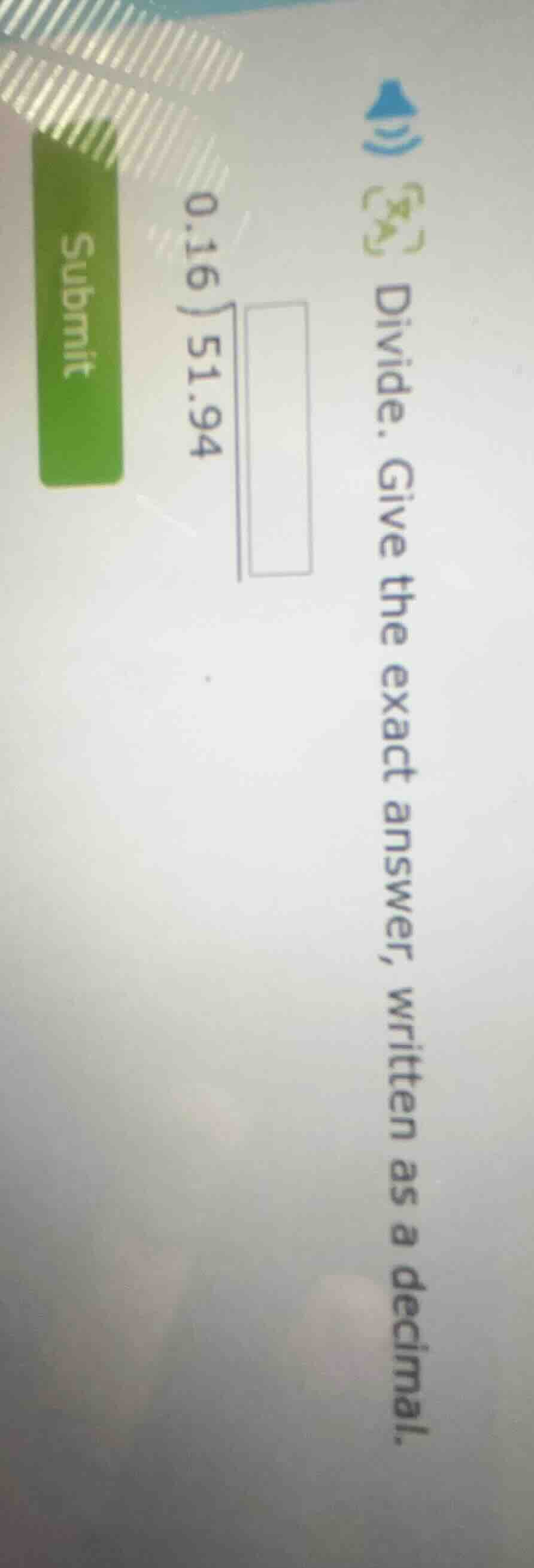
divide. give the exact answer, written as a decimal.
\\(0.16\overline{)51.94}\\)
submit
Step1: Convert divisor to integer
To divide \(51.94\) by \(0.16\), we multiply both the dividend and the divisor by \(100\) to make the divisor an integer. So we have \(\frac{51.94\times100}{0.16\times100}=\frac{5194}{16}\).
Step2: Perform the division
Now we divide \(5194\) by \(16\). \(16\times324 = 5184\), and \(5194 - 5184=10\). Bring down a zero (we can think of \(5194\) as \(5194.0\) for decimal division), so we have \(100\) (after bringing down the zero). \(16\times6 = 96\), \(100 - 96 = 4\). Bring down another zero, we get \(40\). \(16\times2 = 32\), \(40 - 32 = 8\). Bring down another zero, we get \(80\). \(16\times5=80\). So putting it all together: \(324 + \frac{10}{16}=324 + 0.625=324.625\)? Wait, no, wait. Wait, \(5194\div16\): Let's do long division properly.
\(16\) into \(51\) (the first two digits of \(5194\)) is \(3\) (since \(16\times3 = 48\)), subtract \(48\) from \(51\), we get \(3\). Bring down \(9\) to make \(39\). \(16\) into \(39\) is \(2\) ( \(16\times2 = 32\) ), subtract \(32\) from \(39\), get \(7\). Bring down \(4\) to make \(74\). \(16\) into \(74\) is \(4\) ( \(16\times4 = 64\) ), subtract \(64\) from \(74\), get \(10\). Now we are at the decimal point, bring down a \(0\) to make \(100\). \(16\) into \(100\) is \(6\) ( \(16\times6 = 96\) ), subtract \(96\) from \(100\), get \(4\). Bring down a \(0\) to make \(40\). \(16\) into \(40\) is \(2\) ( \(16\times2 = 32\) ), subtract \(32\) from \(40\), get \(8\). Bring down a \(0\) to make \(80\). \(16\) into \(80\) is \(5\) ( \(16\times5 = 80\) ). So the division is \(324.625\)? Wait, no, wait, the original problem is \(51.94\div0.16\), not \(5194\div16\). Wait, I made a mistake in step 1. Wait, \(51.94\div0.16\): when we multiply numerator and denominator by \(100\), we get \(5194\div16\)? Wait, no: \(51.94\times100 = 5194\), \(0.16\times100 = 16\), so yes, \(5194\div16\). Wait, but \(51.94\) is \(51.94\), so \(51.94\div0.16\): let's check with another approach. \(0.16\times324 = 51.84\), \(51.94 - 51.84 = 0.1\). Then \(0.1\div0.16=\frac{10}{16}=0.625\)? Wait, no, \(0.1\div0.16 = 0.625\)? Wait, \(0.16\times0.625 = 0.1\), yes. So \(324 + 0.625=324.625\)? Wait, no, that can't be. Wait, no, wait, \(51.94\div0.16\): let's do it as \(51.94\div0.16=\frac{51.94}{0.16}\). Multiply numerator and denominator by \(100\): \(\frac{5194}{16}\). Now divide \(5194\) by \(16\):
\(16\times324 = 5184\), \(5194 - 5184 = 10\). So we have \(10\) left, and we are at the decimal part. So we write \(324\) and then the decimal part: \(10\div16 = 0.625\) (since \(16\times0.625 = 10\)). Wait, yes! Because \(10\div16 = 0.625\). So \(5194\div16 = 324.625\). Wait, but let's check with a calculator: \(0.16\times324.625 = 0.16\times300 + 0.16\times24 + 0.16\times0.625 = 48 + 3.84 + 0.1 = 51.94\). Yes! So that's correct.
Wait, maybe my initial long division steps were confusing, but the key is that when we have \(a\div b\) where \(b\) is a decimal, we can multiply numerator and denominator by a power of 10 to make \(b\) an integer, then perform the division.
So \(51.94\div0.16=\frac{51.94\times100}{0.16\times100}=\frac{5194}{16}=324.625\).

Snap & solve any problem in the app
Get step-by-step solutions on Sovi AI
Photo-based solutions with guided steps
Explore more problems and detailed explanations
\(324.625\)