QUESTION IMAGE
Question
division
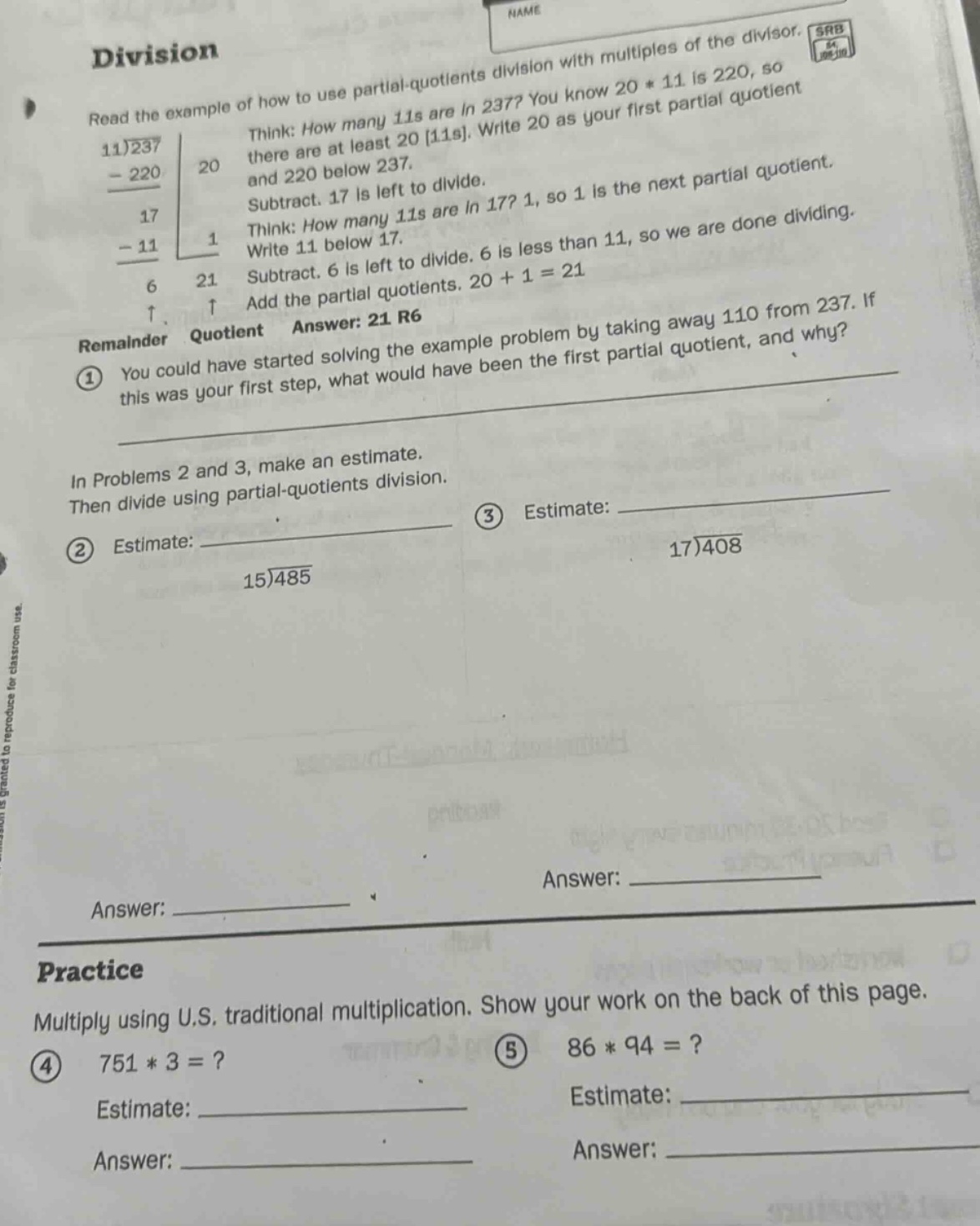
read the example of how to use partial - quotients division with multiples of the divisor.
\\(\
\\) \\(\
\\)
think: how many 11s are in 237? you know \\(20\times11\\) is 220, so there are at least 20 11s. write 20 as your first partial quotient and 220 below 237.
subtract. 17 is left to divide.
think: how many 11s are in 17? 1, so 1 is the next partial quotient. write 11 below 17.
subtract. 6 is left to divide. 6 is less than 11, so we are done dividing.
add the partial quotients. \\(20 + 1=21\\)
remainder \\(\uparrow\\) quotient \\(\uparrow\\) answer: 21 r6
\\(\boldsymbol{\text{1}}\\) you could have started solving the example problem by taking away 110 from 237. if this was your first step, what would have been the first partial quotient, and why?
\\(___________________________________________________________________________\\)
in problems 2 and 3, make an estimate. then divide using partial - quotients division.
\\(\boldsymbol{\text{2}}\\) estimate: \\__________________
\\(15\enclose{longdiv}{485}\\)
answer: \\__________________
\\(\boldsymbol{\text{3}}\\) estimate: \\__________________
\\(17\enclose{longdiv}{408}\\)
answer: \\__________________
practice
multiply using u.s. traditional multiplication. show your work on the back of this page.
\\(\boldsymbol{\text{4}}\\) \\(751\times3 =?\\)
estimate: \\__________________
answer: \\__________________
\\(\boldsymbol{\text{5}}\\) \\(86\times94 =?\\)
estimate: \\__________________
answer: \\__________________
Problem 1
Step1: Analyze the first step
The divisor is 11, and we start by taking away 110 (which is \(11\times10\)) from 237.
Step2: Determine the partial quotient
Since \(11\times10 = 110\), the number of 11s in 110 is 10. So the first partial quotient would be 10 because we are finding how many times 11 fits into 110 (the amount we took away initially), and \(11\times10=110\).
Step1: Estimate
To estimate, we can round 485 to 480 (a multiple of 15) and \(480\div15 = 32\), so the estimate is 32.
Step2: Partial - quotients division
- First, think about how many 15s are in 485. We know that \(15\times30=450\). Write 30 as the first partial quotient and subtract \(15\times30 = 450\) from 485: \(485 - 450=35\).
- Then, think about how many 15s are in 35. \(15\times2 = 30\). Write 2 as the next partial quotient and subtract \(15\times2=30\) from 35: \(35 - 30 = 5\).
- Now, 5 is less than 15, so we stop dividing.
- Add the partial quotients: \(30+2 = 32\) with a remainder of 5.
Step1: Estimate
Round 408 to 400 and 17 to 20 (or we can use \(17\times20 = 340\) and \(17\times24=408\)). A better estimate: since \(17\times20 = 340\) and \(17\times24 = 408\), we can estimate 24. Alternatively, \(408\approx400\), \(400\div20 = 20\), but a more accurate estimate is 24 (since \(17\times24=408\)).
Step2: Partial - quotients division
- We know that \(17\times20 = 340\). Write 20 as the first partial quotient and subtract \(17\times20 = 340\) from 408: \(408 - 340=68\).
- Then, think about how many 17s are in 68. \(17\times4 = 68\). Write 4 as the next partial quotient and subtract \(17\times4 = 68\) from 68: \(68 - 68=0\).
- Add the partial quotients: \(20 + 4=24\).

Snap & solve any problem in the app
Get step-by-step solutions on Sovi AI
Photo-based solutions with guided steps
Explore more problems and detailed explanations
The first partial quotient would be 10 because \(11\times10 = 110\) (the amount taken away initially), so there are 10 groups of 11 in 110.