QUESTION IMAGE
Question
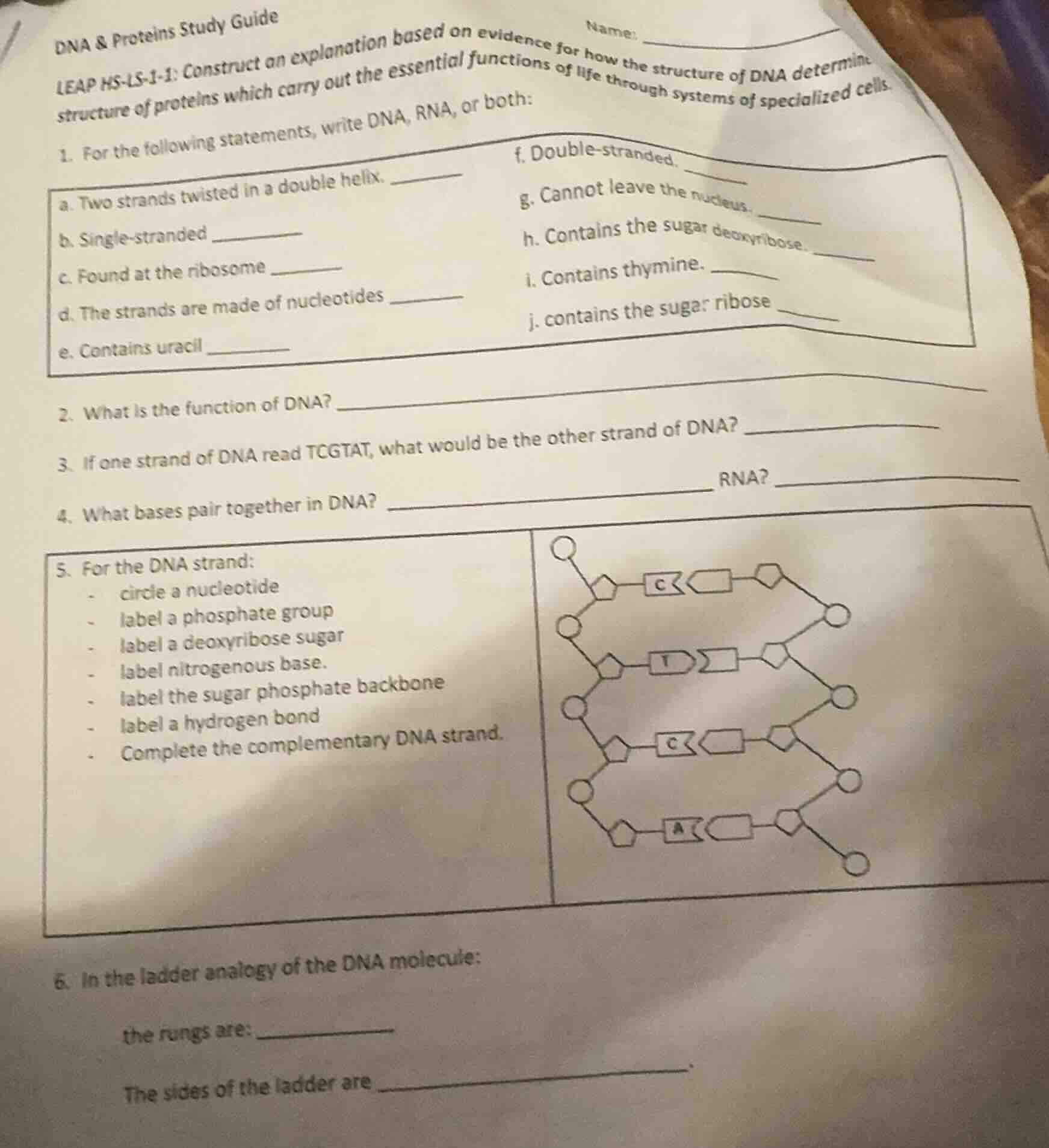
dna & proteins study guide
name:
leap hs - ls - 1 - 1: construct an explanation based on evidence for how the structure of dna determine structure of proteins which carry out the essential functions of life through systems of specialized cells.
- for the following statements, write dna, rna, or both:
\ta. two strands twisted in a double helix.
\tb. single - stranded
\tc. found at the ribosome
\td. the strands are made of nucleotides
\te. contains uracil
\tf. double - stranded.
\tg. cannot leave the nucleus.
\th. contains the sugar deoxyribose.
\ti. contains thymine.
\tj. contains the sugar ribose
- what is the function of dna?
- if one strand of dna read tcgtat, what would be the other strand of dna?
- what bases pair together in dna? rna?
- for the dna strand:
\t- circle a nucleotide
\t- label a phosphate group
\t- label a deoxyribose sugar
\t- label nitrogenous base.
\t- label the sugar phosphate backbone
\t- label a hydrogen bond
\t- complete the complementary dna strand.
- in the ladder analogy of the dna molecule:
\tthe rungs are:
\tthe sides of the ladder are.
- For question 1, answers are based on core structural and location differences between DNA and RNA: DNA is double-stranded, stays in the nucleus, has deoxyribose and thymine; RNA is single-stranded, goes to ribosomes, has ribose and uracil; both are made of nucleotides.
- For question 2, DNA's primary function is storing genetic information for life processes.
- For question 3, DNA uses complementary base pairing: A-T, C-G.
- For question 4, base pairing rules differ between DNA (A-T, C-G) and RNA (A-U, C-G).
- For question 5, a nucleotide is a phosphate + sugar + base; the backbone is phosphate-sugar chains; hydrogen bonds connect complementary bases; complementary strand uses DNA base pairing rules.
- For question 6, the ladder analogy compares base pairs to rungs and the sugar-phosphate backbone to the ladder sides.

Snap & solve any problem in the app
Get step-by-step solutions on Sovi AI
Photo-based solutions with guided steps
Explore more problems and detailed explanations
1.
a. DNA
b. RNA
c. RNA
d. both
e. RNA
f. DNA
g. DNA
h. DNA
i. DNA
j. RNA
- To store and transmit the genetic information that codes for the production of proteins and controls the essential functions of living organisms.
- AGCATA
- DNA: Adenine (A) pairs with Thymine (T); Cytosine (C) pairs with Guanine (G)
RNA: Adenine (A) pairs with Uracil (U); Cytosine (C) pairs with Guanine (G)
- (Visual labels for the diagram):
- Circle one unit containing a phosphate (circle), deoxyribose (pentagon), and nitrogenous base (rectangle with letter)
- Label a circle as "Phosphate group"
- Label a pentagon as "Deoxyribose sugar"
- Label a rectangle (C, T, C, A) as "Nitrogenous base"
- Label the alternating circle-pentagon chains as "Sugar phosphate backbone"
- Label the small lines between complementary bases as "Hydrogen bond"
- Complementary strand bases (from top to bottom): G, A, G, T
6.
the rungs are: complementary nitrogenous base pairs (A-T, C-G)
The sides of the ladder are: the sugar-phosphate backbones of the DNA strands