QUESTION IMAGE
Question
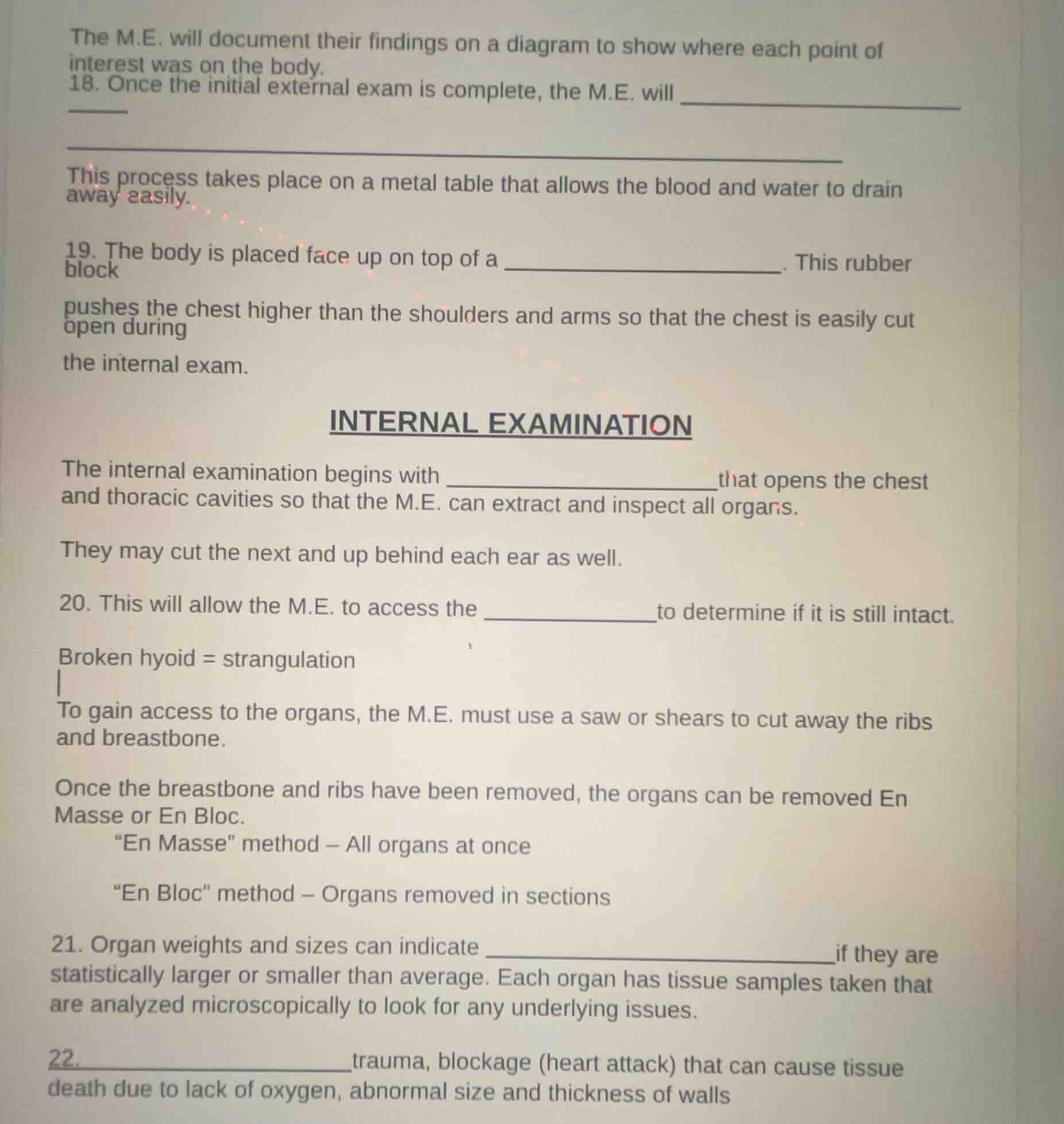
the m.e. will document their findings on a diagram to show where each point of interest was on the body. 18. once the initial external exam is complete, the m.e. will ______ ____ this process takes place on a metal table that allows the blood and water to drain away easily. 19. the body is placed face up on top of a ____. this rubber block pushes the chest higher than the shoulders and arms so that the chest is easily cut open during the internal exam. internal examination the internal examination begins with ____ that opens the chest and thoracic cavities so that the m.e. can extract and inspect all organs. they may cut the next and up behind each ear as well. 20. this will allow the m.e. to access the ____ to determine if it is still intact. broken hyoid = strangulation to gain access to the organs, the m.e. must use a saw or shears to cut away the ribs and breastbone. once the breastbone and ribs have been removed, the organs can be removed en masse or en bloc. “en masse” method – all organs at once “en bloc” method – organs removed in sections 21. organ weights and sizes can indicate ____ if they are statistically larger or smaller than average. each organ has tissue samples taken that are analyzed microscopically to look for any underlying issues. 22. ______ trauma, blockage (heart attack) that can cause tissue death due to lack of oxygen, abnormal size and thickness of walls
Question 18 (assuming context of medical examiner (M.E.) procedures, likely related to what happens after external exam, e.g., proceed to internal exam setup, but since the text is about autopsy steps, after external exam, the M.E. will likely prepare for internal exam, but the blank needs context. Wait, the original text's 18: "Once the initial external exam is complete, the M.E. will ________" and the next part says "This process takes place on a metal table...". So maybe "move the body to the autopsy table (or prepare for internal exam, but the blank is to be filled. However, since this is about medical (forensic) procedures, let's tackle each:
Question 19: The body is placed face up on top of a ______. The text says "This rubber block pushes the chest higher...", so the blank is "rubber block" (wait, no, the sentence is "The body is placed face up on top of a ____. This rubber block...", so the first blank is the object, then the rubber block is explained? Wait, no, the original: "19. The body is placed face up on top of a ____. This rubber block pushes the chest higher than the shoulders and arms so that the chest is easily cut open during the internal exam." So the blank is the thing the body is placed on, and then the rubber block is part of it? Wait, maybe "autopsy table with a rubber block" but the blank is before "This rubber block", so the first blank is the base, but the text says "on top of a ______. This rubber block..." So the blank is the support, maybe "autopsy table" but no, the rubber block is the thing. Wait, maybe the answer is "rubber block" but the sentence structure: "placed face up on top of a [blank]. This rubber block..." So the blank is the object, and then "this rubber block" refers to it. So the answer is "rubber block"? Wait, no, the text says "This rubber block pushes the chest...", so the body is placed on a rubber block? Wait, maybe "autopsy table" but the next sentence says "This rubber block...", so maybe the blank is "rubber block" (but the article "a" before, so "a rubber block".
Question 20: "This will allow the M.E. to access the ________ to determine if it is still intact. Broken hyoid = strangulation" So the hyoid bone is related to strangulation, so the blank is "hyoid bone".
Question 21: "Organ weights and sizes can indicate ________ if they are statistically larger or smaller than average." So organ weights/sizes can indicate disease (or pathology, or abnormalities) if they deviate from average. So the blank is "disease (or pathology, or abnormalities)".
Question 22: "________ trauma, blockage (heart attack) that can cause tissue death due to lack of oxygen, abnormal size and thickness of walls" So this is about heart (since blockage is heart attack) or other organs? Wait, the context is organ analysis. So maybe "Heart" trauma, or "Organ" trauma, but the examples are blockage (heart attack), so the blank is "Heart" or "Organ" but more likely "Heart" or "Cardiac" or "Organ" (but the text is about organs, so maybe "Organ" or specific like "Heart". Wait, the sentence is listing things: [blank] trauma, blockage (heart attack)... So the blank is the type of trauma, maybe "Cardiac" (heart) trauma, or "Organ" trauma. But given the heart attack example, "Cardiac" or "Heart".
Question 18: Going back, "Once the initial external exam is complete, the M.E. will ________" and the next part says "This process takes place on a metal table that allows the blood and water to drain away easily." So after external exam, the M.E. will "prepare the body for interna…
After external exam, M.E. moves to internal exam setup, using a metal table for drainage. So the blank is likely "prepare the body for internal examination" or "move the body to the autopsy table" (specifically, the action after external exam is to set up for internal, so "begin the internal examination" or "move the body to the autopsy table" (where blood/water drains).
The body is placed on a rubber block to elevate the chest for internal exam.
The hyoid bone's integrity is checked for strangulation (broken hyoid indicates strangulation).

Snap & solve any problem in the app
Get step-by-step solutions on Sovi AI
Photo-based solutions with guided steps
Explore more problems and detailed explanations
begin the internal examination (or move the body to the autopsy table)