QUESTION IMAGE
Question
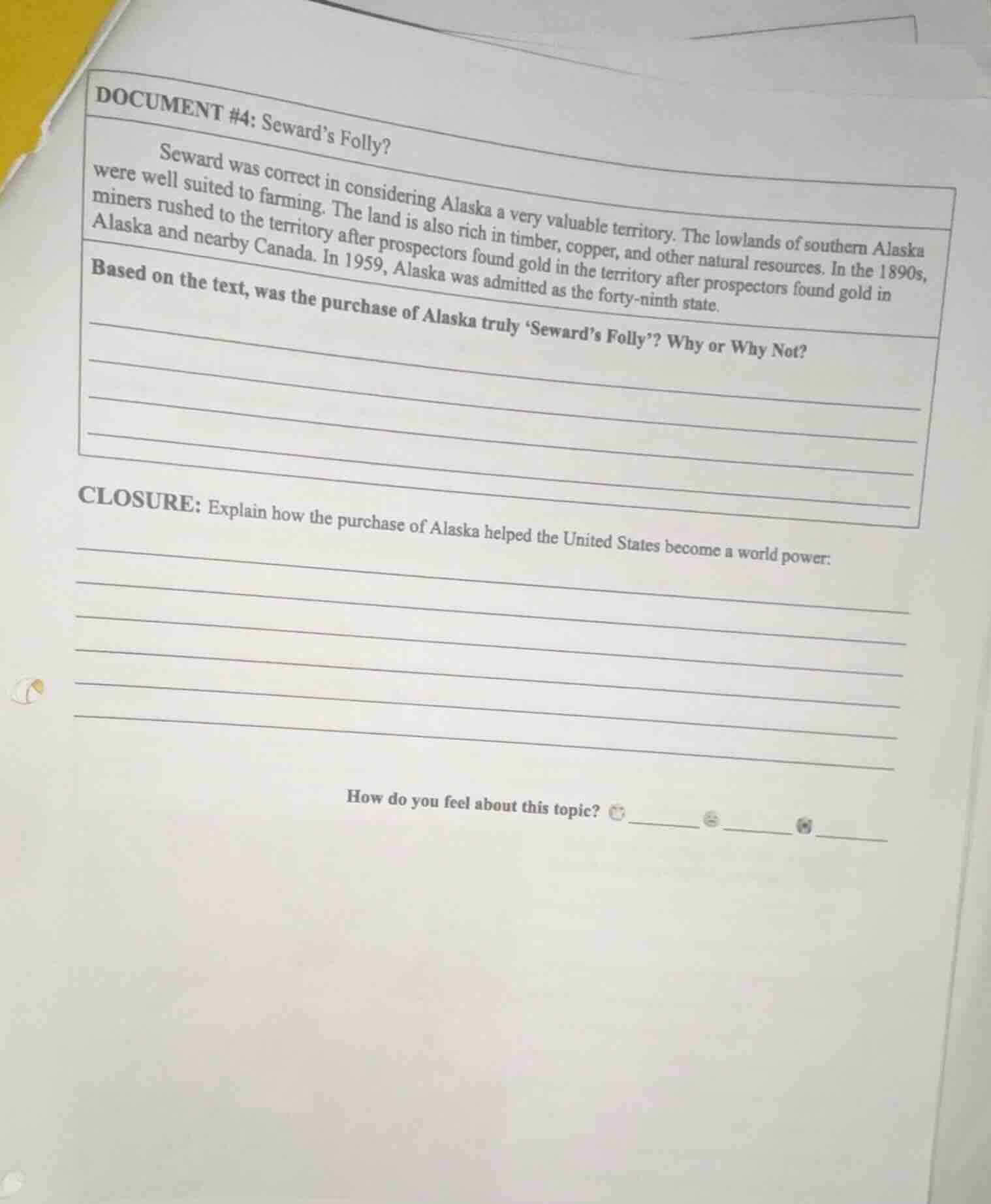
document #4: seward’s folly?
seward was correct in considering alaska a very valuable territory. the lowlands of southern alaska were well suited to farming. the land is also rich in timber, copper, and other natural resources. in the 1890s, miners rushed to the territory after prospectors found gold in the territory after prospectors found gold in alaska and nearby canada. in 1959, alaska was admitted as the forty - ninth state.
based on the text, was the purchase of alaska truly ‘seward’s folly’? why or why not?
closure: explain how the purchase of alaska helped the united states become a world power:
how do you feel about this topic?
For the first question:
The text states Alaska had valuable farmland in its southern lowlands, abundant natural resources like timber, copper, and gold, which drew miners and economic activity, and later became a state. The term "Seward's Folly" implied the purchase was a mistake, but Alaska's clear economic and territorial value shows it was not a folly.
For the second question:
Alaska provided the U.S. with vast, resource-rich territory, boosting the nation's economic power through access to gold, timber, and minerals. It also expanded U.S. territorial reach in the Pacific, strengthening the country's strategic geographic position, which contributed to its status as a world power.

Snap & solve any problem in the app
Get step-by-step solutions on Sovi AI
Photo-based solutions with guided steps
Explore more problems and detailed explanations
- No, the purchase of Alaska was not truly 'Seward's Folly'. Alaska was a valuable territory: its southern lowlands were suitable for farming, it was rich in timber, copper, gold, and other natural resources that drove economic activity, and it later became the 49th U.S. state, proving its long-term worth.
- The purchase of Alaska helped the U.S. become a world power in two key ways: first, it provided massive natural resources (gold, timber, minerals) that grew the U.S. economy and industrial capacity. Second, it expanded U.S. territorial holdings significantly, giving the country greater strategic geographic influence in the northern Pacific, which enhanced its global standing.