QUESTION IMAGE
Question
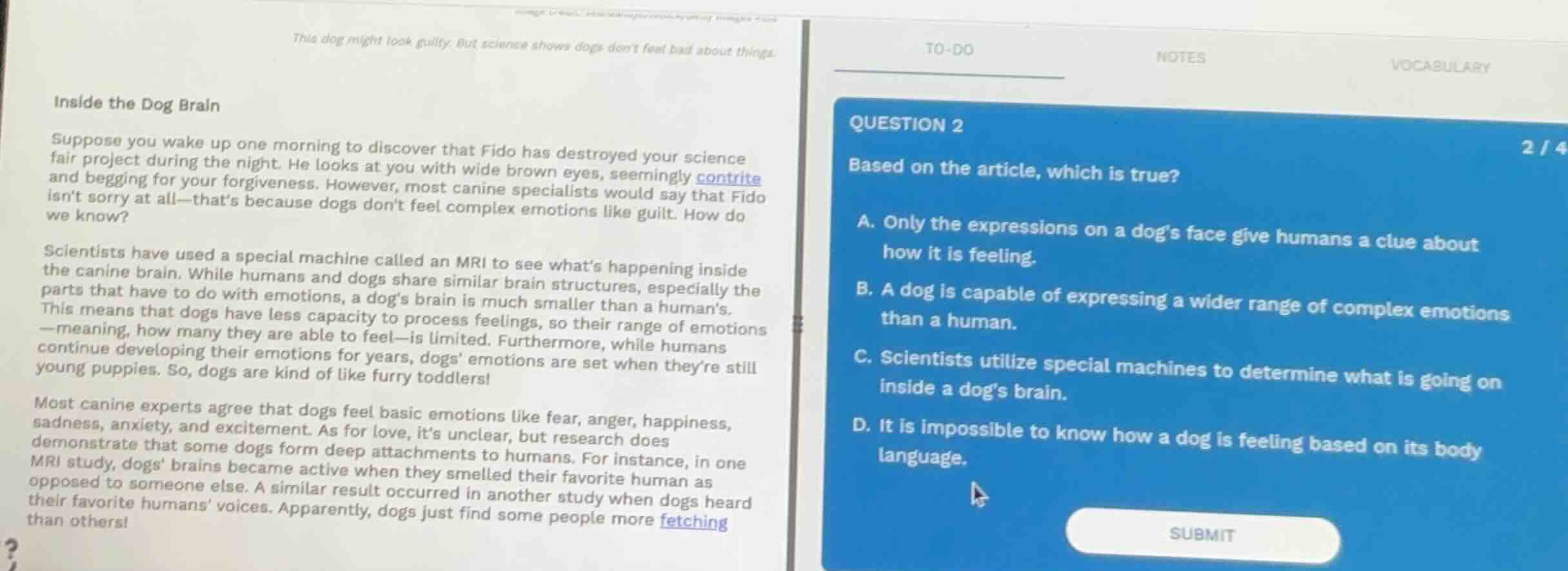
this dog might look guilty. but science shows dogs dont feel bad about things.
inside the dog brain
suppose you wake up one morning to discover that fido has destroyed your science fair project during the night. he looks at you with wide brown eyes, seemingly contrite and begging for your forgiveness. however, most canine specialists would say that fido isnt sorry at all—thats because dogs dont feel complex emotions like guilt. how do we know?
scientists have used a special machine called an mri to see whats happening inside the canine brain. while humans and dogs share similar brain structures, especially the parts that have to do with emotions, a dogs brain is much smaller than a humans. this means that dogs have less capacity to process feelings, so their range of emotions —meaning, how many they are able to feel—is limited. furthermore, while humans continue developing their emotions for years, dogs emotions are set when theyre still young puppies. so, dogs are kind of like furry toddlers!
most canine experts agree that dogs feel basic emotions like fear, anger, happiness, sadness, anxiety, and excitement. as for love, its unclear, but research does demonstrate that some dogs form deep attachments to humans. for instance, in one mri study, dogs brains became active when they smelled their favorite human as opposed to someone else. a similar result occurred in another study when dogs heard their favorite humans voices. apparently, dogs just find some people more fetching than others!
question 2
based on the article, which is true?
a. only the expressions on a dogs face give humans a clue about how it is feeling.
b. a dog is capable of expressing a wider range of complex emotions than a human.
c. scientists utilize special machines to determine what is going on inside a dogs brain.
d. it is impossible to know how a dog is feeling based on its body language.
- Option A is incorrect because the article doesn't state only facial expressions give clues; it mentions brain activity and other cues too.
- Option B is incorrect because the article says dogs have a more limited range of emotions than humans, not wider.
- Option C is correct as the article explicitly states scientists use MRI machines to study the canine brain.
- Option D is incorrect because the article shows we can learn about dog feelings through studies and their responses, so it's not impossible.

Snap & solve any problem in the app
Get step-by-step solutions on Sovi AI
Photo-based solutions with guided steps
Explore more problems and detailed explanations
C. Scientists utilize special machines to determine what is going on inside a dog's brain.