QUESTION IMAGE
Question
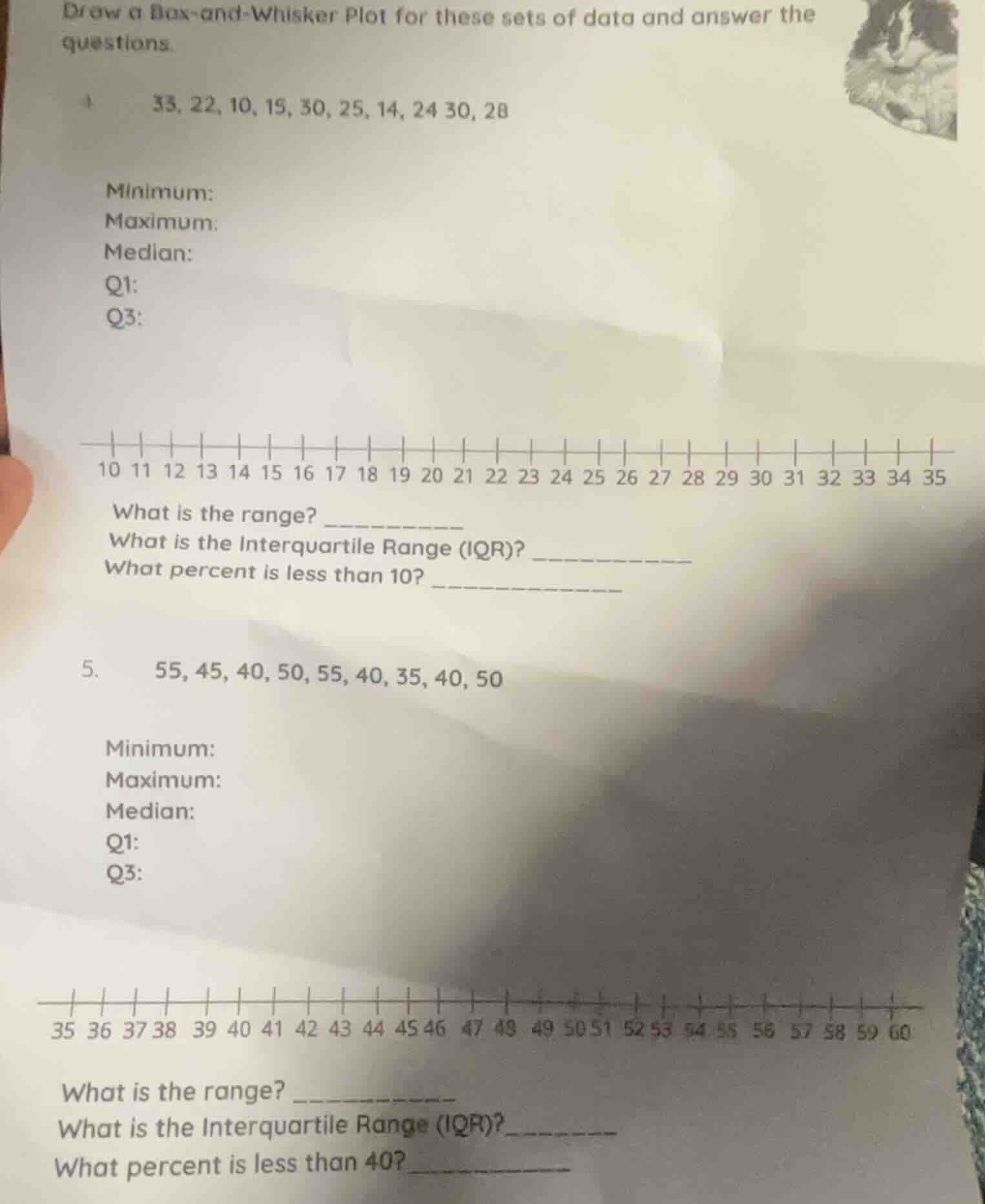
draw a box-and-whisker plot for these sets of data and answer the questions.
4 33, 22, 10, 15, 30, 25, 14, 24 30, 28
minimum:
maximum:
median:
q1:
q3:
10 11 12 13 14 15 16 17 18 19 20 21 22 23 24 25 26 27 28 29 30 31 32 33 34 35
what is the range? __________
what is the interquartile range (iqr)? __________
what percent is less than 10? __________
- 55, 45, 40, 50, 55, 40, 35, 40, 50
minimum:
maximum:
median:
q1:
q3:
35 36 37 38 39 40 41 42 43 44 45 46 47 48 49 50 51 52 53 54 55 56 57 58 59 60
what is the range? __________
what is the interquartile range (iqr)?________
what percent is less than 40?________
Problem 4
Step 1: Organize the data
First, we sort the data set: \(10, 14, 15, 22, 24, 25, 28, 30, 30, 33\) (note: assuming the original data "24 30" is a typo and should be "24, 30" to have 10 data points).
Step 2: Find Minimum and Maximum
- Minimum: The smallest value in the sorted data is \(10\).
- Maximum: The largest value in the sorted data is \(33\).
Step 3: Find Median
Since there are \(n = 10\) (even number of data points), the median is the average of the \(\frac{n}{2}\)-th and \((\frac{n}{2}+ 1)\)-th values.
\(\frac{n}{2}=5\), \(\frac{n}{2}+ 1 = 6\). The 5th value is \(24\) and the 6th value is \(25\).
Median \(=\frac{24 + 25}{2}=\frac{49}{2}=24.5\)
Step 4: Find Q1 (First Quartile)
Q1 is the median of the lower half of the data. The lower half is \(10, 14, 15, 22, 24\) (first 5 values).
Since \(n_{lower}=5\) (odd), the median of the lower half is the 3rd value, which is \(15\). So \(Q1 = 15\)
Step 5: Find Q3 (Third Quartile)
Q3 is the median of the upper half of the data. The upper half is \(25, 28, 30, 30, 33\) (last 5 values).
Since \(n_{upper}=5\) (odd), the median of the upper half is the 3rd value, which is \(30\). So \(Q3=30\)
Step 6: Find Range
Range \(=\text{Maximum}-\text{Minimum}=33 - 10=23\)
Step 7: Find Interquartile Range (IQR)
IQR \(=Q3 - Q1=30 - 15 = 15\)
Step 8: Percent less than 10
All data points are greater than or equal to \(10\) (the minimum is \(10\)). So the number of data points less than \(10\) is \(0\).
Percent \(=\frac{0}{10}\times100 = 0\%\)
Problem 5
Step 1: Organize the data
Sort the data set: \(35, 40, 40, 40, 45, 50, 50, 55, 55\)
Step 2: Find Minimum and Maximum
- Minimum: The smallest value in the sorted data is \(35\).
- Maximum: The largest value in the sorted data is \(55\).
Step 3: Find Median
Since there are \(n = 9\) (odd number of data points), the median is the \(\frac{n + 1}{2}=\frac{9+1}{2}=5\)-th value. The 5th value is \(45\). So Median \(= 45\)
Step 4: Find Q1 (First Quartile)
Q1 is the median of the lower half of the data. The lower half is \(35, 40, 40, 40\) (first 4 values).
Since \(n_{lower}=4\) (even), the median of the lower half is the average of the 2nd and 3rd values.
\(Q1=\frac{40+40}{2}=40\)
Step 5: Find Q3 (Third Quartile)
Q3 is the median of the upper half of the data. The upper half is \(50, 50, 55, 55\) (last 4 values).
Since \(n_{upper}=4\) (even), the median of the upper half is the average of the 2nd and 3rd values.
\(Q3=\frac{50 + 55}{2}=\frac{105}{2}=52.5\)
Step 6: Find Range
Range \(=\text{Maximum}-\text{Minimum}=55 - 35=20\)
Step 7: Find Interquartile Range (IQR)
IQR \(=Q3 - Q1=52.5-40 = 12.5\)
Step 8: Percent less than 40
The data points less than \(40\) is only \(35\) (1 data point). Total number of data points \(n = 9\).
Percent \(=\frac{1}{9}\times100\approx11.11\%\) (or \(\frac{1}{9}\times100 = \frac{100}{9}\approx11.1\%\))
Final Answers for Problem 4
- Minimum: \(10\)
- Maximum: \(33\)
- Median: \(24.5\)
- Q1: \(15\)
- Q3: \(30\)
- Range: \(23\)
- IQR: \(15\)
- Percent less than 10: \(0\%\)
Final Answers for Problem 5
- Minimum: \(35\)
- Maximum: \(55\)
- Median: \(45\)
- Q1: \(40\)
- Q3: \(52.5\)
- Range: \(20\)
- IQR: \(12.5\)
- Percent less than 40: \(\frac{100}{9}\%\approx11.1\%\) (or \(11.11\%\))

Snap & solve any problem in the app
Get step-by-step solutions on Sovi AI
Photo-based solutions with guided steps
Explore more problems and detailed explanations
Problem 4
Step 1: Organize the data
First, we sort the data set: \(10, 14, 15, 22, 24, 25, 28, 30, 30, 33\) (note: assuming the original data "24 30" is a typo and should be "24, 30" to have 10 data points).
Step 2: Find Minimum and Maximum
- Minimum: The smallest value in the sorted data is \(10\).
- Maximum: The largest value in the sorted data is \(33\).
Step 3: Find Median
Since there are \(n = 10\) (even number of data points), the median is the average of the \(\frac{n}{2}\)-th and \((\frac{n}{2}+ 1)\)-th values.
\(\frac{n}{2}=5\), \(\frac{n}{2}+ 1 = 6\). The 5th value is \(24\) and the 6th value is \(25\).
Median \(=\frac{24 + 25}{2}=\frac{49}{2}=24.5\)
Step 4: Find Q1 (First Quartile)
Q1 is the median of the lower half of the data. The lower half is \(10, 14, 15, 22, 24\) (first 5 values).
Since \(n_{lower}=5\) (odd), the median of the lower half is the 3rd value, which is \(15\). So \(Q1 = 15\)
Step 5: Find Q3 (Third Quartile)
Q3 is the median of the upper half of the data. The upper half is \(25, 28, 30, 30, 33\) (last 5 values).
Since \(n_{upper}=5\) (odd), the median of the upper half is the 3rd value, which is \(30\). So \(Q3=30\)
Step 6: Find Range
Range \(=\text{Maximum}-\text{Minimum}=33 - 10=23\)
Step 7: Find Interquartile Range (IQR)
IQR \(=Q3 - Q1=30 - 15 = 15\)
Step 8: Percent less than 10
All data points are greater than or equal to \(10\) (the minimum is \(10\)). So the number of data points less than \(10\) is \(0\).
Percent \(=\frac{0}{10}\times100 = 0\%\)
Problem 5
Step 1: Organize the data
Sort the data set: \(35, 40, 40, 40, 45, 50, 50, 55, 55\)
Step 2: Find Minimum and Maximum
- Minimum: The smallest value in the sorted data is \(35\).
- Maximum: The largest value in the sorted data is \(55\).
Step 3: Find Median
Since there are \(n = 9\) (odd number of data points), the median is the \(\frac{n + 1}{2}=\frac{9+1}{2}=5\)-th value. The 5th value is \(45\). So Median \(= 45\)
Step 4: Find Q1 (First Quartile)
Q1 is the median of the lower half of the data. The lower half is \(35, 40, 40, 40\) (first 4 values).
Since \(n_{lower}=4\) (even), the median of the lower half is the average of the 2nd and 3rd values.
\(Q1=\frac{40+40}{2}=40\)
Step 5: Find Q3 (Third Quartile)
Q3 is the median of the upper half of the data. The upper half is \(50, 50, 55, 55\) (last 4 values).
Since \(n_{upper}=4\) (even), the median of the upper half is the average of the 2nd and 3rd values.
\(Q3=\frac{50 + 55}{2}=\frac{105}{2}=52.5\)
Step 6: Find Range
Range \(=\text{Maximum}-\text{Minimum}=55 - 35=20\)
Step 7: Find Interquartile Range (IQR)
IQR \(=Q3 - Q1=52.5-40 = 12.5\)
Step 8: Percent less than 40
The data points less than \(40\) is only \(35\) (1 data point). Total number of data points \(n = 9\).
Percent \(=\frac{1}{9}\times100\approx11.11\%\) (or \(\frac{1}{9}\times100 = \frac{100}{9}\approx11.1\%\))
Final Answers for Problem 4
- Minimum: \(10\)
- Maximum: \(33\)
- Median: \(24.5\)
- Q1: \(15\)
- Q3: \(30\)
- Range: \(23\)
- IQR: \(15\)
- Percent less than 10: \(0\%\)
Final Answers for Problem 5
- Minimum: \(35\)
- Maximum: \(55\)
- Median: \(45\)
- Q1: \(40\)
- Q3: \(52.5\)
- Range: \(20\)
- IQR: \(12.5\)
- Percent less than 40: \(\frac{100}{9}\%\approx11.1\%\) (or \(11.11\%\))