QUESTION IMAGE
Question
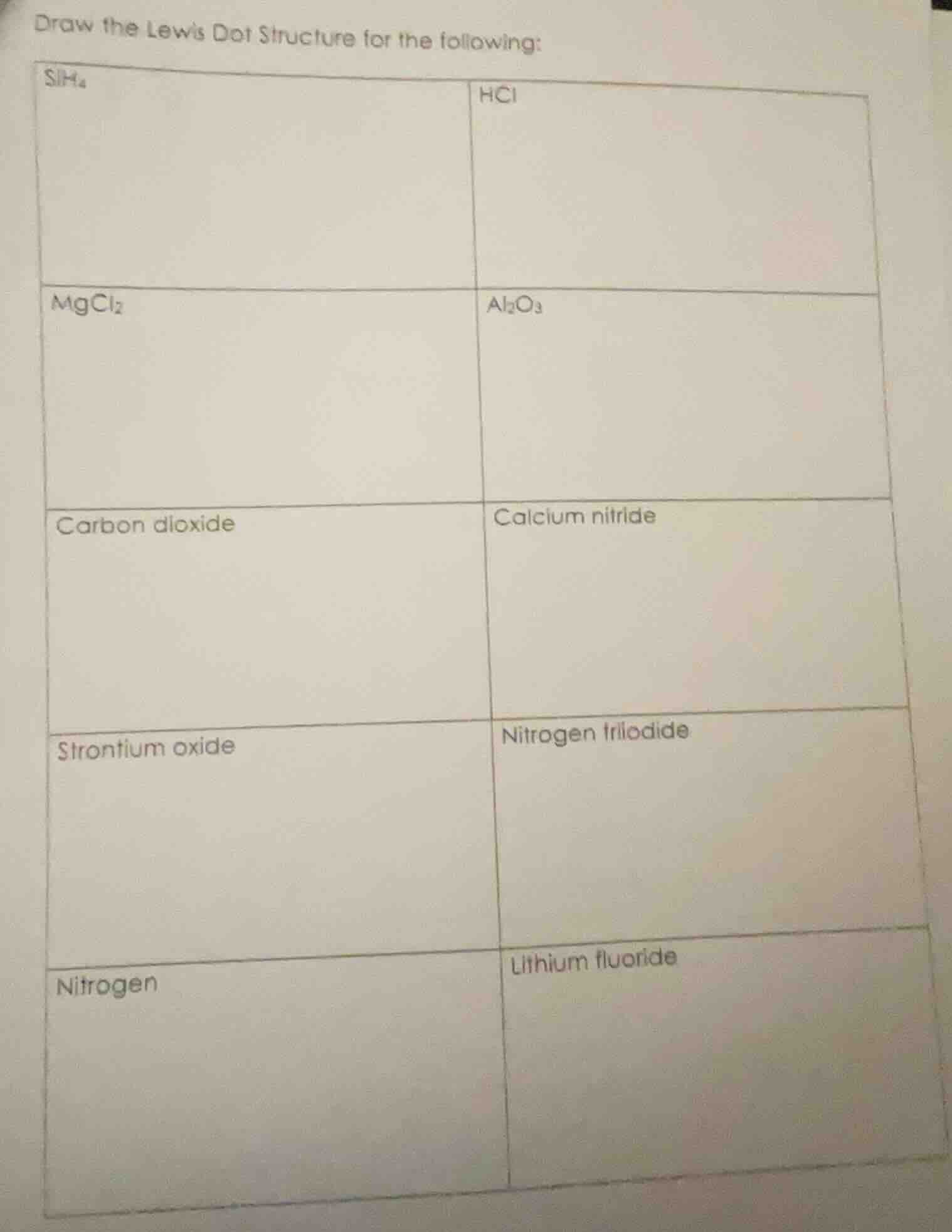
draw the lewis dot structure for the following:
sih₄\thcl
mgcl₂\tal₂o₃
carbon dioxide\tcalcium nitride
strontium oxide\tnitrogen triiodide
nitrogen\tlithium fluoride
1. $\boldsymbol{\ce{SiH4}}$
Step 1: Determine valence electrons
Si (Group 14) has 4 valence electrons; each H (Group 1) has 1, so total: $4 + 4(1) = 8$.
Step 2: Arrange atoms
Si is central, bonded to 4 H atoms.
Step 3: Draw bonds and lone pairs
Each Si–H bond is a single bond (2 electrons). No lone pairs on Si (4 bonds use 8 electrons).
Lewis structure: $\ce{H:\!\!\overset{..}{Si}\!\!\!:H}$ (with H atoms on all four sides, each H having 2 electrons, Si with 8 total).
2. $\boldsymbol{\ce{HCl}}$
Step 1: Valence electrons
H: 1, Cl (Group 17): 7. Total: $1 + 7 = 8$.
Step 2: Arrange atoms
H bonded to Cl.
Step 3: Draw bonds and lone pairs
Single H–Cl bond (2 electrons). Cl has 3 lone pairs (6 electrons) to complete octet.
Lewis structure: $\ce{H - Cl}$ (with Cl having 3 lone pairs: $\ce{H:\!\!\overset{..}{Cl}\!\!\!:}$).
3. $\boldsymbol{\ce{MgCl2}}$ (Ionic, Lewis dot for ions)
Step 1: Ionic charges
Mg (Group 2) loses 2 electrons: $\ce{Mg^{2+}}$; each Cl (Group 17) gains 1 electron: $\ce{Cl^-}$.
Step 2: Draw ions
$\ce{Mg^{2+}}$ with no valence electrons (lost 2), each $\ce{Cl^-}$ with 8 valence electrons (3 lone pairs + 1 bond pair, but as ion, shown as $\ce{[:\!\!\overset{..}{Cl}\!\!\!:]^-}$).
Lewis structure: $\ce{[:\!\!\overset{..}{Cl}\!\!\!:]^- Mg^{2+} [:\!\!\overset{..}{Cl}\!\!\!:]^-}$
4. $\boldsymbol{\ce{Al2O3}}$ (Ionic)
Step 1: Ionic charges
Al (Group 13) loses 3 electrons: $\ce{Al^{3+}}$; O (Group 16) gains 2 electrons: $\ce{O^{2-}}$.
Step 2: Balance charges
2 $\ce{Al^{3+}}$ (total +6) and 3 $\ce{O^{2-}}$ (total -6).
Lewis structure: $\ce{[:\!\!\overset{..}{O}\!\!\!:]^{2-} Al^{3+} [:\!\!\overset{..}{O}\!\!\!:]^{2-} Al^{3+} [:\!\!\overset{..}{O}\!\!\!:]^{2-}}$ (simplified as ions with charges).
5. $\boldsymbol{\ce{CO2}}$
Step 1: Valence electrons
C (Group 14): 4, O (Group 16): 6 each. Total: $4 + 2(6) = 16$.
Step 2: Arrange atoms
C central, bonded to 2 O atoms.
Step 3: Draw bonds (double bonds)
C needs 4 bonds. Each C=O double bond (4 electrons) uses 8 electrons per bond? No: total electrons: 16. Two double bonds (C=O) use $2 \times 4 = 8$ electrons, and each O has 2 lone pairs (4 electrons per O, total 8).
Lewis structure: $\ce{O::C::O}$ (each O has 2 lone pairs: $\ce{:\!\!\overset{..}{O}::C::\overset{..}{O}\!\!\!:}$).
6. $\boldsymbol{\ce{Ca3N2}}$ (Ionic)
Step 1: Ionic charges
Ca (Group 2): $\ce{Ca^{2+}}$; N (Group 15): $\ce{N^{3-}}$ (gains 3 electrons).
Step 2: Balance charges
3 $\ce{Ca^{2+}}$ (total +6) and 2 $\ce{N^{3-}}$ (total -6).
Lewis structure: $\ce{[:\!\!\overset{..}{N}\!\!\!:]^{3-} Ca^{2+} [:\!\!\overset{..}{N}\!\!\!:]^{3-} Ca^{2+} [:\!\!\overset{..}{N}\!\!\!:]^{3-} Ca^{2+}}$ (simplified as ions with charges).
7. $\boldsymbol{\ce{SrO}}$ (Ionic)
Step 1: Ionic charges
Sr (Group 2): $\ce{Sr^{2+}}$; O (Group 16): $\ce{O^{2-}}$.
Step 2: Draw ions
$\ce{Sr^{2+}}$ and $\ce{[:\!\!\overset{..}{O}\!\!\!:]^{2-}}$.
Lewis structure: $\ce{[:\!\!\overset{..}{O}\!\!\!:]^{2-} Sr^{2+}}$
8. $\boldsymbol{\ce{NI3}}$
Step 1: Valence electrons
N (Group 15): 5; each I (Group 17): 7. Total: $5 + 3(7) = 26$.
Step 2: Arrange atoms
N central, bonded to 3 I atoms.
Step 3: Draw bonds and lone pairs
3 N–I single bonds (6 electrons). N has 1 lone pair (2 electrons); each I has 3 lone pairs (6 electrons) to complete octets.
Lewis structure: $\ce{I:\!\!\overset{..}{N}\!\!\!:I}$ (with I atoms on three sides, each I having 3 lone pairs, N with 1 lone pair).
9. $\boldsymbol{\ce{N2}}$ (Diatomic)
####…

Snap & solve any problem in the app
Get step-by-step solutions on Sovi AI
Photo-based solutions with guided steps
Explore more problems and detailed explanations
1. $\boldsymbol{\ce{SiH4}}$
Step 1: Determine valence electrons
Si (Group 14) has 4 valence electrons; each H (Group 1) has 1, so total: $4 + 4(1) = 8$.
Step 2: Arrange atoms
Si is central, bonded to 4 H atoms.
Step 3: Draw bonds and lone pairs
Each Si–H bond is a single bond (2 electrons). No lone pairs on Si (4 bonds use 8 electrons).
Lewis structure: $\ce{H:\!\!\overset{..}{Si}\!\!\!:H}$ (with H atoms on all four sides, each H having 2 electrons, Si with 8 total).
2. $\boldsymbol{\ce{HCl}}$
Step 1: Valence electrons
H: 1, Cl (Group 17): 7. Total: $1 + 7 = 8$.
Step 2: Arrange atoms
H bonded to Cl.
Step 3: Draw bonds and lone pairs
Single H–Cl bond (2 electrons). Cl has 3 lone pairs (6 electrons) to complete octet.
Lewis structure: $\ce{H - Cl}$ (with Cl having 3 lone pairs: $\ce{H:\!\!\overset{..}{Cl}\!\!\!:}$).
3. $\boldsymbol{\ce{MgCl2}}$ (Ionic, Lewis dot for ions)
Step 1: Ionic charges
Mg (Group 2) loses 2 electrons: $\ce{Mg^{2+}}$; each Cl (Group 17) gains 1 electron: $\ce{Cl^-}$.
Step 2: Draw ions
$\ce{Mg^{2+}}$ with no valence electrons (lost 2), each $\ce{Cl^-}$ with 8 valence electrons (3 lone pairs + 1 bond pair, but as ion, shown as $\ce{[:\!\!\overset{..}{Cl}\!\!\!:]^-}$).
Lewis structure: $\ce{[:\!\!\overset{..}{Cl}\!\!\!:]^- Mg^{2+} [:\!\!\overset{..}{Cl}\!\!\!:]^-}$
4. $\boldsymbol{\ce{Al2O3}}$ (Ionic)
Step 1: Ionic charges
Al (Group 13) loses 3 electrons: $\ce{Al^{3+}}$; O (Group 16) gains 2 electrons: $\ce{O^{2-}}$.
Step 2: Balance charges
2 $\ce{Al^{3+}}$ (total +6) and 3 $\ce{O^{2-}}$ (total -6).
Lewis structure: $\ce{[:\!\!\overset{..}{O}\!\!\!:]^{2-} Al^{3+} [:\!\!\overset{..}{O}\!\!\!:]^{2-} Al^{3+} [:\!\!\overset{..}{O}\!\!\!:]^{2-}}$ (simplified as ions with charges).
5. $\boldsymbol{\ce{CO2}}$
Step 1: Valence electrons
C (Group 14): 4, O (Group 16): 6 each. Total: $4 + 2(6) = 16$.
Step 2: Arrange atoms
C central, bonded to 2 O atoms.
Step 3: Draw bonds (double bonds)
C needs 4 bonds. Each C=O double bond (4 electrons) uses 8 electrons per bond? No: total electrons: 16. Two double bonds (C=O) use $2 \times 4 = 8$ electrons, and each O has 2 lone pairs (4 electrons per O, total 8).
Lewis structure: $\ce{O::C::O}$ (each O has 2 lone pairs: $\ce{:\!\!\overset{..}{O}::C::\overset{..}{O}\!\!\!:}$).
6. $\boldsymbol{\ce{Ca3N2}}$ (Ionic)
Step 1: Ionic charges
Ca (Group 2): $\ce{Ca^{2+}}$; N (Group 15): $\ce{N^{3-}}$ (gains 3 electrons).
Step 2: Balance charges
3 $\ce{Ca^{2+}}$ (total +6) and 2 $\ce{N^{3-}}$ (total -6).
Lewis structure: $\ce{[:\!\!\overset{..}{N}\!\!\!:]^{3-} Ca^{2+} [:\!\!\overset{..}{N}\!\!\!:]^{3-} Ca^{2+} [:\!\!\overset{..}{N}\!\!\!:]^{3-} Ca^{2+}}$ (simplified as ions with charges).
7. $\boldsymbol{\ce{SrO}}$ (Ionic)
Step 1: Ionic charges
Sr (Group 2): $\ce{Sr^{2+}}$; O (Group 16): $\ce{O^{2-}}$.
Step 2: Draw ions
$\ce{Sr^{2+}}$ and $\ce{[:\!\!\overset{..}{O}\!\!\!:]^{2-}}$.
Lewis structure: $\ce{[:\!\!\overset{..}{O}\!\!\!:]^{2-} Sr^{2+}}$
8. $\boldsymbol{\ce{NI3}}$
Step 1: Valence electrons
N (Group 15): 5; each I (Group 17): 7. Total: $5 + 3(7) = 26$.
Step 2: Arrange atoms
N central, bonded to 3 I atoms.
Step 3: Draw bonds and lone pairs
3 N–I single bonds (6 electrons). N has 1 lone pair (2 electrons); each I has 3 lone pairs (6 electrons) to complete octets.
Lewis structure: $\ce{I:\!\!\overset{..}{N}\!\!\!:I}$ (with I atoms on three sides, each I having 3 lone pairs, N with 1 lone pair).
9. $\boldsymbol{\ce{N2}}$ (Diatomic)
Step 1: Valence electrons
Each N: 5. Total: $5 + 5 = 10$.
Step 2: Draw bonds
Triple bond (6 electrons) between N atoms. Each N has 1 lone pair (2 electrons).
Lewis structure: $\ce{:\!\!\overset{..}{N}\!\!\equiv\!\!\overset{..}{N}\!\!\!:}$
10. $\boldsymbol{\ce{LiF}}$ (Ionic)
Step 1: Ionic charges
Li (Group 1): $\ce{Li^+}$; F (Group 17): $\ce{F^-}$.
Step 2: Draw ions
$\ce{Li^+}$ and $\ce{[:\!\!\overset{..}{F}\!\!\!:]^-}$.
Lewis structure: $\ce{[:\!\!\overset{..}{F}\!\!\!:]^- Li^+}$
Final Answers (Lewis Structures Summary)
| Compound | Lewis Structure (Simplified) |
|---|---|
| $\ce{HCl}$ | $\ce{H - Cl}$ (Cl with 3 lone pairs) |
| $\ce{MgCl2}$ | $\ce{[:\!\!\overset{..}{Cl}\!\!\!:]^- Mg^{2+} [:\!\!\overset{..}{Cl}\!\!\!:]^-}$ |
| $\ce{Al2O3}$ | $\ce{[:\!\!\overset{..}{O}\!\!\!:]^{2-} Al^{3+}...}$ (2 N³⁻, 3 Ca²⁺) |
| $\ce{CO2}$ | $\ce{:\!\!\overset{..}{O}::C::\overset{..}{O}\!\!\!:}$ |
| $\ce{Ca3N2}$ | $\ce{[:\!\!\overset{..}{N}\!\!\!:]^{3-} Ca^{2+}...}$ (3 Ca²⁺, 2 N³⁻) |
| $\ce{SrO}$ | $\ce{[:\!\!\overset{..}{O}\!\!\!:]^{2-} Sr^{2+}}$ |
| $\ce{NI3}$ | $\ce{I:\!\!\overset{..}{N}\!\!\!:I}$ (3 I atoms, N with 1 lone pair) |
| $\ce{N2}$ | $\ce{:\!\!\overset{..}{N}\!\!\equiv\!\!\overset{..}{N}\!\!\!:}$ |
| $\ce{LiF}$ | $\ce{[:\!\!\overset{..}{F}\!\!\!:]^- Li^+}$ |
(Note: For ionic compounds, the structure shows ion charges and electron pairs; for covalent, bonds and lone pairs.)