QUESTION IMAGE
Question
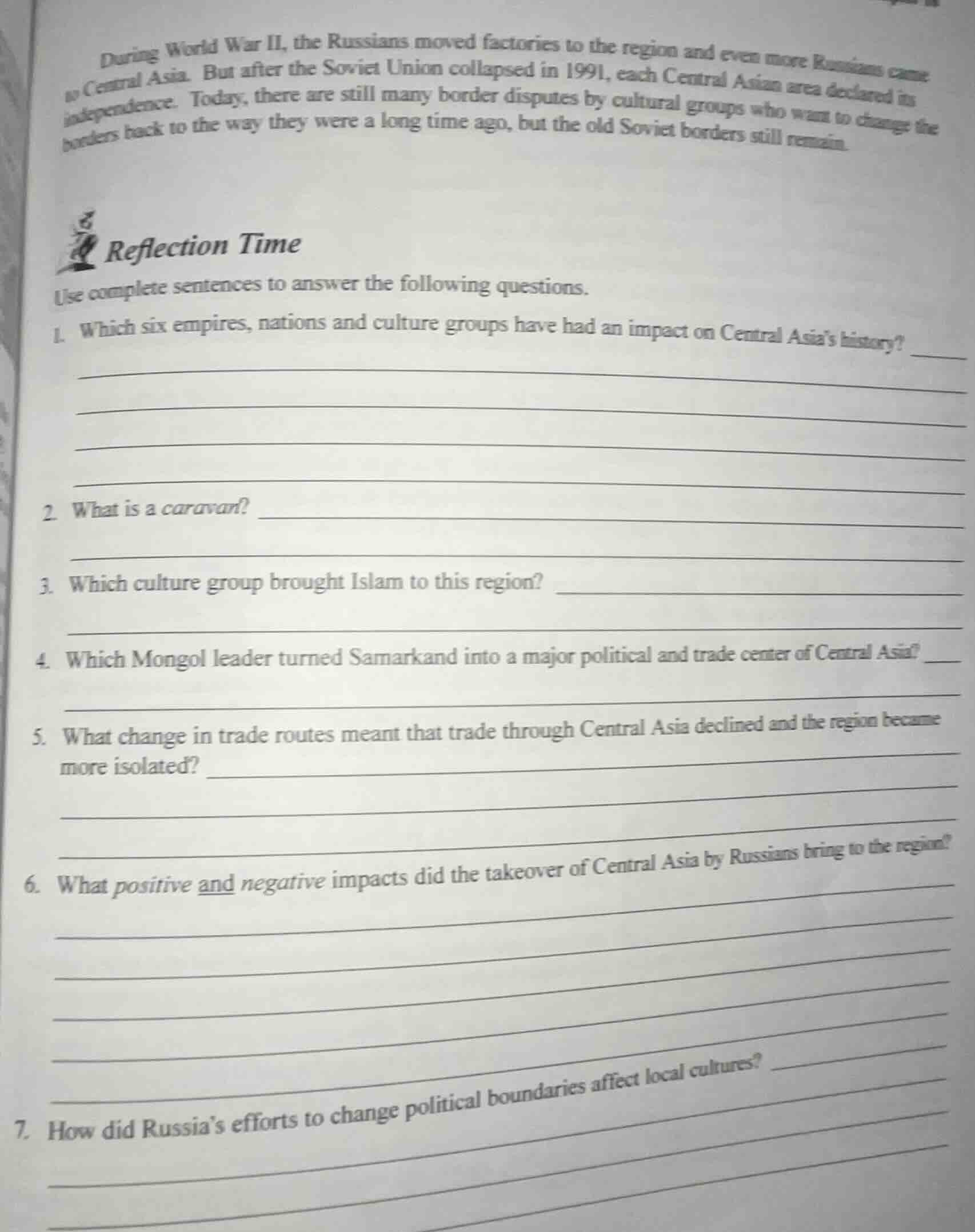
during world war ii, the russians moved factories to the region and even more russians came to central asia. but after the soviet union collapsed in 1991, each central asian area declared its independence. today, there are still many border disputes by cultural groups who want to change the borders back to the way they were a long time ago, but the old soviet borders still remain.
reflection time
use complete sentences to answer the following questions.
- which six empires, nations and culture groups have had an impact on central asia’s history?
- what is a caravan?
- which culture group brought islam to this region?
- which mongol leader turned samarkand into a major political and trade center of central asia?
- what change in trade routes meant that trade through central asia declined and the region became more isolated?
- what positive and negative impacts did the takeover of central asia by russians bring to the region?
- how did russia’s efforts to change political boundaries affect local cultures?
Brief Explanations
- Identifies key groups that shaped Central Asia's history through conquest, trade, and rule.
- Defines the historical trade vehicle/convoy critical to Central Asian commerce.
- Names the group responsible for spreading Islam to the region via conquest and trade.
- Identifies the Mongol ruler who revitalized Samarkand as a regional hub.
- Explains the shift in global trade routes that reduced Central Asia's commercial role.
- Outlines both beneficial and harmful effects of Russian/Soviet control of the region.
- Describes how Soviet border redrawing impacted local cultural groups and dynamics.

Snap & solve any problem in the app
Get step-by-step solutions on Sovi AI
Photo-based solutions with guided steps
Explore more problems and detailed explanations
- The six empires, nations, and culture groups that impacted Central Asia's history are the Persians, Alexander the Great's Macedonian Empire, the Arabs, the Mongols, the Russians/Soviet Union, and the Turkic peoples.
- A caravan is a group of travelers, merchants, and their camels or other pack animals that travel together across deserts or other remote regions, typically for trade purposes.
- The Arab culture group brought Islam to Central Asia during their military conquests and trade expansion starting in the 7th century.
- Timur (Tamerlane), a Mongol leader, turned Samarkand into a major political and trade center of Central Asia in the 14th century.
- The shift to maritime trade routes between Europe and Asia (around the Cape of Good Hope) meant that trade through Central Asia declined, leaving the region more isolated.
- Positive impacts: The Russians built infrastructure like railroads and schools, improved access to healthcare, and modernized some parts of the region. Negative impacts: They suppressed local cultures and languages, forced collectivization that harmed traditional agriculture, and moved Russian settlers into the region which displaced local groups and created long-term ethnic tensions.
- Russia's (and later the Soviet Union's) redrawing of political boundaries split some cultural and ethnic groups across different republics, while grouping rival or unrelated ethnic communities together. This created ongoing border disputes and cultural tensions after the collapse of the Soviet Union, as some groups seek to reunite with their cultural kin across arbitrary borders.