QUESTION IMAGE
Question
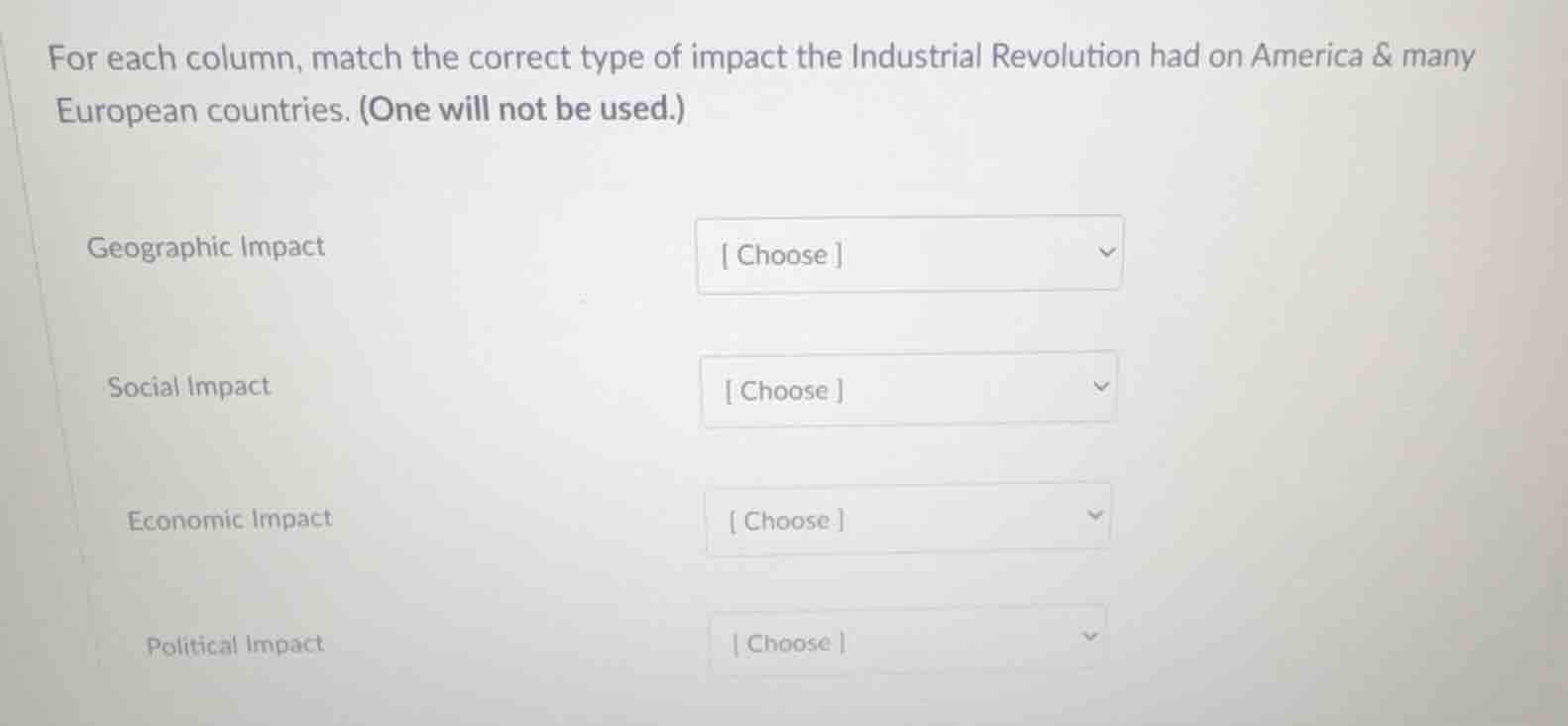
for each column, match the correct type of impact the industrial revolution had on america & many european countries. (one will not be used.)
geographic impact choose
social impact choose
economic impact choose
political impact choose
To solve this matching problem about the Industrial Revolution's impacts, we first recall the typical impacts for each category:
Geographic Impact
- Explanation: Geographic impacts relate to changes in location, movement, or distribution of people/resources. For the Industrial Revolution, this includes urbanization (people moving to cities for factory jobs), growth of industrial regions (e.g., Northeast US), or changes in transportation networks (canals, railroads). A common geographic impact is Urbanization (growth of cities) or shift of population from rural to urban areas (as factories drew workers to cities).
Social Impact
- Explanation: Social impacts involve changes to society, culture, or daily life. Key examples: rise of the working class, formation of labor unions, changes in gender roles (women in factories), or growth of a middle class. A typical social impact is Growth of the working class or increased urban poverty (due to poor factory conditions).
Economic Impact
- Explanation: Economic impacts relate to production, trade, or wealth. The Industrial Revolution shifted economies from agrarian to industrial: rise of capitalism, growth of factories/mass production, expansion of trade, or emergence of monopolies. A core economic impact is Shift from agrarian to industrial economy or growth of factory-based production.
Political Impact
- Explanation: Political impacts involve changes to government, laws, or power dynamics. Examples: rise of labor laws (to address factory abuses), growth of political movements (socialism, communism), or increased government regulation of industry. A common political impact is Growth of labor reform movements or expansion of government’s role in regulating industry.
Since the dropdown options are not provided, here’s how to match them (assuming typical options):
- Geographic Impact: Urbanization (or “Growth of cities/industrial regions”)
- Social Impact: Growth of the working class (or “Changes in family life/urban poverty”)
- Economic Impact: Industrialization (or “Shift to factory production”)
- Political Impact: Labor reform (or “Expansion of government regulation”)
If you provide the dropdown options, we can refine the match further. For now, these are the standard impacts for each category.

Snap & solve any problem in the app
Get step-by-step solutions on Sovi AI
Photo-based solutions with guided steps
Explore more problems and detailed explanations
To solve this matching problem about the Industrial Revolution's impacts, we first recall the typical impacts for each category:
Geographic Impact
- Explanation: Geographic impacts relate to changes in location, movement, or distribution of people/resources. For the Industrial Revolution, this includes urbanization (people moving to cities for factory jobs), growth of industrial regions (e.g., Northeast US), or changes in transportation networks (canals, railroads). A common geographic impact is Urbanization (growth of cities) or shift of population from rural to urban areas (as factories drew workers to cities).
Social Impact
- Explanation: Social impacts involve changes to society, culture, or daily life. Key examples: rise of the working class, formation of labor unions, changes in gender roles (women in factories), or growth of a middle class. A typical social impact is Growth of the working class or increased urban poverty (due to poor factory conditions).
Economic Impact
- Explanation: Economic impacts relate to production, trade, or wealth. The Industrial Revolution shifted economies from agrarian to industrial: rise of capitalism, growth of factories/mass production, expansion of trade, or emergence of monopolies. A core economic impact is Shift from agrarian to industrial economy or growth of factory-based production.
Political Impact
- Explanation: Political impacts involve changes to government, laws, or power dynamics. Examples: rise of labor laws (to address factory abuses), growth of political movements (socialism, communism), or increased government regulation of industry. A common political impact is Growth of labor reform movements or expansion of government’s role in regulating industry.
Since the dropdown options are not provided, here’s how to match them (assuming typical options):
- Geographic Impact: Urbanization (or “Growth of cities/industrial regions”)
- Social Impact: Growth of the working class (or “Changes in family life/urban poverty”)
- Economic Impact: Industrialization (or “Shift to factory production”)
- Political Impact: Labor reform (or “Expansion of government regulation”)
If you provide the dropdown options, we can refine the match further. For now, these are the standard impacts for each category.