QUESTION IMAGE
Question
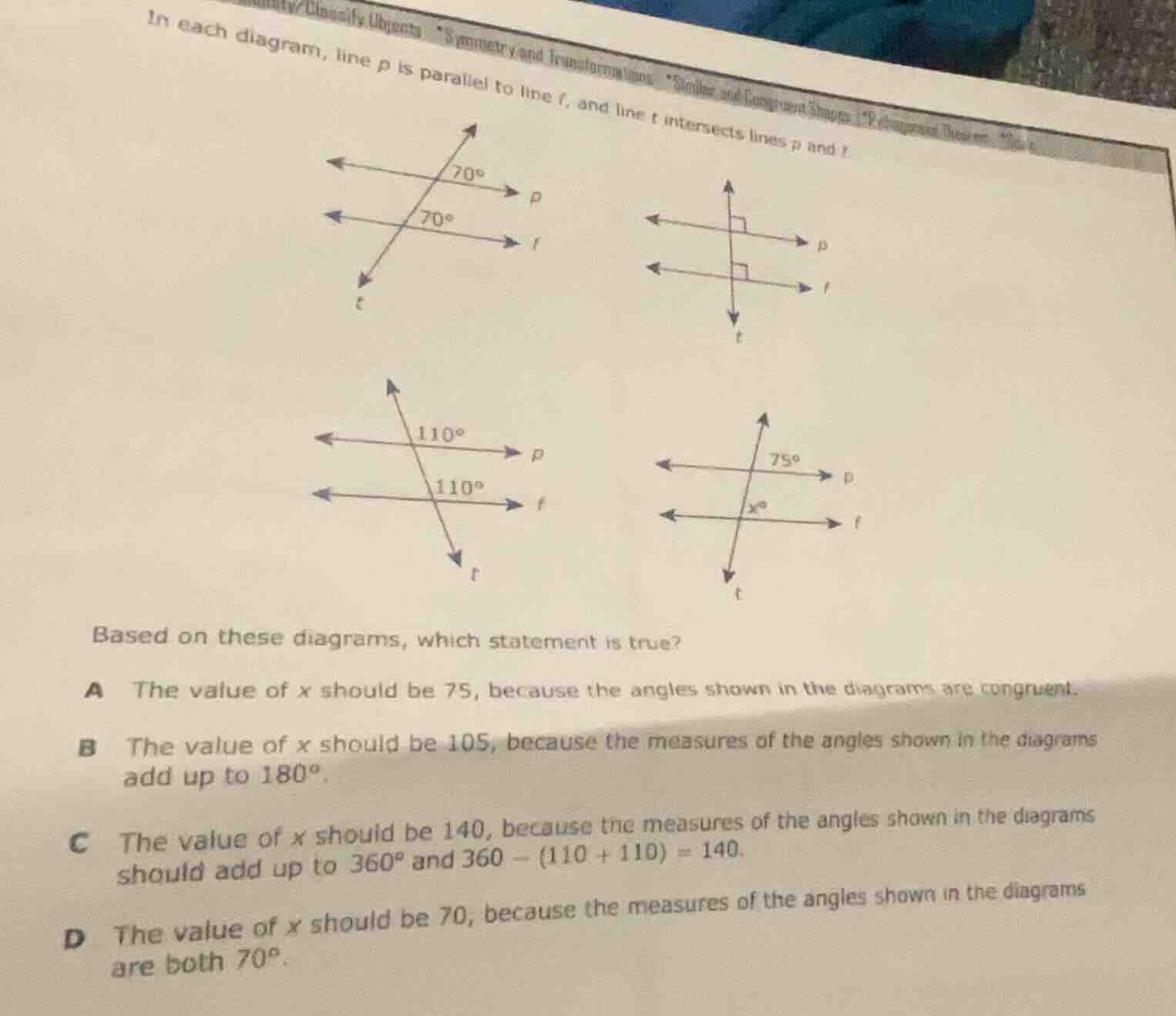
in each diagram, line p is parallel to line f, and line t intersects lines p and f
based on these diagrams, which statement is true?
a the value of x should be 75, because the angles shown in the diagrams are congruent.
b the value of x should be 105, because the measures of the angles shown in the diagrams add up to 180°.
c the value of x should be 140, because the measures of the angles shown in the diagrams should add up to 360° and 360 - (110 + 110) = 140.
d the value of x should be 70, because the measures of the angles shown in the diagrams are both 70°.
Step1: Analyze the diagrams
The first three diagrams show that when a transversal (line \( t \)) intersects two parallel lines (\( p \) and \( f \)), the corresponding angles are congruent (70° = 70°, 90° = 90°, 110° = 110°). In the fourth diagram, the angle with \( p \) is 75°, so the corresponding angle with \( f \) (which is \( x \)) should also be congruent. Wait, no, wait—wait, actually, in the fourth diagram, the angle given is 75°, but let's check the relationship. Wait, no, maybe I misread. Wait, the first three diagrams: in the first, the angles are 70° (corresponding), second 90° (corresponding, right angles), third 110° (corresponding). So the pattern is that corresponding angles are congruent when lines are parallel. But in the fourth diagram, the angle with \( p \) is 75°, but wait, maybe it's a linear pair? Wait, no, let's re-examine the options.
Wait, option A says \( x = 75 \) because angles are congruent. Let's check the first three diagrams:
- First diagram: transversal \( t \) intersects parallel \( p \) and \( f \), angle with \( p \) is 70°, angle with \( f \) is 70° (corresponding angles, congruent).
- Second diagram: transversal \( t \) is perpendicular, so both angles are 90° (congruent, right angles).
- Third diagram: angle with \( p \) is 110°, angle with \( f \) is 110° (corresponding angles, congruent).
So the pattern is that corresponding angles are congruent. In the fourth diagram, the angle with \( p \) is 75°, so the corresponding angle with \( f \) (which is \( x \)) should be 75°, because they are corresponding angles (since \( p \parallel f \) and \( t \) is transversal). Wait, but let's check the options:
Option A: "The value of \( x \) should be 75, because the angles shown in the diagrams are congruent." This matches the pattern of corresponding angles being congruent (70=70, 90=90, 110=110, so 75 should equal \( x \)).
Option B: 105, because angles add to 180. But in the first diagram, 70 + 70 = 140 ≠ 180, so that's not the pattern.
Option C: 140, adding to 360. 110 + 110 = 220, 360 - 220 = 140, but that's not the pattern here.
Option D: 70, but the angle given is 75, so that's not.
So the correct pattern is corresponding angles are congruent, so \( x = 75 \), which is option A.
Step2: Evaluate each option
- Option A: States \( x = 75 \) because angles are congruent. The first three diagrams show corresponding angles (70°-70°, 90°-90°, 110°-110°) are congruent, so by the same logic, the 75° angle with \( p \) should correspond to \( x \) with \( f \), so \( x = 75 \). This matches the pattern.
- Option B: Claims \( x = 105 \) because angles add to 180°. But in the first diagram, 70 + 70 = 140 ≠ 180, so this is incorrect.
- Option C: Claims \( x = 140 \) because angles add to 360°. The first diagram: 70 + 70 = 140, 360 - 140 = 220 ≠ 140, so this is incorrect.
- Option D: Claims \( x = 70 \), but the given angle is 75°, so this is incorrect.

Snap & solve any problem in the app
Get step-by-step solutions on Sovi AI
Photo-based solutions with guided steps
Explore more problems and detailed explanations
A. The value of \( x \) should be 75, because the angles shown in the diagrams are congruent.