QUESTION IMAGE
Question
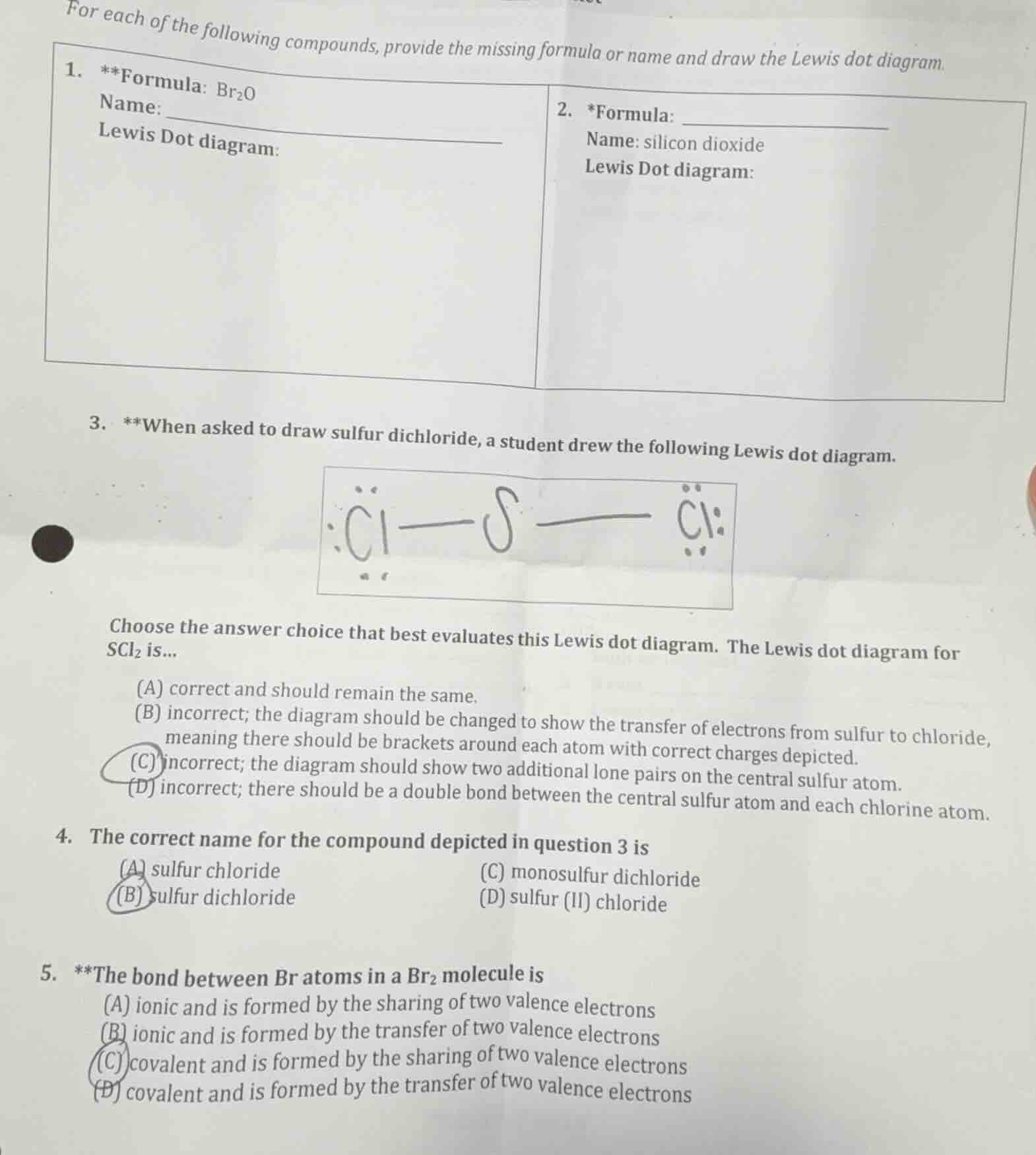
for each of the following compounds, provide the missing formula or name and draw the lewis dot diagram.
- **formula: br₂o
name: _______________
lewis dot diagram:
- *formula: _______________
name: silicon dioxide
lewis dot diagram:
- **when asked to draw sulfur dichloride, a student drew the following lewis dot diagram.
image of a lewis dot diagram: :cl—s—cl: with some lone pairs
choose the answer choice that best evaluates this lewis dot diagram. the lewis dot diagram for scl₂ is...
(a) correct and should remain the same.
(b) incorrect; the diagram should be changed to show the transfer of electrons from sulfur to chloride, meaning there should be brackets around each atom with correct charges depicted.
(c) incorrect; the diagram should show two additional lone pairs on the central sulfur atom.
(d) incorrect; there should be a double bond between the central sulfur atom and each chlorine atom.
- the correct name for the compound depicted in question 3 is
(a) sulfur chloride
(b) sulfur dichloride
(c) monosulfur dichloride
(d) sulfur (ii) chloride
- **the bond between br atoms in a br₂ molecule is
(a) ionic and is formed by the sharing of two valence electrons
(b) ionic and is formed by the transfer of two valence electrons
(c) covalent and is formed by the sharing of two valence electrons
(d) covalent and is formed by the transfer of two valence electrons
Question 1
Step1: Identify the elements and their prefixes
The formula is \( \text{Br}_2\text{O} \). Bromine (Br) has a subscript of 2, so we use the prefix "di-" for bromine. Oxygen (O) has a subscript of 1, so we use the prefix "mono-" for oxygen. The name of the compound is determined by naming the first element with its prefix (except if the subscript is 1, we usually omit "mono-" for the first element) and the second element with its prefix and ending in "-ide". So for \( \text{Br}_2\text{O} \), the first element is bromine (with "di-" since there are 2 atoms), the second is oxygen (with "mono-" since there is 1 atom) and ending in "-ide". So the name is dibromine monoxide.
Step2: Draw the Lewis Dot diagram
First, calculate the total number of valence electrons. Bromine (Br) is in group 17, so it has 7 valence electrons. There are 2 Br atoms, so \( 2 \times 7 = 14 \) valence electrons from Br. Oxygen (O) is in group 16, so it has 6 valence electrons. Total valence electrons: \( 14 + 6 = 20 \).
The central atom is usually the least electronegative atom. Here, O is less electronegative than Br? Wait, no, actually, in \( \text{Br}_2\text{O} \), the structure is O in the center (since O is less electronegative than Br? Wait, electronegativity of O is 3.5, Br is 2.8. So O is more electronegative? Wait, maybe I made a mistake. Wait, the formula is \( \text{Br}_2\text{O} \), so the structure is Br - O - Br? Let's check the valence electrons.
Each Br has 7 valence electrons, O has 6. So total valence electrons: \( 2\times7 + 6 = 20 \).
We place O in the center. Connect each Br to O with a single bond. Each single bond uses 2 electrons, so 2 bonds (Br - O and O - Br) use \( 2\times2 = 4 \) electrons. Remaining electrons: \( 20 - 4 = 16 \) electrons.
Now, we distribute the remaining electrons as lone pairs. Each Br needs 6 more electrons (since it has 2 from the bond, needs 8 total). So each Br gets 3 lone pairs (6 electrons). So 2 Br atoms: \( 2\times6 = 12 \) electrons. Remaining electrons: \( 16 - 12 = 4 \) electrons, which go to O as 2 lone pairs.
So the Lewis dot diagram: O in the center, single bonds to each Br. Each Br has 3 lone pairs (6 dots), O has 2 lone pairs (4 dots). So:
  :Br:
  |
:O:
  |
  :Br:
Wait, but with the lone pairs. Let's draw it properly. Each Br has 3 lone pairs (6 electrons) around it, O has 2 lone pairs (4 electrons) around it. So:
    ..
    Br
   /  \
  ..  ..
O      Br
  ..
    ..
Wait, maybe better to represent as:
For \( \text{Br}_2\text{O} \), the Lewis structure:
- Central O atom.
- Single bonds to each Br atom (Br - O - Br).
- Each Br has 3 lone pairs (6 electrons) (so around each Br: 6 dots).
- O has 2 lone pairs (4 dots) (around O: 4 dots).
So the Lewis dot diagram:
  :Br:
  |
:O:
  |
  :Br:
But with the lone pairs. Each Br has 3 lone pairs (so 6 dots: two above, two below, one on the side? Wait, maybe:
    :
   Br:
  /   \
 :O:   :Br:
  \   /
    :
Wait, maybe I should calculate the formal charges to confirm. Formal charge on O: valence electrons - non - bonding electrons - 0.5×bonding electrons = 6 - 4 - 0.5×4 = 6 - 4 - 2 = 0. Formal charge on each Br: 7 - 6 - 0.5×2 = 7 - 6 - 1 = 0. So that's correct.
Step1: Determine the formula from the name
The name is silicon dioxide. Silicon (Si) has a subscript of 1 (since there's no prefix, we assume 1), and oxygen (O) has a subscript of 2 (from "di - oxide"). So the formula is \( \text{SiO}_2 \).
Step2: Draw the Lewis Dot diagram
First, calculate the total number of valence electrons. Silicon (Si) is in group 14, so it has 4 valence electrons. Oxygen (O) is in group 16, so it has 6 valence electrons. There are 2 O atoms, so total valence electrons: \( 4 + 2\times6 = 4 + 12 = 16 \).
The structure of \( \text{SiO}_2 \) is a network covalent structure, but for the Lewis dot diagram (simplified), we can consider the basic unit. Wait, actually, \( \text{SiO}_2 \) is a giant covalent structure, but if we consider the Lewis dot diagram for the molecular formula (even though it's a network), we can think of Si in the center (or in a network). But for the purpose of drawing, each Si is bonded to 4 O atoms in the network, but the formula is \( \text{SiO}_2 \), so the empirical formula. Wait, maybe the question expects the Lewis dot diagram for the molecule (even though it's a network). Wait, maybe the question is considering it as a molecular compound (but actually \( \text{SiO}_2 \) is a network). But let's proceed.
Assuming a molecular structure (even though it's not molecular), Si has 4 valence electrons, each O has 6. Total valence electrons: 4 + 12 = 16.
Si is in the center, bonded to 2 O atoms? Wait, no, in the network, each Si is bonded to 4 O, but the formula is \( \text{SiO}_2 \). Wait, maybe the question expects the Lewis dot diagram for the \( \text{SiO}_2 \) unit. Let's consider Si bonded to 2 O atoms (even though it's not accurate, but for the sake of the question).
Wait, maybe the question has a mistake, but let's proceed. If we consider Si bonded to 2 O atoms:
Connect Si to each O with a double bond? Wait, let's calculate the formal charges.
If Si is bonded to 2 O atoms with double bonds: each double bond uses 4 electrons, so 2 double bonds use 8 electrons. Si has 4 valence electrons, so it uses 4 electrons in bonds (2 double bonds), so formal charge on Si: 4 - 0 - 0.5×8 = 4 - 4 = 0. Each O: 6 - 4 (from double bond) - 0 = 2? No, that's not right.
Wait, maybe the correct way is to consider the Lewis dot diagram for \( \text{SiO}_2 \) as a network, but since it's a network, the Lewis dot diagram is more complex. Alternatively, maybe the question expects the formula first, which is \( \text{SiO}_2 \), and the Lewis dot diagram (simplified) as Si in the center with two double bonds to O, but that's not accurate. Alternatively, maybe the question is considering it as a molecular compound, but \( \text{SiO}_2 \) is not molecular. Anyway, the formula is \( \text{SiO}_2 \).
To evaluate the Lewis dot diagram for \( \text{SCl}_2 \):
First, calculate the total number of valence electrons. Sulfur (S) is in group 16, so it has 6 valence electrons. Chlorine (Cl) is in group 17, so it has 7 valence electrons. There are 2 Cl atoms, so total valence electrons: \( 6 + 2\times7 = 6 + 14 = 20 \) valence electrons.
The student's diagram: Let's analyze the student's diagram. The student drew Cl - S - Cl, with some lone pairs. Wait, the student's diagram shows Cl with some lone pairs, S with no lone pairs? Wait, the student's diagram: "Cl - S - Cl" with Cl having some dots. Wait, let's check the correct Lewis dot diagram for \( \text{SCl}_2 \).
The correct structure: S is the central atom (since it's less electronegative than Cl). Connect each Cl to S with a single bond. Each single bond uses 2 electrons, so 2 bonds use \( 2\times2 = 4 \) electrons. Remaining electrons: \( 20 - 4 = 16 \) electrons.
Now, distribute the remaining electrons as lone pairs. Each Cl needs 6 more electrons (since it has 2 from the bond, needs 8 total), so each Cl gets 3 lone pairs (6 electrons). So 2 Cl atoms: \( 2\times6 = 12 \) electrons. Remaining electrons: \( 16 - 12 = 4 \) electrons, which go to S as 2 lone pairs.
So the correct Lewis dot diagram should have S with 2 lone pairs (4 electrons) and each Cl with 3 lone pairs (6 electrons). The student's diagram: does it show S with lone pairs? The student's diagram shows "Cl - S - Cl" with Cl having some dots, but S has no lone pairs. So the student's diagram is missing the two lone pairs on S. So the correct evaluation is:
Option (C): incorrect; the diagram should show two additional lone pairs on the central sulfur atom.
Let's check the options:
(A) correct and should remain the same: No, because S is missing lone pairs.
(B) incorrect; the diagram should be changed to show the transfer of electrons from sulfur to chloride: No, \( \text{SCl}_2 \) is a covalent compound, not ionic, so no electron transfer.
(C) incorrect; the diagram should show two additional lone pairs on the central sulfur atom: Yes, because S has 6 valence electrons, uses 2 in bonds, so needs 4 more (2 lone pairs) to complete its octet (or have 8 electrons around it? Wait, S can have an expanded octet, but in this case, with 2 bonds (4 electrons) and 2 lone pairs (4 electrons), total 8 electrons, which is an octet. Wait, S has 6 valence electrons, so 4 from lone pairs and 4 from bonds? Wait, no: each bond is 2 electrons, so 2 bonds (4 electrons) and 2 lone pairs (4 electrons), total 8 electrons. So S has 8 electrons (octet). The student's diagram has S with no lone pairs, so it's missing the two lone pairs (4 electrons, 2 lone pairs). So option (C) is correct.
(D) incorrect; there should be a double bond between the central sulfur atom and each chlorine atom: No, because if we have double bonds, the number of valence electrons would be different. Let's check: if there are double bonds, each double bond uses 4 electrons, 2 double bonds use 8 electrons. Remaining electrons: \( 20 - 8 = 12 \) electrons. Each Cl would get 3 lone pairs (6 electrons), so 2 Cl: 12 electrons, which uses all remaining electrons. But then S would have 4 electrons from the double bonds (2 double bonds, 4 electrons each? Wait, no, double bond is 4 electrons per bond. So 2 double bonds: 8 electrons. S has 6 valence electrons, so formal charge on S: 6 - 0 - 0.5×8 = 6 - 4 = +2. Each Cl: 7 - 6 (lone pairs) - 0.5×4 (double bond) = 7 - 6 - 2 = -1. So formal charges are +2 on S and -1 on each Cl, which is not favorable. So single bonds are bett…

Snap & solve any problem in the app
Get step-by-step solutions on Sovi AI
Photo-based solutions with guided steps
Explore more problems and detailed explanations
Name: dibromine monoxide
Lewis Dot diagram: (O in center, single bonds to two Br atoms. Each Br has 3 lone pairs (6 electrons), O has 2 lone pairs (4 electrons))