QUESTION IMAGE
Question
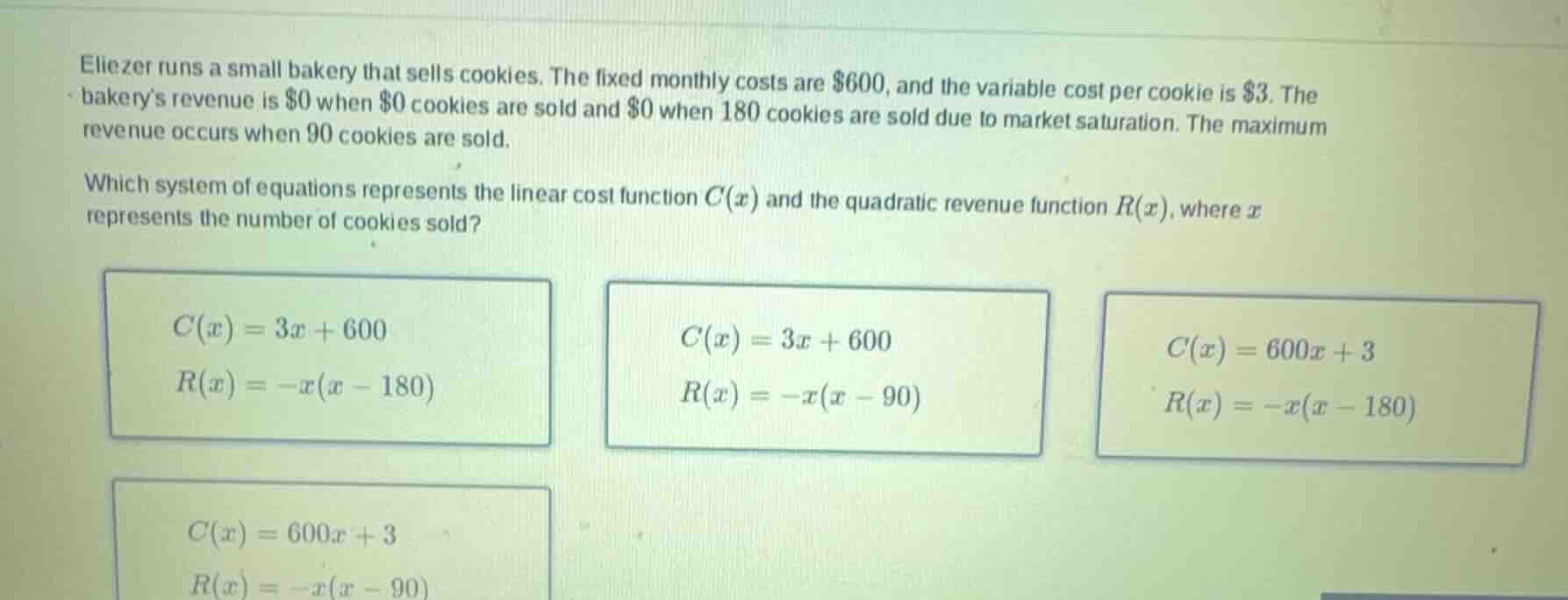
eliezer runs a small bakery that sells cookies. the fixed monthly costs are $600, and the variable cost per cookie is $3. the bakery’s revenue is $0 when $0 cookies are sold and $0 when 180 cookies are sold due to market saturation. the maximum revenue occurs when 90 cookies are sold. which system of equations represents the linear cost function c(x) and the quadratic revenue function r(x), where x represents the number of cookies sold? c(x) = 3x + 600 r(x) = -x(x - 180) c(x) = 3x + 600 r(x) = -x(x - 90) c(x) = 600x + 3 r(x) = -x(x - 180) c(x) = 600x + 3 r(x) = -x(x - 90)
Step1: Derive linear cost function
The linear cost function follows the form $C(x) = \text{variable cost} \cdot x + \text{fixed cost}$. Here, variable cost per cookie is $\$3$, fixed cost is $\$600$.
$C(x) = 3x + 600$
Step2: Derive quadratic revenue function
A quadratic revenue function with roots at $x=0$ and $x=180$ (revenue is $\$0$ at these points) has the form $R(x) = ax(x-180)$. The maximum occurs at the vertex, which is the midpoint of the roots: $\frac{0+180}{2}=90$, matching the given condition. For simplicity, $a=-1$ (to ensure the parabola opens downward, which makes sense for revenue saturation).
$R(x) = -x(x-180)$

Snap & solve any problem in the app
Get step-by-step solutions on Sovi AI
Photo-based solutions with guided steps
Explore more problems and detailed explanations
$C(x) = 3x + 600$
$R(x) = -x(x - 180)$