QUESTION IMAGE
Question
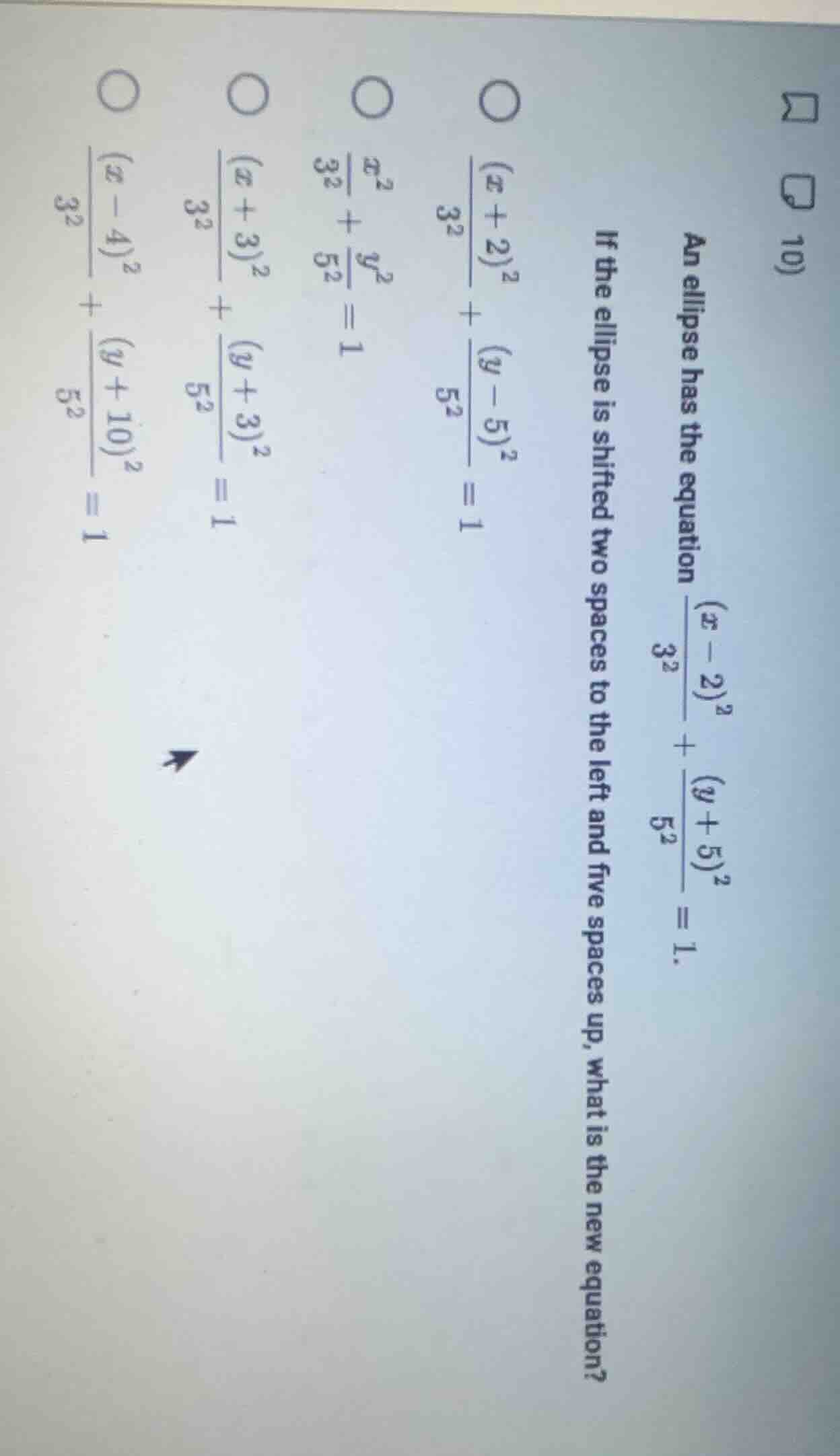
an ellipse has the equation \\(\frac{(x - 2)^2}{3^2} + \frac{(y + 5)^2}{5^2} = 1\\). if the ellipse is shifted two spaces to the left and five spaces up, what is the new equation?\\(\frac{(x + 2)^2}{3^2} + \frac{(y - 5)^2}{5^2} = 1\\)\\(\frac{x^2}{3^2} + \frac{y^2}{5^2} = 1\\)\\(\frac{(x + 3)^2}{3^2} + \frac{(y + 3)^2}{5^2} = 1\\)\\(\frac{(x - 4)^2}{3^2} + \frac{(y + 10)^2}{5^2} = 1\\)
Step1: Recall the transformation rules for ellipses
For a horizontal shift \( h \) units left, we replace \( x \) with \( x + h \) in the equation of the ellipse. For a vertical shift \( k \) units up, we replace \( y \) with \( y - k \) in the equation of the ellipse. The original equation of the ellipse is \(\frac{(x - 2)^2}{3^2}+\frac{(y + 5)^2}{5^2}=1\). We need to shift it 2 units left and 5 units up.
Step2: Apply the horizontal shift
Shifting 2 units left means \( h = 2 \), so we replace \( x \) with \( x+2 \) in the \( x \)-term. The \( x \)-term was \((x - 2)\), after replacing \( x \) with \( x + 2\), we get \(( (x + 2)- 2)=(x)\)? Wait, no. Wait, the original \( x \)-coordinate of the center is \( 2 \) (from \((x - 2)\)). Shifting left by 2 units: new \( x \)-coordinate of center is \( 2- 2=0 \)? Wait, no, the transformation for horizontal shift: if we shift the graph of \( y = f(x) \) left by \( a \) units, we get \( y = f(x + a) \). So for the ellipse equation \(\frac{(x - h)^2}{a^2}+\frac{(y - k)^2}{b^2}=1\), shifting left by \( a \) units: \( h\) becomes \( h - a \), so the \( x \)-term becomes \((x-(h - a))=(x - h + a)\). Wait, original center is \((h,k)=(2,- 5)\). Shifting left by 2 units: new \( h'=h - 2=2 - 2 = 0\)? No, wait, shifting left by 2 units: the \( x \)-coordinate of the center moves from \( x = 2 \) to \( x=2 - 2=0 \)? Wait, no, left shift: if you have a point \((x,y)\) on the original ellipse, after shifting left by 2 units, the new point is \((x - 2,y)\)? Wait, I think I messed up. Let's correct:
The standard form of an ellipse is \(\frac{(x - h)^2}{a^2}+\frac{(y - k)^2}{b^2}=1\), where \((h,k)\) is the center.
- Shifting the ellipse \( c \) units to the left: the new center is \((h - c,k)\), so the \( x \)-term becomes \((x-(h - c))=(x - h + c)\)
- Shifting the ellipse \( d \) units up: the new center is \((h,k + d)\), so the \( y \)-term becomes \((y-(k + d))=(y - k - d)\)
Original center: \( h = 2\), \( k=-5 \)
Shifting 2 units left: \( c = 2\), new \( h'=h - c=2 - 2 = 0\)? No, wait, shifting left by 2 units: the \( x \)-coordinate of the center decreases by 2. So original \( h = 2 \), new \( h'=2-2 = 0\)? Wait, no, if we shift the graph left by 2 units, the transformation on the \( x \)-variable is \( x\to x + 2 \) (because \( f(x)\to f(x + 2) \) for left shift). So for the \( x \)-term \((x - h)\), replacing \( x \) with \( x + 2 \), we get \(( (x + 2)-h)\). Original \( h = 2 \), so \((x + 2 - 2)=x\). Wait, that can't be. Wait, let's take an example: original ellipse center at (2, -5). Shift left by 2 units: new center is (2 - 2, -5)=(0, -5). Shift up by 5 units: new center is (0, -5 + 5)=(0, 0). Wait, no, the problem says shift two spaces to the left and five spaces up.
Wait, original equation: \(\frac{(x - 2)^2}{3^2}+\frac{(y + 5)^2}{5^2}=1\). Let's rewrite \( y + 5\) as \( y-(-5) \), so center is (2, -5).
Shifting left by 2 units: the \( x \)-coordinate of the center: \( 2-2 = 0\)
Shifting up by 5 units: the \( y \)-coordinate of the center: \(-5 + 5=0\)
Wait, no, shifting up by 5 units: the \( y \)-coordinate increases by 5, so from \( y=-5 \) to \( y=-5 + 5 = 0\)
Now, the new center is (0, 0)? Wait, but let's check the options. Wait, the first option after the original is \(\frac{(x + 2)^2}{3^2}+\frac{(y - 5)^2}{5^2}=1\)
Wait, maybe my transformation was wrong. Let's use the function transformation:
If we have a graph \( \frac{(x - h)^2}{a^2}+\frac{(y - k)^2}{b^2}=1 \)
- Shift left by \( m \) units: replace \( x \) with \( x + m \) in the \( x \)-term. So \((x - h)\) becomes…

Snap & solve any problem in the app
Get step-by-step solutions on Sovi AI
Photo-based solutions with guided steps
Explore more problems and detailed explanations
\(\frac{x^2}{3^2}+\frac{y^2}{5^2}=1\) (the second option: \(\boldsymbol{\frac{x^2}{3^2}+\frac{y^2}{5^2}=1}\))