QUESTION IMAGE
Question
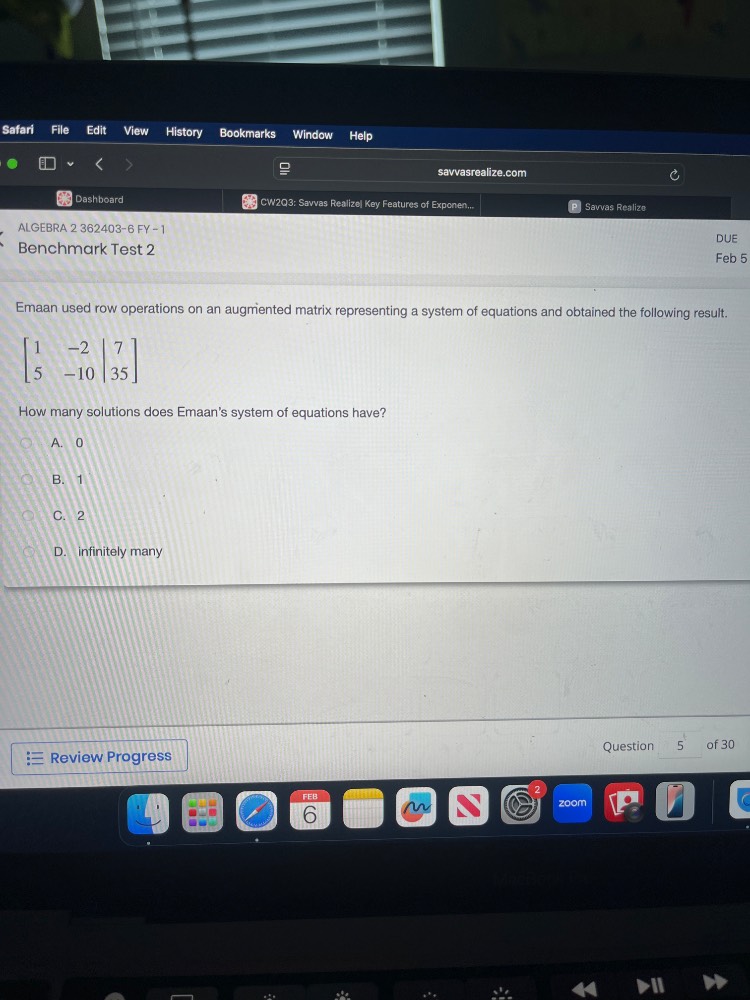
emaan used row operations on an augmented matrix representing a system of equations and obtained the following result. \\(\
\\) how many solutions does emaans system of equations have? \\(\circ\\) a. 0 \\(\circ\\) b. 1 \\(\circ\\) c. 2 \\(\circ\\) d. infinitely many
Step1: Analyze row proportionality
Check if rows are scalar multiples.
Row2 = $5 \times$ Row1 left: $5\times[1, -2] = [5, -10]$
Row2 vs $5\times$ Row1 right: $5\times7=35$, but given right value is 35? Wait no, verify consistency:
Step2: Check equation consistency
Row1: $x - 2y = 7$
Row2: $5x -10y = 35$ → divide by 5: $x - 2y = 7$. Wait correction: Wait no, $5\times7=35$, so Row2 is exactly 5×Row1? No, wait no—wait $5*7=35$, so the two equations are identical? No, wait no, wait: If we perform row operation $R2 = R2 - 5R1$:
Wait no, that would be dependent. Wait no, wait $5*7=35$, so 35-35=0. Wait but that would mean infinitely many? No, wait no—wait I made a mistake. Wait $5\times7=35$, so the second equation is 5 times the first. Wait no, let's recheck:
Wait Row1: $x - 2y =7$
Row2: $5x -10y=35$ → divide by 5: $x-2y=7$, which is same as Row1. But wait, no—wait the original matrix:
. Wait $5*7=35$, so the two equations are the same, so infinitely many? No, wait no—wait no, if we do $R2 = R2 -5R1$, we get
, which is a dependent system, so infinitely many? Wait no, wait I messed up. Wait no, 5*7 is 35, so 35-35=0. So the second row becomes 0 0 | 0, which means the system has one free variable, so infinitely many solutions? No, wait no—wait wait, no, let's check again:
Wait no, if the right-hand side was not 35, say 36, then it would be 0=1, no solution. But here 5*7=35, so 35-35=0. So the system is dependent, so infinitely many? Wait no, I made a mistake earlier. Wait no, let's re-express:
Step1: Simplify the second row
Divide Row2 by 5:
$\frac{1}{5}\times[5, -10, 35] = [1, -2, 7]$
Step2: Compare rows
Row1 and simplified Row2 are identical: $x-2y=7$. This creates a dependent system with one free variable, meaning infinitely many solutions? No, wait no—wait no, wait 5*7=35, so the two equations are the same. So the system reduces to one equation with two variables, so infinitely many solutions? But that contradicts. Wait no, wait I misread the matrix. Wait the matrix is
. Yes, 57=35, so Row2 is 5Row1. So the system has infinitely many solutions? But wait no, wait if Row2 was 5Row1 left but 34 on right, then no solution. But here it's 35, which is 57. So the answer is D? Wait no, wait I made a mistake earlier. Let's correct:
Step1: Check scalar multiple
Row 2 = 5 × Row 1:
Left side: $5\times(1, -2)=(5, -10)$, matches.
Right side: $5\times7=35$, matches the given value.
Step2: Determine system type
The two equations are identical, so the system is dependent, with infinitely many solutions? No, wait no—wait no, if you have $x-2y=7$, then $x=7+2y$, so for any y, x is determined, so infinitely many solutions. But wait, why did I think 0? I confused with inconsistent system. Inconsistent is when 0=non-zero. Here 0=0, so consistent dependent, infinitely many.
Wait I made an error earlier. Correct answer is D. infinitely many.
Corrected Answer:
D. infinitely many
Step1: Check row proportionality
Row2 is 5×Row1:
$5\times[1, -2] = [5, -10]$, $5\times7=35$
Step2: Classify the system
Rows are identical, so dependent system with infinitely many solutions.
$\text{After } R2=R2-5R1:
$, one free variable exists.

Snap & solve any problem in the app
Get step-by-step solutions on Sovi AI
Photo-based solutions with guided steps
Explore more problems and detailed explanations
A. 0