QUESTION IMAGE
Question
the end behavior of a polynomial function is determined by the degree and the sign of the leading coefficient. identify the degree of the polynomial and the sign of the leading coefficient
a) leading coefficient positive
degree - even
b) leading coefficient positive
degree - odd
c) leading coefficient negative
degree - even
d) leading coefficient negative
degree - odd
options: a, c, b, d
Step1: Analyze End Behavior for Degree
For a polynomial, the end behavior (how the graph behaves as \( x \to \pm\infty \)) depends on degree (even/odd) and leading coefficient sign.
- If degree is odd: As \( x \to +\infty \) and \( x \to -\infty \), the ends of the graph go in opposite directions.
- If degree is even: As \( x \to +\infty \) and \( x \to -\infty \), the ends go in the same direction.
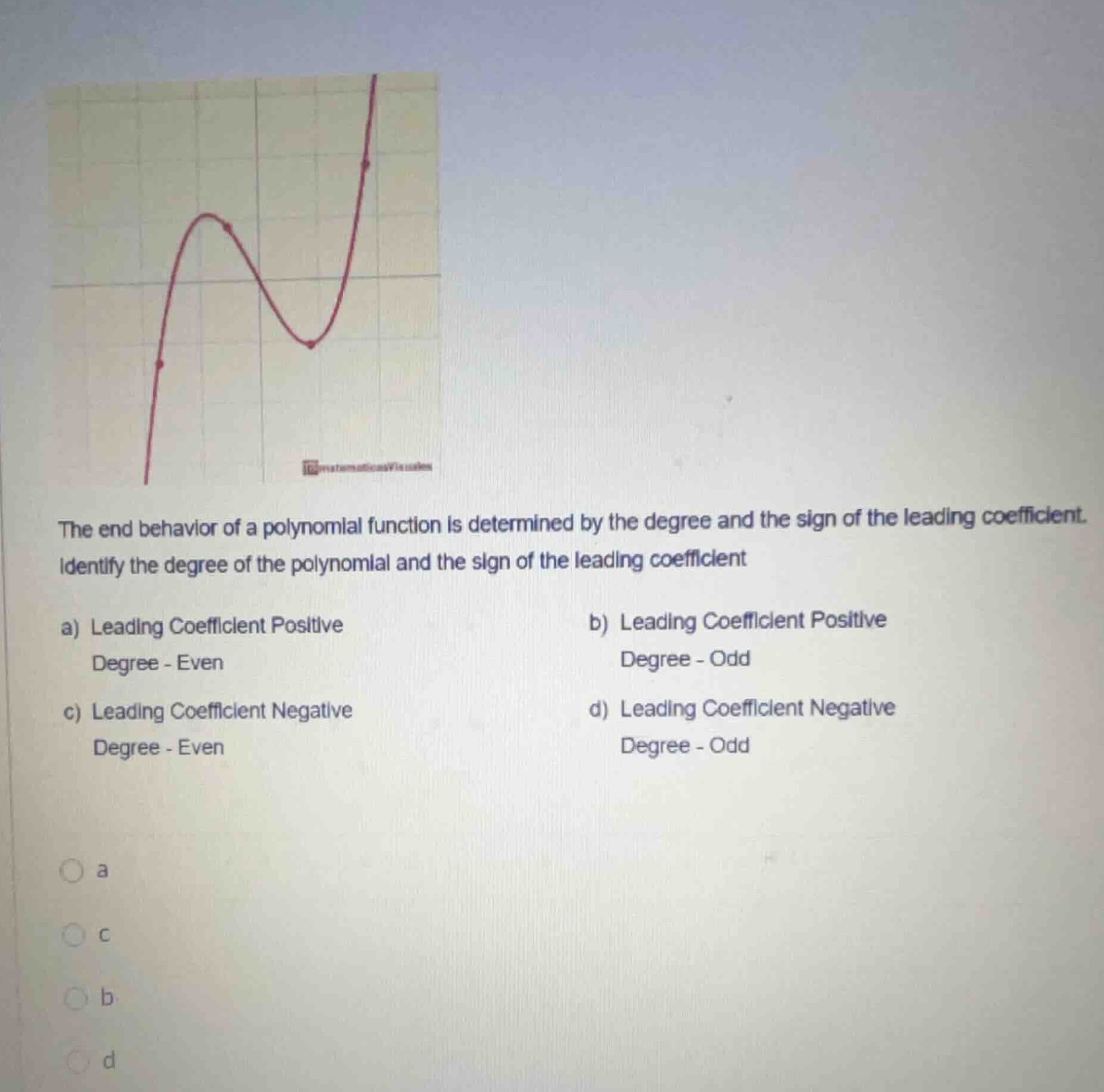
Looking at the graph:
- As \( x \to +\infty \), the graph rises (goes up).
- As \( x \to -\infty \), the graph falls (goes down).
This means the ends go in opposite directions, so the degree is odd.
Step2: Analyze Leading Coefficient Sign
For an odd - degree polynomial:
- If leading coefficient is positive: As \( x \to +\infty \), \( f(x) \to +\infty \) (graph rises); as \( x \to -\infty \), \( f(x) \to -\infty \) (graph falls).
- If leading coefficient is negative: As \( x \to +\infty \), \( f(x) \to -\infty \) (graph falls); as \( x \to -\infty \), \( f(x) \to +\infty \) (graph rises).
From the graph:
- \( x \to +\infty \): rises (so \( f(x) \to +\infty \)).
- \( x \to -\infty \): falls (so \( f(x) \to -\infty \)).
This matches a positive leading coefficient with an odd degree.

Snap & solve any problem in the app
Get step-by-step solutions on Sovi AI
Photo-based solutions with guided steps
Explore more problems and detailed explanations
b) Leading Coefficient Positive
Degree - Odd