QUESTION IMAGE
Question
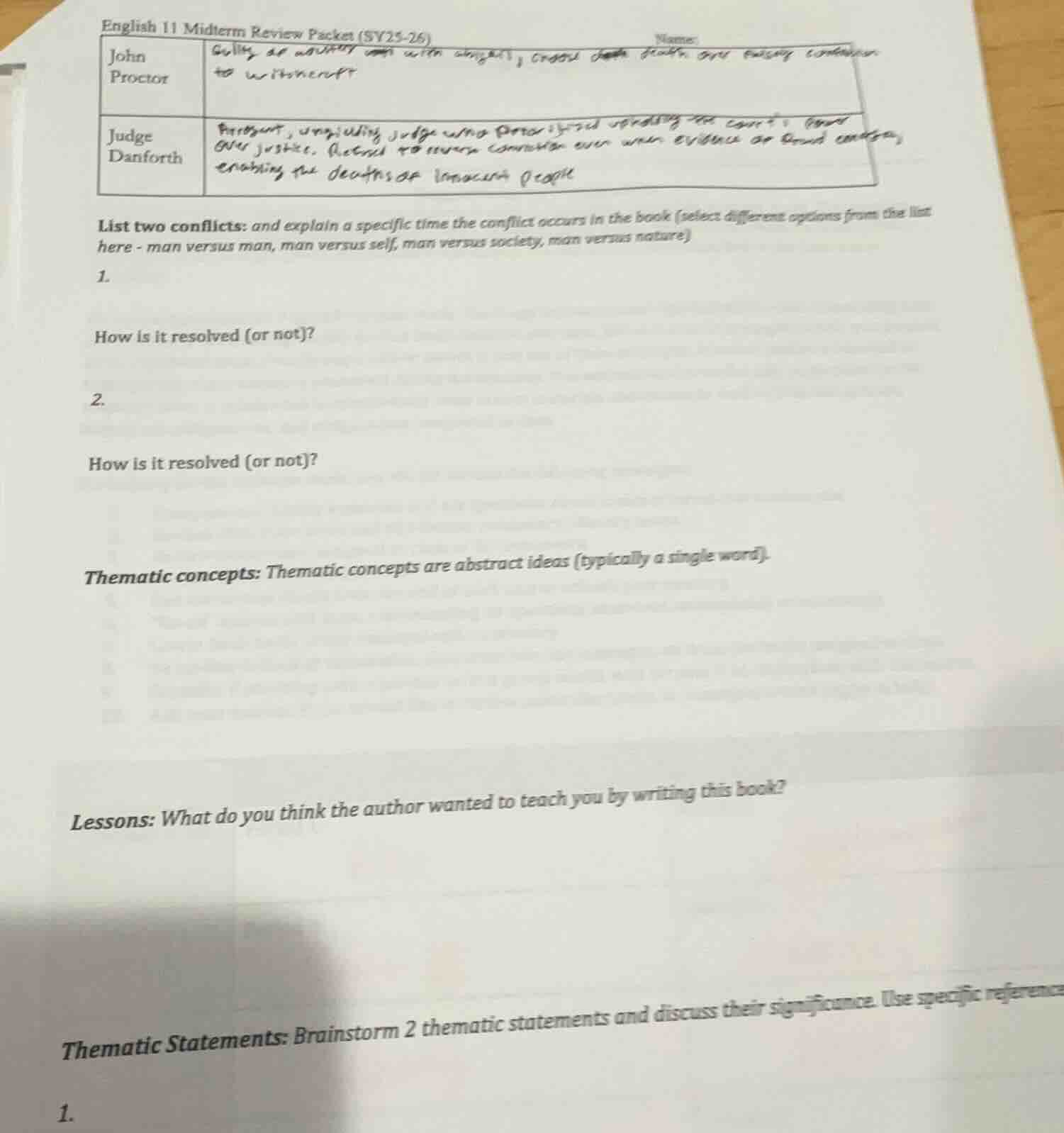
english 11 midterm review packet (sy25-26) name: john proctor judge danforth list two conflicts: and explain a specific time the conflict occurs in the book (select different options from the list here - man versus man, man versus self, man versus society, man versus nature) 1. how is it resolved (or not)? 2. how is it resolved (or not)? thematic concepts: thematic concepts are abstract ideas (typically a single word). lessons: what do you think the author wanted to teach you by writing this book? thematic statements: brainstorm 2 thematic statements and discuss their significance. use specific reference 1.
To solve this, we analyze the context (likely The Crucible) and address each part:
1. Conflicts (Man vs. Self & Man vs. Society)
Conflict 1: Man vs. Self (John Proctor’s Guilt)
- Occurrence: John Proctor struggles with guilt over his affair with Abigail Williams. This conflict is evident when he debates whether to confess his adultery to expose Abigail’s lies (e.g., in Act II, as he grapples with honesty vs. protecting his reputation).
- Resolution: He resolves it by choosing to confess his sin publicly, even though it damages his name, to uphold truth and save others. However, he later tears up his confession to preserve his integrity, so it’s resolved through self-sacrifice (he dies, but his moral integrity is intact).
Conflict 2: Man vs. Society (Proctor vs. Salem’s Hysteria)
- Occurrence: The town of Salem is consumed by witchcraft hysteria, led by the court (Judge Danforth) and Abigail. Proctor opposes this by trying to prove the accusations are false (e.g., bringing Mary Warren to testify in Act III).
- Resolution: It is not fully resolved. The court ignores evidence, and Proctor is executed. However, his resistance exposes the injustice of the society’s blind faith in the court, highlighting the dangers of mass hysteria.
2. Thematic Concepts
Thematic concepts (single-word abstract ideas) in The Crucible include:
- Guilt: Explored through Proctor’s internal struggle.
- Justice: Questioned via the corrupt court system.
- Hysteria: Drives the witch trials and societal chaos.
3. Lessons (Author’s Message)
Arthur Miller (the author) wanted to teach:
- Dangers of Hysteria/Mob Mentality: Salem’s witch trials mirror McCarthyism (Miller’s context) to show how fear and ignorance corrupt society.
- Importance of Integrity: Proctor’s choice to die rather than lie shows that moral integrity is worth defending, even against societal pressure.
4. Thematic Statements
A thematic statement is a sentence explaining a theme. Examples:
- “In The Crucible, guilt can either destroy a person or inspire redemption, as seen in John Proctor’s journey from shame to self-sacrifice.”
- Significance: It highlights how guilt shapes Proctor’s actions, driving the plot and exploring moral growth.
- “Miller uses the Salem witch trials to illustrate that when society prioritizes fear over reason, justice and human dignity are sacrificed.”
- Significance: This connects the play’s historical context (Salem) to universal themes of societal corruption and the need for critical thinking.
Final Answers (Summarized)
- Conflicts:
- Man vs. Self (Proctor’s Guilt): Occurs in Act II/III; Resolved via self-sacrifice (integrity over reputation).
- Man vs. Society (Proctor vs. Hysteria): Occurs in Act III; Unresolved (Proctor dies, but exposes injustice).
- Thematic Concepts: Guilt, Justice, Hysteria.
- Lessons: Defend integrity against hysteria; Question blind faith in authority.
- Thematic Statements: As above, explaining how themes (guilt, societal corruption) drive the story.

Snap & solve any problem in the app
Get step-by-step solutions on Sovi AI
Photo-based solutions with guided steps
Explore more problems and detailed explanations
To solve this, we analyze the context (likely The Crucible) and address each part:
1. Conflicts (Man vs. Self & Man vs. Society)
Conflict 1: Man vs. Self (John Proctor’s Guilt)
- Occurrence: John Proctor struggles with guilt over his affair with Abigail Williams. This conflict is evident when he debates whether to confess his adultery to expose Abigail’s lies (e.g., in Act II, as he grapples with honesty vs. protecting his reputation).
- Resolution: He resolves it by choosing to confess his sin publicly, even though it damages his name, to uphold truth and save others. However, he later tears up his confession to preserve his integrity, so it’s resolved through self-sacrifice (he dies, but his moral integrity is intact).
Conflict 2: Man vs. Society (Proctor vs. Salem’s Hysteria)
- Occurrence: The town of Salem is consumed by witchcraft hysteria, led by the court (Judge Danforth) and Abigail. Proctor opposes this by trying to prove the accusations are false (e.g., bringing Mary Warren to testify in Act III).
- Resolution: It is not fully resolved. The court ignores evidence, and Proctor is executed. However, his resistance exposes the injustice of the society’s blind faith in the court, highlighting the dangers of mass hysteria.
2. Thematic Concepts
Thematic concepts (single-word abstract ideas) in The Crucible include:
- Guilt: Explored through Proctor’s internal struggle.
- Justice: Questioned via the corrupt court system.
- Hysteria: Drives the witch trials and societal chaos.
3. Lessons (Author’s Message)
Arthur Miller (the author) wanted to teach:
- Dangers of Hysteria/Mob Mentality: Salem’s witch trials mirror McCarthyism (Miller’s context) to show how fear and ignorance corrupt society.
- Importance of Integrity: Proctor’s choice to die rather than lie shows that moral integrity is worth defending, even against societal pressure.
4. Thematic Statements
A thematic statement is a sentence explaining a theme. Examples:
- “In The Crucible, guilt can either destroy a person or inspire redemption, as seen in John Proctor’s journey from shame to self-sacrifice.”
- Significance: It highlights how guilt shapes Proctor’s actions, driving the plot and exploring moral growth.
- “Miller uses the Salem witch trials to illustrate that when society prioritizes fear over reason, justice and human dignity are sacrificed.”
- Significance: This connects the play’s historical context (Salem) to universal themes of societal corruption and the need for critical thinking.
Final Answers (Summarized)
- Conflicts:
- Man vs. Self (Proctor’s Guilt): Occurs in Act II/III; Resolved via self-sacrifice (integrity over reputation).
- Man vs. Society (Proctor vs. Hysteria): Occurs in Act III; Unresolved (Proctor dies, but exposes injustice).
- Thematic Concepts: Guilt, Justice, Hysteria.
- Lessons: Defend integrity against hysteria; Question blind faith in authority.
- Thematic Statements: As above, explaining how themes (guilt, societal corruption) drive the story.