QUESTION IMAGE
Question
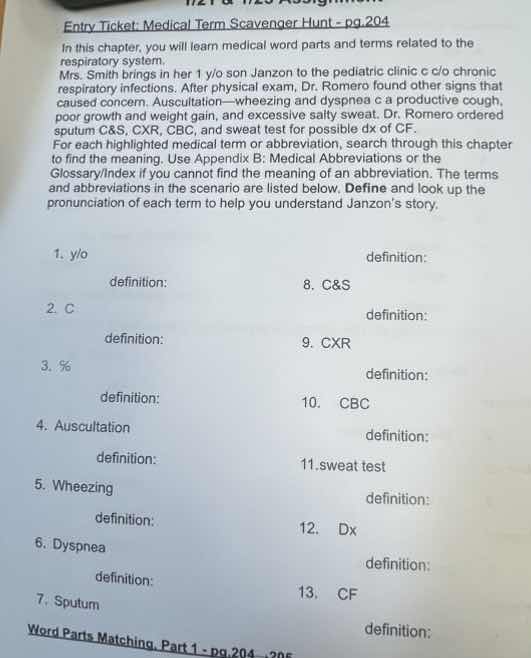
entry ticket: medical term scavenger hunt - pg. 204
in this chapter, you will learn medical word parts and terms related to the
respiratory system.
mrs. smith brings in her 1 y/o son janzon to the pediatric clinic c/o chronic
respiratory concern. after physical exam, dr. romero found other signs that
caused infections. auscultation—wheezing and dyspnea c a productive cough,
poor growth and weight gain, and excessive salty sweat. dr. romero ordered
sputum c&s, cxr, cbc, and sweat test for possible dx of cf.
for each highlighted medical term or abbreviation, search through this chapter
to find the meaning. use appendix b: medical abbreviations or the
glossary/index if you cannot find the meaning of an abbreviation. the terms
and abbreviations in the scenario are listed below. define and look up the
pronunciation of each term to help you understand janzon’s story.
- y/o
definition:
- c
definition:
- %
definition:
- auscultation
definition:
- wheezing
definition:
- dyspnea
definition:
- sputum
definition:
- c&s
definition:
- cxr
definition:
- cbc
definition:
- sweat test
definition:
- dx
definition:
- cf
definition:
word parts matching, part 1 - pg.204 - 205
Each term is defined based on standard medical terminology related to respiratory and clinical procedures:
- y/o: Stands for "years old", a common abbreviation for age.
- c: Stands for "with", used in medical notes to indicate a patient has a condition.
- %: Stands for "percent", often used to denote saturation levels (e.g., oxygen saturation) in clinical settings.
- Auscultation: The act of listening to internal body sounds (like lung/heart sounds) using a stethoscope.
- Wheezing: A high-pitched, whistling breath sound caused by narrowed airways, common in respiratory conditions.
- Dyspnea: Difficult, labored, or painful breathing; shortness of breath.
- Sputum: Mucus or phlegm coughed up from the respiratory tract, often tested for pathogens.
- C&S: Stands for "Culture and Sensitivity", a lab test to identify infection-causing organisms and effective antibiotics.
- CXR: Stands for "Chest X-Ray", an imaging test to view the lungs, heart, and chest cavity.
- CBC: Stands for "Complete Blood Count", a blood test measuring red/white blood cells, platelets, etc., to check for infection/anemia.
- sweat test: A diagnostic test to measure chloride levels in sweat, used primarily to diagnose cystic fibrosis.
- Dx: Stands for "Diagnosis", the identification of a disease or medical condition.
- CF: Stands for "Cystic Fibrosis", a genetic disorder causing thick mucus buildup in the lungs, digestive tract, and other organs.

Snap & solve any problem in the app
Get step-by-step solutions on Sovi AI
Photo-based solutions with guided steps
Explore more problems and detailed explanations
- y/o: years old
- c: with
- %: percent (often for saturation levels)
- Auscultation: Listening to internal body sounds via stethoscope
- Wheezing: High-pitched whistling breath sound from narrowed airways
- Dyspnea: Difficult or labored breathing; shortness of breath
- Sputum: Mucus coughed up from the respiratory tract
- C&S: Culture and Sensitivity (lab test for infections)
- CXR: Chest X-Ray (imaging of chest structures)
- CBC: Complete Blood Count (comprehensive blood test)
- sweat test: Test measuring sweat chloride to diagnose cystic fibrosis
- Dx: Diagnosis (identification of a medical condition)
- CF: Cystic Fibrosis (genetic respiratory/digestive disorder)