QUESTION IMAGE
Question
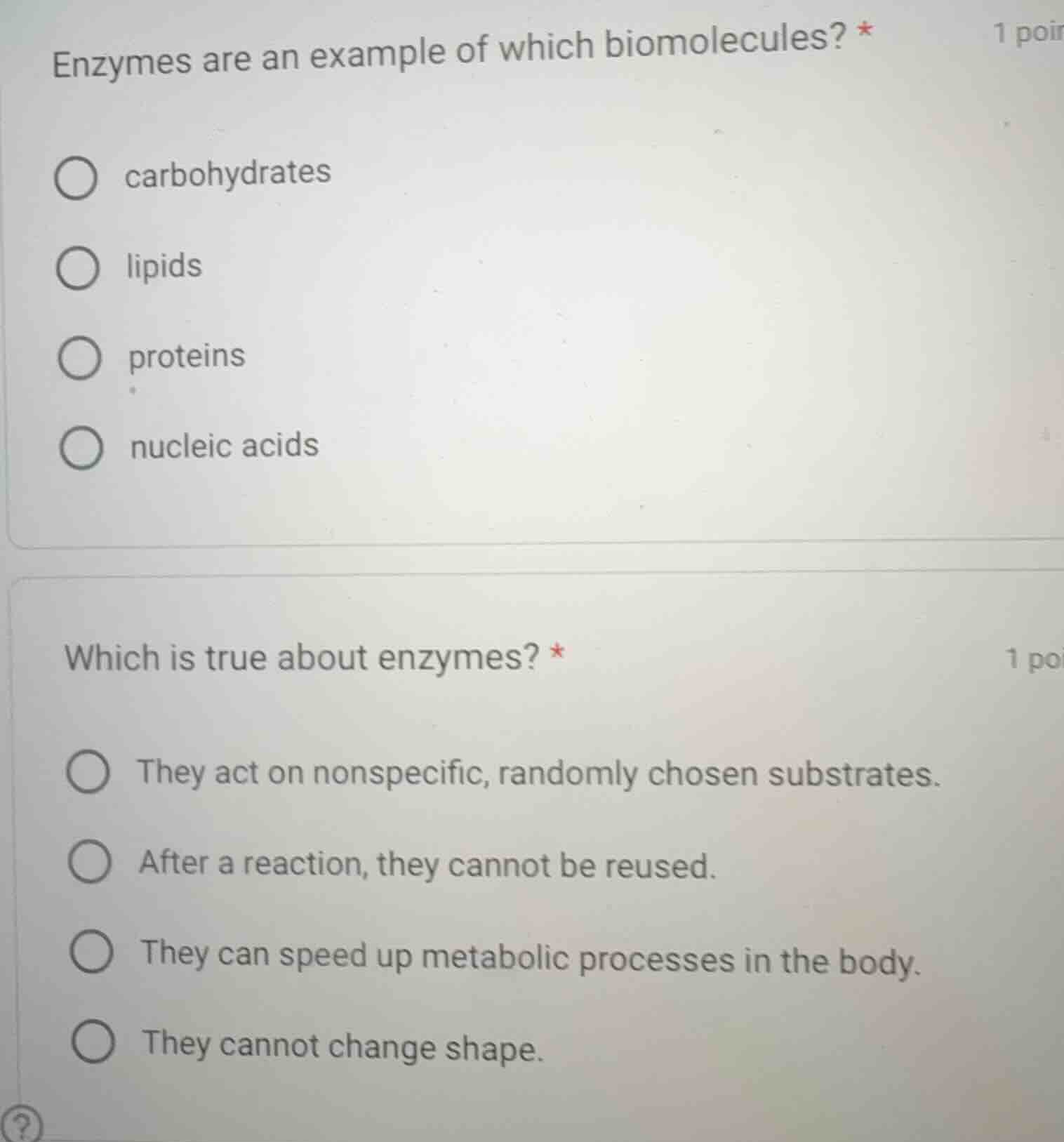
enzymes are an example of which biomolecules? *
○ carbohydrates
○ lipids
○ proteins
○ nucleic acids
which is true about enzymes? *
○ they act on nonspecific, randomly chosen substrates.
○ after a reaction, they cannot be reused.
○ they can speed up metabolic processes in the body.
○ they cannot change shape.
First Question: Enzymes are an example of which biomolecules?
Enzymes are biological catalysts, and most enzymes are proteins (some are RNA, but among the options, proteins is the correct choice as carbohydrates, lipids, and nucleic acids don't primarily function as enzymes in the same way). Carbohydrates are for energy/storage, lipids for energy/storage/structure, nucleic acids for genetic info. So enzymes are proteins.
- Option 1: Enzymes are specific to substrates (lock - and - key or induced - fit model), so they don't act on random substrates. Eliminate.
- Option 2: Enzymes are not consumed in reactions and can be reused. Eliminate.
- Option 3: Enzymes are catalysts, and catalysts speed up chemical reactions (including metabolic processes in the body) by lowering activation energy. This is correct.
- Option 4: Enzymes can change shape (e.g., induced - fit model where the active site changes shape to fit the substrate better). Eliminate.

Snap & solve any problem in the app
Get step-by-step solutions on Sovi AI
Photo-based solutions with guided steps
Explore more problems and detailed explanations
C. proteins