QUESTION IMAGE
Question
eoc prepper: cell division
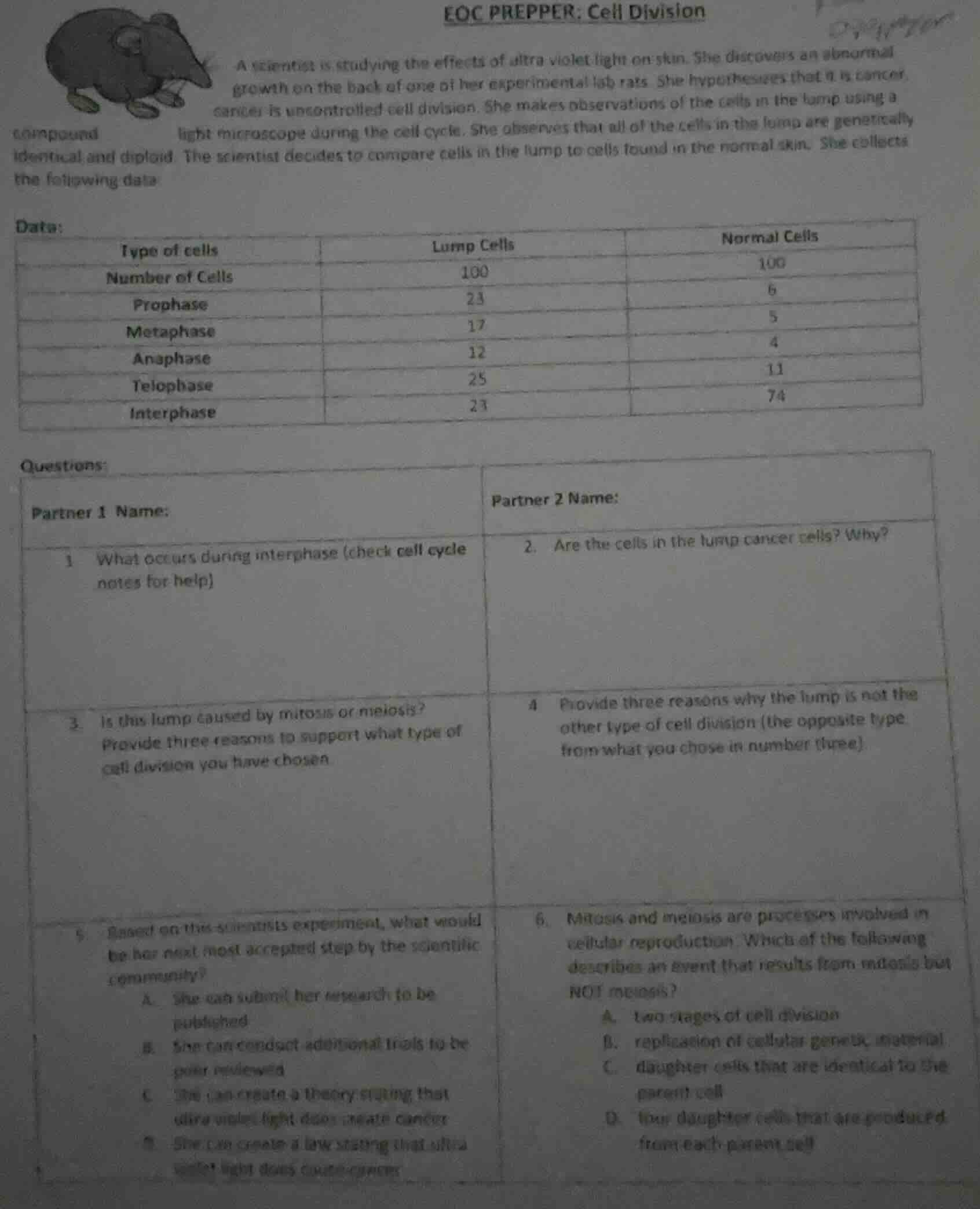
a scientist is studying the effects of ultra violet light on skin. she discovers an abnormal growth on the back of one of her experimental lab rats. she hypothesizes that it is cancer, cancer is uncontrolled cell division. she makes observations of the cells in the lump using a light microscope during the cell cycle. she observes that all of the cells in the lump are genetically identical and diploid. the scientist decides to compare cells in the lump to cells found in the normal skin. she collects the following data
data:
| type of cells | lump cells | normal cells |
|---|---|---|
| prophase | 23 | 6 |
| metaphase | 17 | 5 |
| anaphase | 12 | 4 |
| telophase | 25 | 11 |
| interphase | 23 | 74 |
questions:
partner 1 name: \tpartner 2 name:
1 what occurs during interphase (check cell cycle notes for help) \t2. are the cells in the lump cancer cells? why?
- is this lump caused by mitosis or meiosis? provide three reasons to support what type of cell division you have chosen \t4 provide three reasons why the lump is not the other type of cell division (the opposite type from what you chose in number three)
- based on the scientists experiment, what would be her next most accepted step by the scientific community?
a. she can submit her research to be published
b. she can conduct additional trials to be peer reviewed
c. she can create a theory stating that ultra violet light does create cancer
d. she can create a law stating that ultra violet light does cause cancer \t6. mitosis and meiosis are processes involved in cellular reproduction. which of the following describes an event that results from mitosis but not meiosis?
a. two stages of cell division
b. replication of cellular genetic material
c. daughter cells that are identical to the parent cell
d. four daughter cells that are produced from each parent cell
- Interphase is the cell cycle stage where the cell grows, replicates its DNA, and prepares for mitosis; it includes G1, S, and G2 phases.
- Cancer cells have uncontrolled cell division, meaning less time in interphase (the non-dividing growth/prep stage) and more time actively dividing. The lump cells have far fewer cells in interphase (23 vs. 74 in normal cells) and more cells in mitotic stages, matching cancer cell behavior.
- Mitosis produces genetically identical diploid body cells, which matches the lump cells (genetically identical, diploid, skin/body tissue cells). Reasons: 1) The lump cells are diploid, like mitosis products. 2) All lump cells are genetically identical, a result of mitosis. 3) The lump is a body (somatic) tissue growth, which uses mitosis.
- Meiosis produces haploid, genetically unique gametes (sex cells), not body tissue. Reasons: 1) Meiosis makes haploid cells, but the lump cells are diploid. 2) Meiosis creates genetically diverse cells, while the lump cells are identical. 3) Meiosis occurs only in sex organs, not skin tissue.
- The scientific method requires replicating and verifying results before publication or forming theories/laws; conducting additional trials is the standard next step.
- Mitosis produces 2 genetically identical diploid daughter cells from one parent cell, while meiosis produces 4 genetically unique haploid cells. Replication of genetic material happens in both, meiosis has two division stages, and only meiosis makes 4 daughter cells.

Snap & solve any problem in the app
Get step-by-step solutions on Sovi AI
Photo-based solutions with guided steps
Explore more problems and detailed explanations
- During interphase, the cell grows, replicates its DNA, and carries out normal functions to prepare for cell division (includes G1, S, and G2 phases).
- Yes, the lump cells are cancer cells. Far fewer lump cells are in interphase (the non-dividing, growth stage) and far more are in active mitotic stages, which matches the uncontrolled cell division characteristic of cancer.
- The lump is caused by mitosis.
- Reason 1: The lump cells are diploid, like mitosis products.
- Reason 2: All lump cells are genetically identical, a result of mitosis.
- Reason 3: The lump is a somatic (body) tissue growth, which uses mitosis.
- Reasons the lump is not from meiosis:
- Reason 1: Meiosis produces haploid cells, but the lump cells are diploid.
- Reason 2: Meiosis creates genetically diverse cells, while the lump cells are identical.
- Reason 3: Meiosis only occurs in sex organs, not skin tissue.
- B. She can conduct additional trials to be peer reviewed
- C. daughter cells that are identical to the parent cell