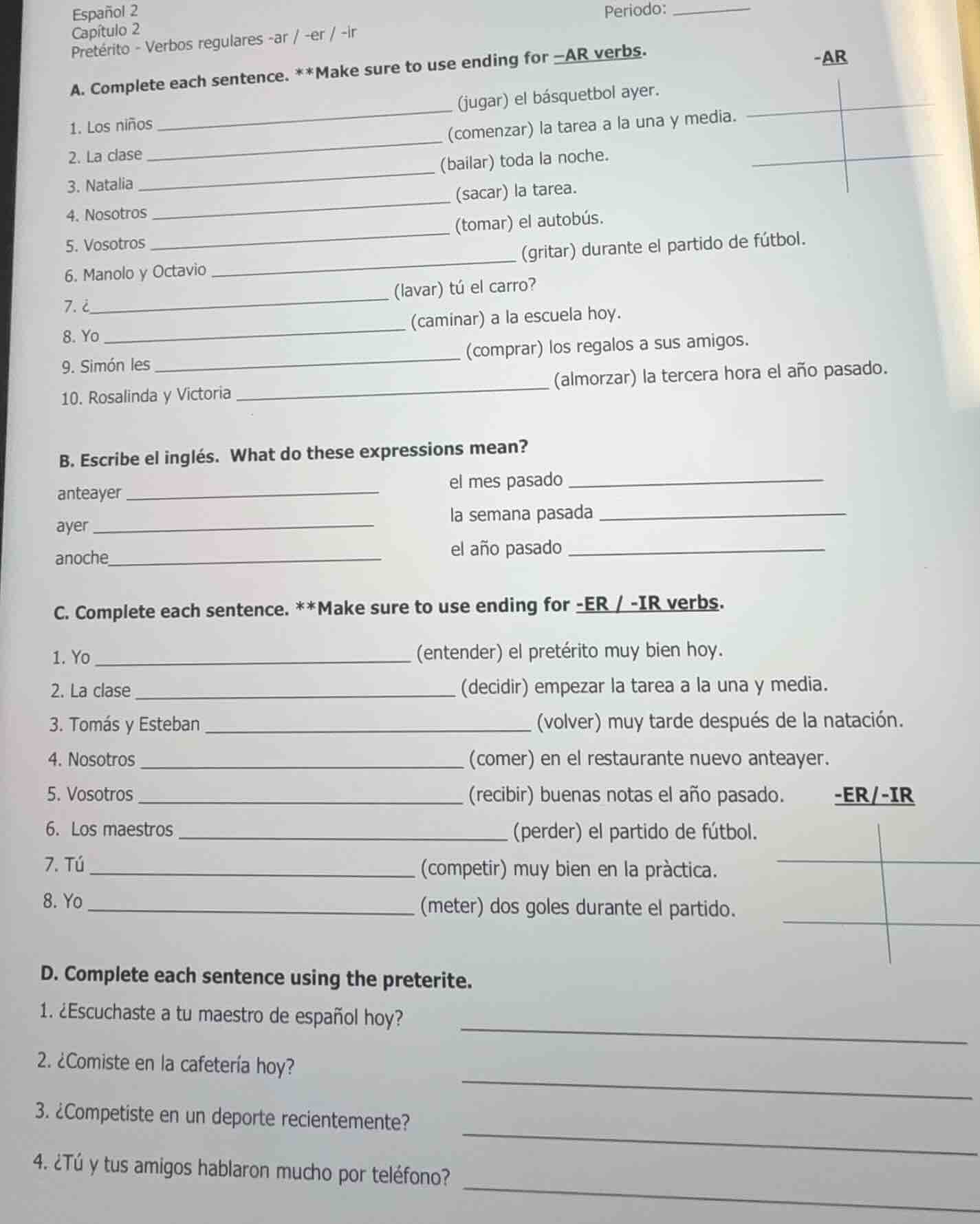
QUESTION IMAGE
Question
español 2
capítulo 2
período: ______
pretérito - verbos regulares -ar / -er / -ir
a. complete each sentence. **make sure to use ending for –ar verbs.
- los niños _______________ (jugar) el básquetbol ayer.
- la clase _______________ (comenzar) la tarea a la una y media.
- natalia _______________ (bailar) toda la noche.
- nosotros _______________ (sacar) la tarea.
- vosotros _______________ (tomar) el autobús.
- manolo y octavio _______________ (gritar) durante el partido de fútbol.
- ¿_______________ (lavar) tú el carro?
- yo _______________ (caminar) a la escuela hoy.
- simón les _______________ (comprar) los regalos a sus amigos.
- rosalinda y victoria _______________ (almorzar) la tercera hora el año pasado.
b. escribe el inglés. what do these expressions mean?
anteayer _____________\tel mes pasado _____________
ayer _____________\tla semana pasada _____________
anoche_____________\tel año pasado _____________
c. complete each sentence. **make sure to use ending for -er / -ir verbs.
- yo _______________ (entender) el pretérito muy bien hoy.
- la clase _______________ (decidir) empezar la tarea a la una y media.
- tomás y esteban _______________ (volver) muy tarde después de la natación.
- nosotros _______________ (comer) en el restaurante nuevo anteayer.
- vosotros _______________ (recibir) buenas notas el año pasado.
- los maestros _______________ (perder) el partido de fútbol.
- tú _______________ (competir) muy bien en la práctica.
- yo _______________ (meter) dos goles durante el partido.
d. complete each sentence using the preterite.
- ¿escuchaste a tu maestro de español hoy?
- ¿comiste en la cafetería hoy?
- ¿competiste en un deporte recientemente?
- ¿tú y tus amigos hablaron mucho por teléfono?
Part A ( -AR verbs in Preterite)
To solve these, we use the preterite endings for -AR verbs: yo: -é, tú: -aste, él/ella/usted: -ó, nosotros: -amos, vosotros: -asteis, ellos/ellas/ustedes: -aron
- Los niños (jugar) el básquetbol ayer.
Step 1: Identify subject and verb. "Los niños" is "ellos" (3rd person plural). For "jugar" (AR verb), preterite ending for "ellos" is -aron. Remove -ar, add -aron.
$jugar
ightarrow jug + aron = jugaron$
- La clase (comenzar) la tarea a la una y media.
Step 1: "La clase" is "ella" (3rd person singular). For "comenzar" (AR verb), preterite ending for "ella" is -ó. Remove -ar, add -ó.
$comenzar
ightarrow comenz + ó = comenzó$
- Natalia (bailar) toda la noche.
Step 1: "Natalia" is "ella" (3rd person singular). For "bailar" (AR verb), preterite ending for "ella" is -ó. Remove -ar, add -ó.
$bailar
ightarrow bail + ó = bailó$
- Nosotros (sacar) la tarea.
Step 1: "Nosotros" (1st person plural). For "sacar" (AR verb), preterite ending for "nosotros" is -amos. Remove -ar, add -amos.
$sacar
ightarrow sac + amos = sacamos$
- Vosotros (tomar) el autobús.
Step 1: "Vosotros" (2nd person plural). For "tomar" (AR verb), preterite ending for "vosotros" is -asteis. Remove -ar, add -asteis.
$tomar
ightarrow tom + asteis = tomasteis$
- Manolo y Octavio (gritar) durante el partido de fútbol.
Step 1: "Manolo y Octavio" is "ellos" (3rd person plural). For "gritar" (AR verb), preterite ending for "ellos" is -aron. Remove -ar, add -aron.
$gritar
ightarrow grit + aron = gritaron$
- ¿(lavar) tú el carro?
Step 1: "tú" (2nd person singular). For "lavar" (AR verb), preterite ending for "tú" is -aste. Remove -ar, add -aste.
$lavar
ightarrow lav + aste = lavaste$
- Yo (caminar) a la escuela hoy.
Step 1: "yo" (1st person singular). For "caminar" (AR verb), preterite ending for "yo" is -é. Remove -ar, add -é.
$caminar
ightarrow camin + é = caminé$
- Simón les (comprar) los regalos a sus amigos.
Step 1: "Simón" is "él" (3rd person singular). For "comprar" (AR verb), preterite ending for "él" is -ó. Remove -ar, add -ó.
$comprar
ightarrow compr + ó = compró$
- Rosalinda y Victoria (almorzar) la tercera hora el año pasado.
*Step 1: "Rosalinda y Victoria" is "ellas" (3rd person plural). For "almorzar" (AR verb, note: "almorzar" has a stem change: "almorz" + aron). Wait, no—"almorzar" is a -AR verb with stem change? Wait, no, preterite for -AR verbs: regular. Wait, "almorzar" is -ar, so remove -ar, add -aron. Wait, "almorzar" → "almorz" + "aron" = "almorzaron"? Wait, no, "almorzar" is a regular -AR verb? Wait, no, "almorzar" is a stem-changing verb in present, but preterite for -AR is regular. Wait, "almorzar" → "almorzar" (AR verb), so "ellas" → -aron. So $almorzar
ightarrow almorz + aron = almorzaron$? Wait, no, "almorzar" is spelled "almorzar", so remove -ar: "almorz", add -aron: "almorzaron". Yes.
Part B (Translate Time Expressions)
- anteayer: The day before yesterday
- el mes pasado: Last month
- ayer: Yesterday
- la semana pasada: Last week
- anoche: Last night
- el año pasado: Last year
Part C ( -ER / -IR verbs in Preterite)
Preterite endings for -ER / -IR verbs: yo: -í, tú: -iste, él/ella/usted: -ió, nosotros: -imos, vosotros: -isteis, ellos/ellas/ustedes: -ieron
- Yo (entender) el pretérito muy bien hoy.
Step 1: "yo" (1st person singular). For "entender" (ER verb), preterite ending for "yo" is -í. Remove -er, add -í.
$entender
ightarrow ente…

Snap & solve any problem in the app
Get step-by-step solutions on Sovi AI
Photo-based solutions with guided steps
Explore more problems and detailed explanations
Part A ( -AR verbs in Preterite)
To solve these, we use the preterite endings for -AR verbs: yo: -é, tú: -aste, él/ella/usted: -ó, nosotros: -amos, vosotros: -asteis, ellos/ellas/ustedes: -aron
- Los niños (jugar) el básquetbol ayer.
Step 1: Identify subject and verb. "Los niños" is "ellos" (3rd person plural). For "jugar" (AR verb), preterite ending for "ellos" is -aron. Remove -ar, add -aron.
$jugar
ightarrow jug + aron = jugaron$
- La clase (comenzar) la tarea a la una y media.
Step 1: "La clase" is "ella" (3rd person singular). For "comenzar" (AR verb), preterite ending for "ella" is -ó. Remove -ar, add -ó.
$comenzar
ightarrow comenz + ó = comenzó$
- Natalia (bailar) toda la noche.
Step 1: "Natalia" is "ella" (3rd person singular). For "bailar" (AR verb), preterite ending for "ella" is -ó. Remove -ar, add -ó.
$bailar
ightarrow bail + ó = bailó$
- Nosotros (sacar) la tarea.
Step 1: "Nosotros" (1st person plural). For "sacar" (AR verb), preterite ending for "nosotros" is -amos. Remove -ar, add -amos.
$sacar
ightarrow sac + amos = sacamos$
- Vosotros (tomar) el autobús.
Step 1: "Vosotros" (2nd person plural). For "tomar" (AR verb), preterite ending for "vosotros" is -asteis. Remove -ar, add -asteis.
$tomar
ightarrow tom + asteis = tomasteis$
- Manolo y Octavio (gritar) durante el partido de fútbol.
Step 1: "Manolo y Octavio" is "ellos" (3rd person plural). For "gritar" (AR verb), preterite ending for "ellos" is -aron. Remove -ar, add -aron.
$gritar
ightarrow grit + aron = gritaron$
- ¿(lavar) tú el carro?
Step 1: "tú" (2nd person singular). For "lavar" (AR verb), preterite ending for "tú" is -aste. Remove -ar, add -aste.
$lavar
ightarrow lav + aste = lavaste$
- Yo (caminar) a la escuela hoy.
Step 1: "yo" (1st person singular). For "caminar" (AR verb), preterite ending for "yo" is -é. Remove -ar, add -é.
$caminar
ightarrow camin + é = caminé$
- Simón les (comprar) los regalos a sus amigos.
Step 1: "Simón" is "él" (3rd person singular). For "comprar" (AR verb), preterite ending for "él" is -ó. Remove -ar, add -ó.
$comprar
ightarrow compr + ó = compró$
- Rosalinda y Victoria (almorzar) la tercera hora el año pasado.
*Step 1: "Rosalinda y Victoria" is "ellas" (3rd person plural). For "almorzar" (AR verb, note: "almorzar" has a stem change: "almorz" + aron). Wait, no—"almorzar" is a -AR verb with stem change? Wait, no, preterite for -AR verbs: regular. Wait, "almorzar" is -ar, so remove -ar, add -aron. Wait, "almorzar" → "almorz" + "aron" = "almorzaron"? Wait, no, "almorzar" is a regular -AR verb? Wait, no, "almorzar" is a stem-changing verb in present, but preterite for -AR is regular. Wait, "almorzar" → "almorzar" (AR verb), so "ellas" → -aron. So $almorzar
ightarrow almorz + aron = almorzaron$? Wait, no, "almorzar" is spelled "almorzar", so remove -ar: "almorz", add -aron: "almorzaron". Yes.
Part B (Translate Time Expressions)
- anteayer: The day before yesterday
- el mes pasado: Last month
- ayer: Yesterday
- la semana pasada: Last week
- anoche: Last night
- el año pasado: Last year
Part C ( -ER / -IR verbs in Preterite)
Preterite endings for -ER / -IR verbs: yo: -í, tú: -iste, él/ella/usted: -ió, nosotros: -imos, vosotros: -isteis, ellos/ellas/ustedes: -ieron
- Yo (entender) el pretérito muy bien hoy.
Step 1: "yo" (1st person singular). For "entender" (ER verb), preterite ending for "yo" is -í. Remove -er, add -í.
$entender
ightarrow entend + í = entendí$
- La clase (decidir) empezar la tarea a la una y media.
Step 1: "La clase" is "ella" (3rd person singular). For "decidir" (IR verb), preterite ending for "ella" is -ió. Remove -ir, add -ió.
$decidir
ightarrow decid + ió = decidió$
- Tomás y Esteban (volver) muy tarde después de la natación.
*Step 1: "Tomás y Esteban" is "ellos" (3rd person plural). For "volver" (ER verb), preterite ending for "ellos" is -ieron. Remove -er, add -ieron. Wait, "volver" is -er, so $volver
ightarrow volv + ieron = volvieron$? Wait, "volver" is a stem-changing verb? Wait, preterite for -ER / -IR: "volver" is -er, so regular? Wait, "volver" in preterite: "yo volví, tú volviste, él volvió, nosotros volvimos, vosotros volvisteis, ellos volvieron". Ah, right! "volver" has a stem change in preterite: "volv" + endings. So "ellos" → "volvieron". So $volver
ightarrow volv + ieron = volvieron$
- Nosotros (comer) en el restaurante nuevo anteayer.
Step 1: "nosotros" (1st person plural). For "comer" (ER verb), preterite ending for "nosotros" is -imos. Remove -er, add -imos.
$comer
ightarrow com + imos = comimos$
- Vosotros (recibir) buenas notas el año pasado.
Step 1: "vosotros" (2nd person plural). For "recibir" (IR verb), preterite ending for "vosotros" is -isteis. Remove -ir, add -isteis.
$recibir
ightarrow recib + isteis = recibisteis$
- Los maestros (perder) el partido de fútbol.
Step 1: "Los maestros" is "ellos" (3rd person plural). For "perder" (ER verb), preterite ending for "ellos" is -ieron. Remove -er, add -ieron. Wait, "perder" → "perd" + "ieron" = "perdieron". Yes.
- Tú (competir) muy bien en la práctica.
Step 1: "tú" (2nd person singular). For "competir" (IR verb), preterite ending for "tú" is -iste. Remove -ir, add -iste.
$competir
ightarrow compet + iste = competiste$
- Yo (meter) dos goles durante el partido.
Step 1: "yo" (1st person singular). For "meter" (ER verb), preterite ending for "yo" is -í. Remove -er, add -í.
$meter
ightarrow met + í = metí$
Part D (Answer Preterite Questions)
These are yes/no questions, so answers are "Sí, yo + preterite" or "No, yo + no + preterite", etc.
- ¿Escuchaste a tu maestro de español hoy?
Example: Sí, yo escuché a mi maestro de español hoy. or No, yo no escuché a mi maestro de español hoy.
- ¿Comiste en la cafetería hoy?
Example: Sí, yo comí en la cafetería hoy. or No, yo no comí en la cafetería hoy.
- ¿Competiste en un deporte recientemente?
Example: Sí, yo competí en un deporte recientemente. or No, yo no competí en un deporte recientemente.
- ¿Tú y tus amigos hablaron mucho por teléfono?
Example: Sí, nosotros hablamos mucho por teléfono. (note: "hablaron" is 3rd person plural, but "tú y tus amigos" is "nosotros" → "hablamos". Wait, "tú y tus amigos" is "vosotros" or "nosotros"? If "tú y tus amigos" is "we" (nosotros), then "hablamos". If "vosotros", "hablasteis". So example: Sí, nosotros hablamos mucho por teléfono. or No, nosotros no hablamos mucho por teléfono.
Final Answers (Key Parts)
Part A (Selected Answers)
- jugaron
- comenzó
- bailó
- sacamos
- tomasteis
- gritaron
- lavaste
- caminé
- compró
- almorzaron
Part B
- anteayer: The day before yesterday
- el mes pasado: Last month
- ayer: Yesterday
- la semana pasada: Last week
- anoche: Last night
- el año pasado: Last year
Part C (Selected Answers)
- entendí
- decidió
- volvieron
- comimos
- recibisteis
- perdieron
- competiste
- metí
Part D (Example Answers)
- Sí, yo escuché a mi maestro de español hoy.
- No, yo no comí en la cafetería hoy.
- Sí, yo competí en un deporte recientemente.
- Sí, nosotros hablamos mucho por teléfono.