QUESTION IMAGE
Question
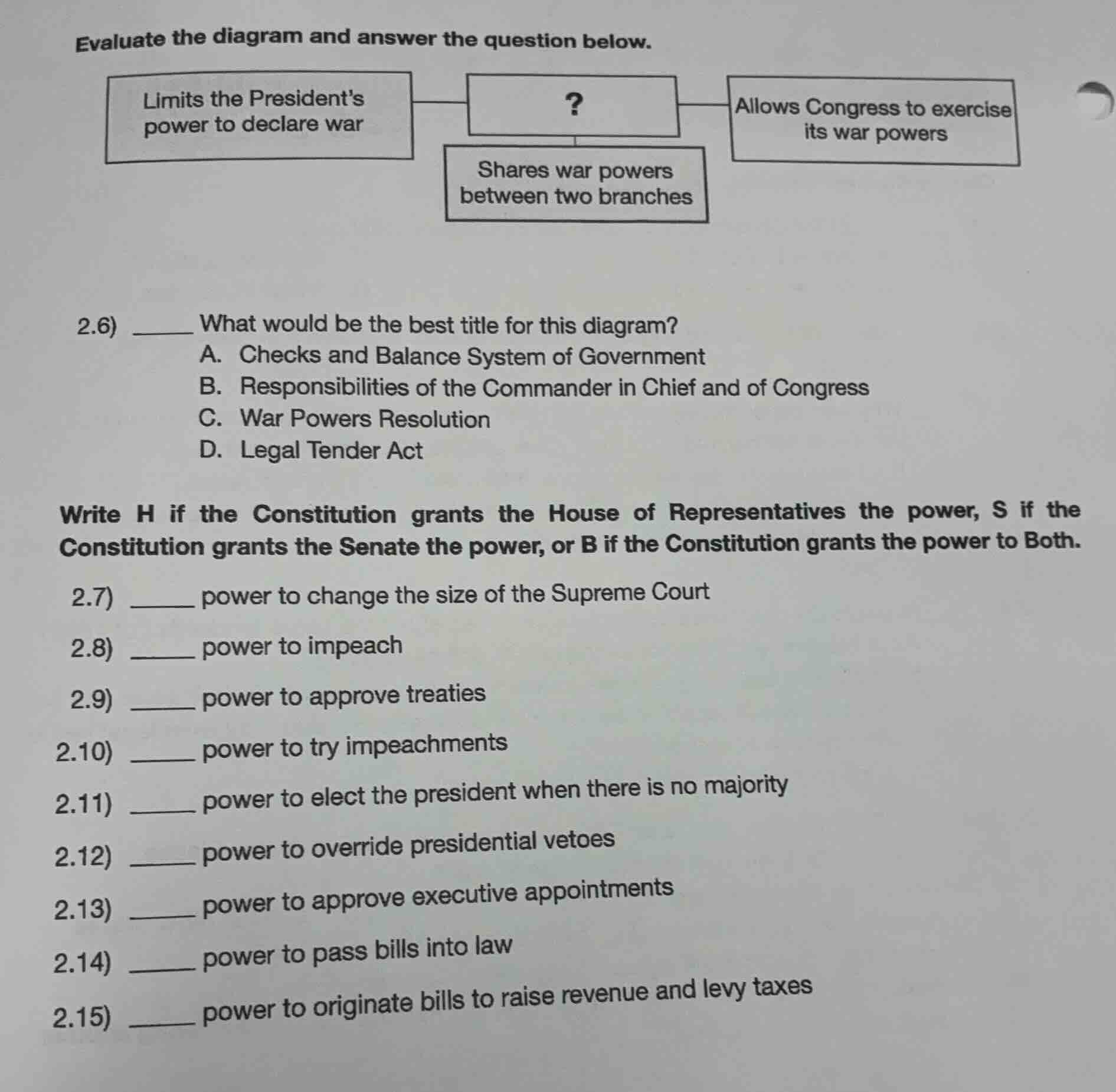
evaluate the diagram and answer the question below.
limits the presidents power to declare war ? allows congress to exercise its war powers
shares war powers between two branches
2.6) ______ what would be the best title for this diagram?
a. checks and balance system of government
b. responsibilities of the commander in chief and of congress
c. war powers resolution
d. legal tender act
write h if the constitution grants the house of representatives the power, s if the constitution grants the senate the power, or b if the constitution grants the power to both.
2.7) ______ power to change the size of the supreme court
2.8) ______ power to impeach
2.9) ______ power to approve treaties
2.10) ______ power to try impeachments
2.11) ______ power to elect the president when there is no majority
2.12) ______ power to override presidential vetoes
2.13) ______ power to approve executive appointments
2.14) ______ power to pass bills into law
2.15) ______ power to originate bills to raise revenue and levy taxes
For 2.6:
The diagram focuses on sharing war powers between the President and Congress, limiting presidential war declaration power and affirming congressional war powers. Option A is too broad (checks and balances cover all branches, not just war powers). Option B misframes it as general responsibilities, not the specific power-sharing mechanism. Option D is unrelated to war powers. The War Powers Resolution specifically governs this split of war authority.
For 2.7-2.15:
These are based on U.S. Constitutional provisions:
- 2.7: Congress (both chambers) controls Supreme Court size.
- 2.8: The House holds the sole power to impeach.
- 2.9: The Senate alone approves treaties.
- 2.10: The Senate has the sole power to try impeachments.
- 2.11: The House elects the president, Senate elects the vice president, when no electoral college majority exists; for the president specifically, it is the House.
- 2.12: Both chambers must vote to override a veto.
- 2.13: The Senate alone approves executive appointments.
- 2.14: Both chambers pass bills to make law.
- 2.15: The House alone originates revenue-raising bills.

Snap & solve any problem in the app
Get step-by-step solutions on Sovi AI
Photo-based solutions with guided steps
Explore more problems and detailed explanations
2.6) C. War Powers Resolution
2.7) B
2.8) H
2.9) S
2.10) S
2.11) H
2.12) B
2.13) S
2.14) B
2.15) H