QUESTION IMAGE
Question
evidence of plate tectonics
date
page 2
keep going! answer the questions below.
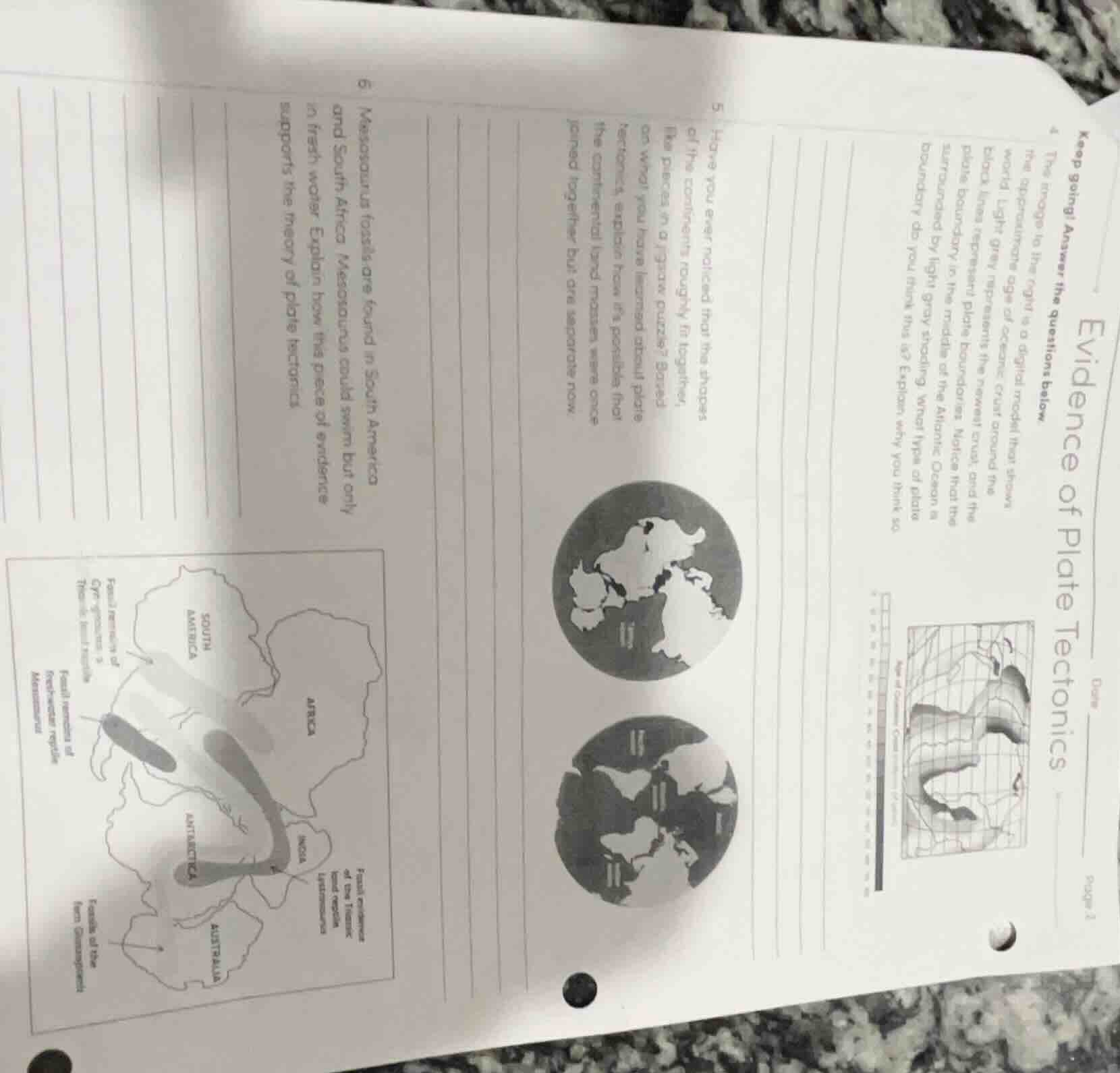
4 the image to the right is a digital model that shows the approximate age of oceanic crust around the world. light gray represents the newest crust, and the black lines represent plate boundaries. notice that the plate boundary in the middle of the atlantic ocean is surrounded by light gray shading. what type of plate boundary do you think this is? explain why you think so.
5 have you ever noticed that the shapes of the continents roughly fit together, like pieces in a jigsaw puzzle? based on what you have learned about plate tectonics, explain how its possible that the continental land masses were once joined together but are separate now.
6 mesosaurus fossils are found in south america and south africa. mesosaurus could swim but only in fresh water. explain how this piece of evidence supports the theory of plate tectonics
For Question 4:
The light gray area marks the youngest oceanic crust, which forms at divergent plate boundaries where tectonic plates pull apart. Magma rises to fill the gap, creating new crust. The Atlantic Ocean's central boundary with this young crust fits this pattern.
For Question 5:
The continents fit together like a puzzle because they were once part of a single supercontinent (Pangaea). Over millions of years, tectonic plates carrying the continents moved apart via seafloor spreading and plate motion, separating the original landmass.
For Question 6:
Mesosaurus was a freshwater reptile, so it could not swim across the saltwater Atlantic Ocean. The presence of its fossils in both South America and South Africa means these two continents were once connected as part of a larger landmass, allowing the reptile to live in a continuous freshwater habitat before the plates drifted apart.

Snap & solve any problem in the app
Get step-by-step solutions on Sovi AI
Photo-based solutions with guided steps
Explore more problems and detailed explanations
- This is a divergent plate boundary. The light gray shading shows the youngest oceanic crust, which forms where plates move apart, and magma rises to create new crust—this matches the process at the Mid-Atlantic Ridge.
- The continents were once joined in a supercontinent (e.g., Pangaea). Tectonic plates carrying the continents slowly moved apart over millions of years, separating the original connected landmass into the continents we see today.
- Since Mesosaurus could only live in freshwater, it could not cross the saltwater ocean between South America and South Africa. The shared fossils prove the two continents were once connected as a single landmass, supporting plate tectonics.