QUESTION IMAGE
Question
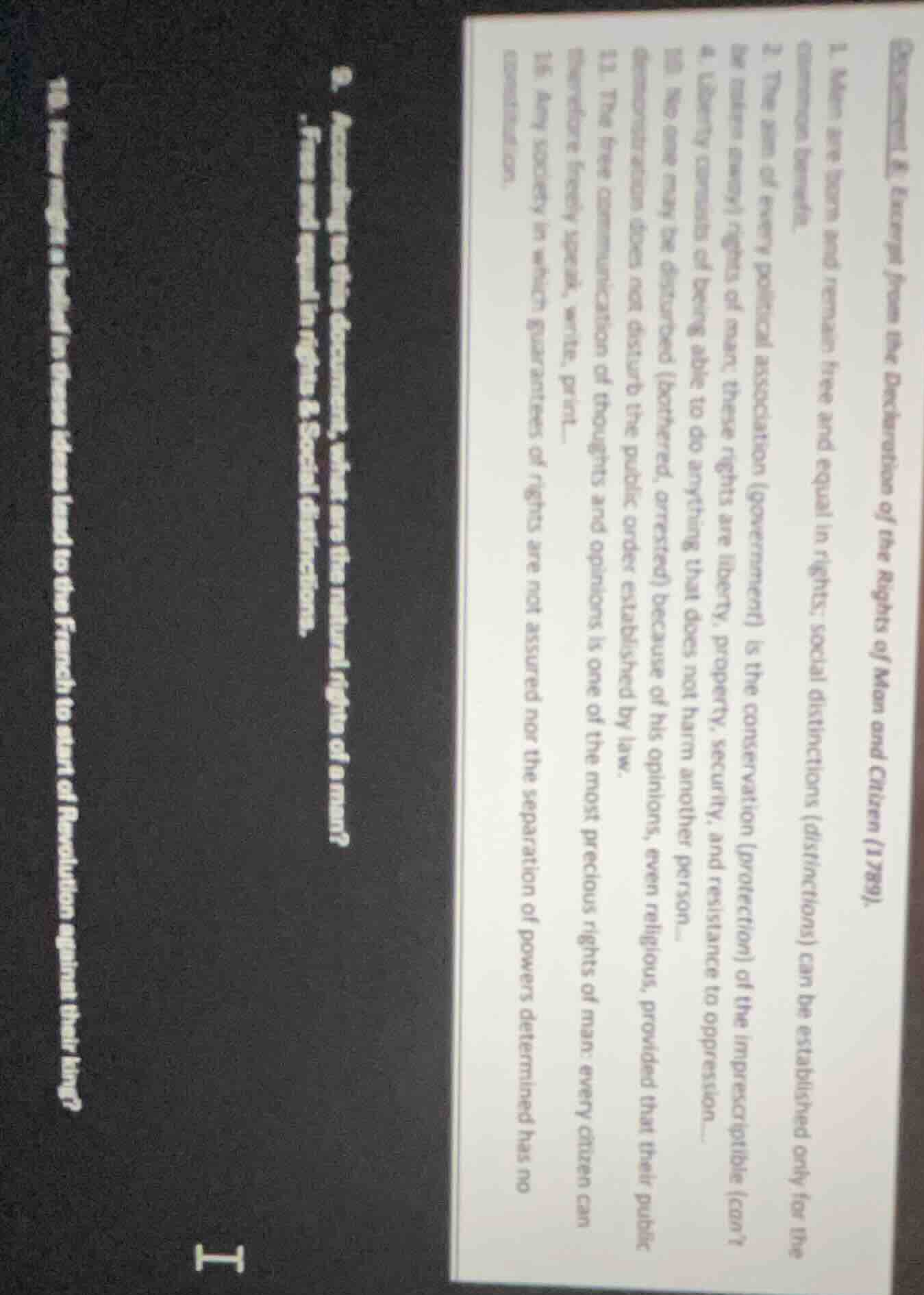
excerpt from the declaration of the rights of man and citizen (1789). 1. men are born and remain free and equal in rights; social distinctions (distinctions) can be established only for the common benefits. 2. the aim of every political association (government) is the conservation (protection) of the imprescriptible (can’t be taken away) rights of man; these rights are liberty, property, security, and resistance to oppression. 3. liberty consists of being able to do anything that does not harm another person... no one may be disturbed (bothered, arrested) because of his opinions, even religious, provided that their public demonstrations do not disturb the public order established by law. 11. the free communication of thoughts and opinions is one of the most precious rights of man; every citizen can therefore freely speak, write, print... 16. any society in which guarantees of rights are not assured nor the separation of powers determined has no constitution. 9. according to this document, what are the natural rights of a man? . fame and wealth in rights & social distinctions. 10. how might a badful in these ideas lead to the french to start of revolution against their king?
Question 9:
To determine the natural rights of a man from the document, we analyze the provided articles:
- Article 2: Lists natural rights as "liberty, property, security, and resistance to oppression".
- Article 4: Defines liberty as the right to act without harming others.
- Article 11: Affirms the free communication of thoughts and opinions (speech, writing, print) as a precious right.
- Article 16: Notes that rights are not assured in societies without separation of powers or guaranteed rights.
These articles collectively outline the natural rights, emphasizing individual freedoms (liberty, expression) and protections (property, security) that exist inherently, with social distinctions only for common benefit.
The ideas in the Declaration of the Rights of Man and Citizen (1789) emphasized natural rights (liberty, equality, property, free expression) and limited government (separation of powers, rule of law). These challenged the French monarchy’s absolute power, feudal privileges, and social inequality (First and Second Estates’ dominance over the Third Estate).
- Enlightenment Influence: Ideas of Rousseau (social contract), Locke (natural rights), and Montesquieu (separation of powers) resonated with the Third Estate (commoners), who faced economic hardship and political disenfranchisement.
- Social Inequality: The document’s call for equality and abolition of unjust social distinctions (based on birth) mobilized the Third Estate against the aristocracy and clergy.
- Political Legitimacy: The declaration’s assertion that government exists to protect rights undermined the monarchy’s "divine right" to rule, justifying revolution.
By 1789, widespread discontent (food shortages, tax burdens) combined with these ideological triggers led the French to revolt against King Louis XVI, seeking to establish a society based on the declaration’s principles.

Snap & solve any problem in the app
Get step-by-step solutions on Sovi AI
Photo-based solutions with guided steps
Explore more problems and detailed explanations
According to the document, the natural rights of a man include liberty, property, security, resistance to oppression, and the free communication of thoughts and opinions (via speech, writing, print). Social distinctions are permitted only if they serve the common good.