QUESTION IMAGE
Question
excerpt from nature
by ralph waldo emerson
chapter i - nature
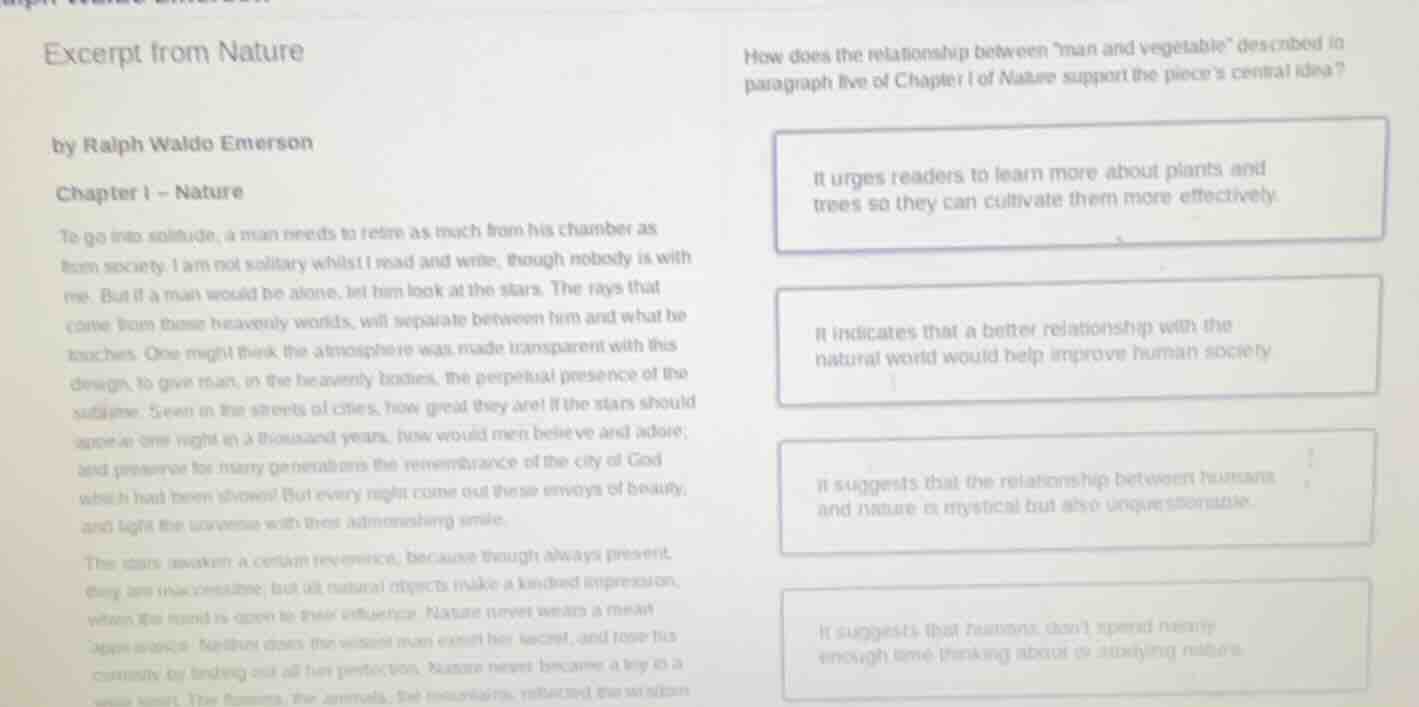
to go into solitude, a man needs to retire as much from his chamber as from society. i am not solitary whilst i read and write, though nobody is with me. but if a man would be alone, let him look at the stars. the rays that
come from those heavenly worlds, will separate between him and what he touches. one might think the atmosphere was made transparent with this
design, to give man, in the heavenly bodies, the perpetual presence of the sublime. seen in the streets of cities, how great they are! if the stars should appear one night in a thousand years, how would men believe and adore;
and preserve for many generations the remembrance of the city of god
which had been shown! but every night come out these envoys of beauty,
and light the universe with their admonishing smile.
the stars awaken a certain reverence, because though always present,
they are inaccessible; but all natural objects make a kindred impression,
when the mind is open to their influence. nature never wears a mean
appearance. neither does the wisest man extort her secret, and lose his
curiosity by finding out all her perfection. nature never became a toy to a
wise spirit. the flowers, the animals, the mountains, reflected the wisdom
how does the relationship between \man and vegetable\ described in
paragraph five of chapter i of nature support the pieces central idea?
it urges readers to learn more about plants and
trees so they can cultivate them more effectively.
it indicates that a better relationship with the
natural world would help improve human society
it suggests that the relationship between humans
and nature is mystical but also unimportant.
it suggests that humans dont spend nearly
enough time thinking about or studying nature.
Ralph Waldo Emerson's Nature centers on the mystical, interconnected bond between humans and the natural world, arguing that nature reveals universal truths and spiritual meaning to open-minded people. The "man and vegetable" passage emphasizes that humans and nature share a fundamental, almost mystical origin and connection, while also noting that humans can recognize and engage with this unique, unbreakable relationship to gain spiritual insight.
- The first option is incorrect: Emerson's focus is not on practical cultivation of plants.
- The second option is incorrect: The passage does not tie the relationship to improving human society; it focuses on individual spiritual connection.
- The fourth option is incorrect: The text does not critique humans for not studying nature enough, but rather highlights the inherent, mystical link.
- The third option aligns with Emerson's central idea: the relationship is mystical (rooted in shared universal essence) and unbreakable (a fundamental, inherent connection).

Snap & solve any problem in the app
Get step-by-step solutions on Sovi AI
Photo-based solutions with guided steps
Explore more problems and detailed explanations
It suggests that the relationship between humans and nature is mystical but also unbreakable.