QUESTION IMAGE
Question
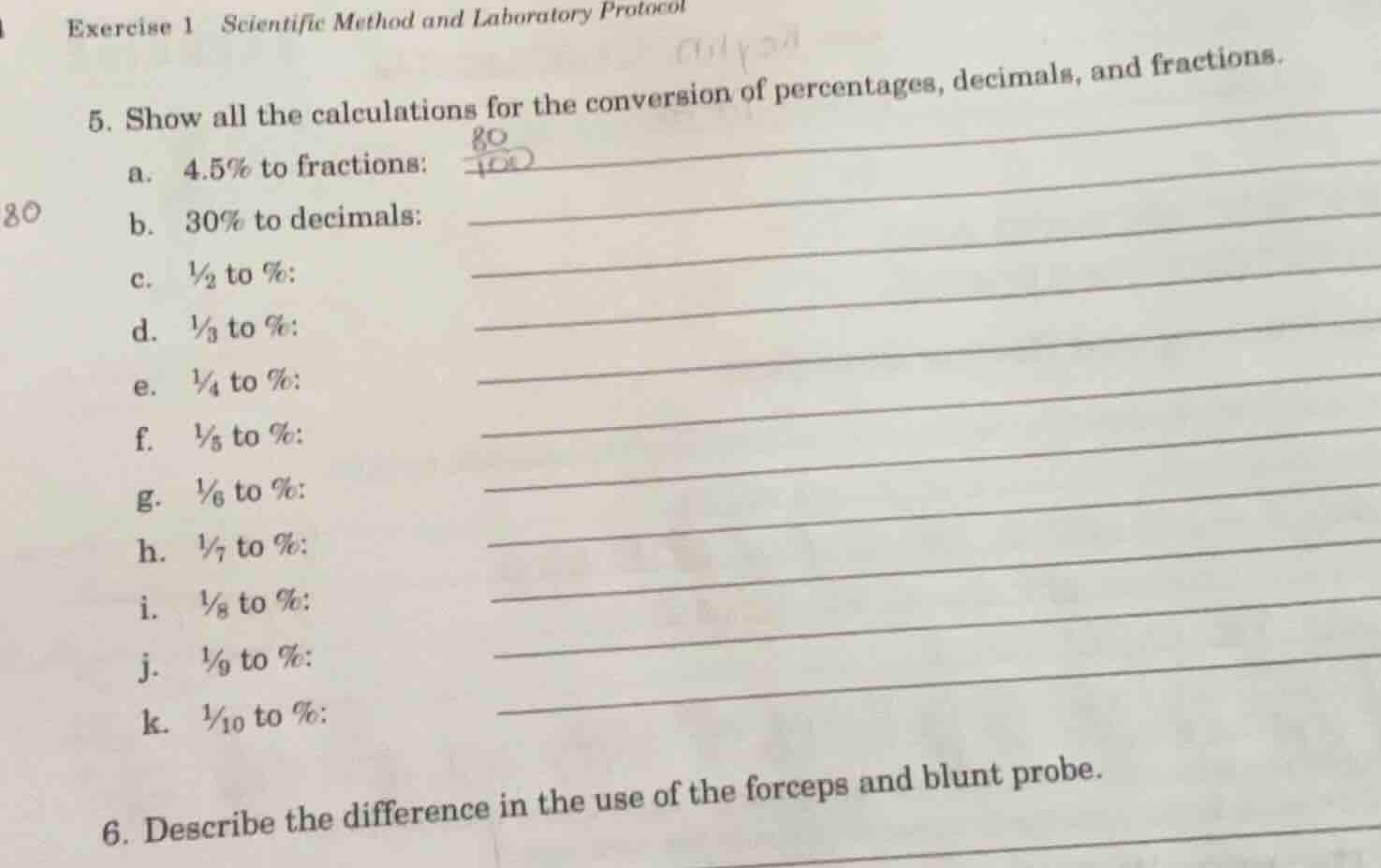
exercise 1 scientific method and laboratory protocol
- show all the calculations for the conversion of percentages, decimals, and fractions.
a. 4.5% to fractions:
b. 30% to decimals:
c. ½ to %:
d. ⅓ to %:
e. ¼ to %:
f. ⅕ to %:
g. ⅙ to %:
h. ⅐ to %:
i. ⅛ to %:
j. ⅑ to %:
k. ⅒ to %:
- describe the difference in the use of the forceps and blunt probe.
Step1: Convert 4.5% to fraction
First, rewrite percentage as fraction over 100:
$4.5\% = \frac{4.5}{100}$
Eliminate decimal by multiplying numerator and denominator by 10:
$\frac{4.5 \times 10}{100 \times 10} = \frac{45}{1000}$
Simplify by dividing by GCD 5:
$\frac{45 \div 5}{1000 \div 5} = \frac{9}{200}$
Step2: Convert 30% to decimal
Divide percentage value by 100:
$30\% = \frac{30}{100} = 0.3$
Step3: Convert $\frac{1}{2}$ to percentage
Multiply fraction by 100%:
$\frac{1}{2} \times 100\% = 50\%$
Step4: Convert $\frac{1}{3}$ to percentage
Multiply fraction by 100%:
$\frac{1}{3} \times 100\% \approx 33.33\%$
Step5: Convert $\frac{1}{4}$ to percentage
Multiply fraction by 100%:
$\frac{1}{4} \times 100\% = 25\%$
Step6: Convert $\frac{1}{5}$ to percentage
Multiply fraction by 100%:
$\frac{1}{5} \times 100\% = 20\%$
Step7: Convert $\frac{1}{6}$ to percentage
Multiply fraction by 100%:
$\frac{1}{6} \times 100\% \approx 16.67\%$
Step8: Convert $\frac{1}{7}$ to percentage
Multiply fraction by 100%:
$\frac{1}{7} \times 100\% \approx 14.29\%$
Step9: Convert $\frac{1}{8}$ to percentage
Multiply fraction by 100%:
$\frac{1}{8} \times 100\% = 12.5\%$
Step10: Convert $\frac{1}{9}$ to percentage
Multiply fraction by 100%:
$\frac{1}{9} \times 100\% \approx 11.11\%$
Step11: Convert $\frac{1}{10}$ to percentage
Multiply fraction by 100%:
$\frac{1}{10} \times 100\% = 10\%$
Step12: Differentiate forceps and blunt probe
Forceps are for grasping, holding, or manipulating small, delicate objects/tissues (e.g., picking up a specimen, holding a structure steady during dissection). A blunt probe is for gentle exploration, retracting tissues, feeling for underlying structures, or separating soft tissues without piercing or damaging them, as it has a rounded tip.

Snap & solve any problem in the app
Get step-by-step solutions on Sovi AI
Photo-based solutions with guided steps
Explore more problems and detailed explanations
a. $\frac{9}{200}$
b. $0.3$
c. $50\%$
d. $\approx 33.33\%$
e. $25\%$
f. $20\%$
g. $\approx 16.67\%$
h. $\approx 14.29\%$
i. $12.5\%$
j. $\approx 11.11\%$
k. $10\%$
- Forceps are used for grasping, holding, or manipulating small/delicate specimens or tissues, while a blunt probe is used for gentle exploration, retracting tissues, or feeling for underlying structures without piercing or damaging soft tissue.