QUESTION IMAGE
Question
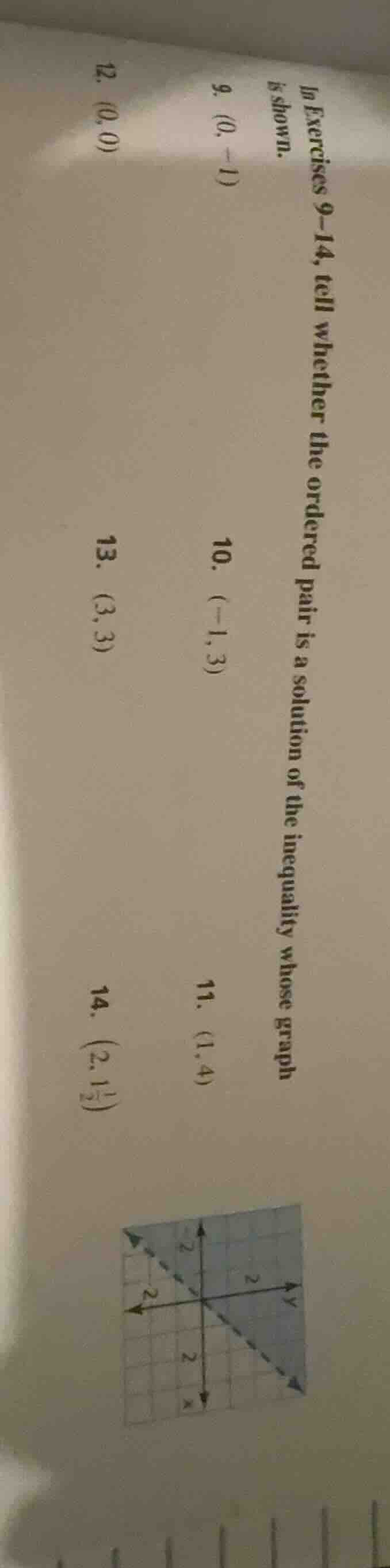
in exercises 9–14, tell whether the ordered pair is a solution of the inequality whose graph is shown.
- (0, -1)
- (-1, 3)
- (1, 4)
- (0, 0)
- (3, 3)
- (2, 1\frac{1}{2})
To solve these problems, we first need to determine the inequality represented by the graph. From the graph, we can see that the line passes through the origin \((0,0)\) and has a slope of \(1\) (since it goes through \((1,1)\) as well, if we assume the slope is \(1\) for simplicity, but looking at the dashed line and the shaded region, let's analyze the inequality.
The general form of a linear inequality is \(y < mx + b\) or \(y > mx + b\), etc. From the graph, the line is dashed (so the inequality is strict, either \(<\) or \(>\)) and the shaded region is above the line? Wait, no, looking at the graph, the shaded region seems to be where \(y > -x\) or \(y < -x\)? Wait, let's re-examine. The line passes through \((0,0)\) and has a slope of \(-1\) (since it goes from \((0,0)\) to \((1, -1)\) or \((-1, 1)\)). Wait, the line in the graph: let's see the coordinates. The line is dashed, and the shaded region is, for example, if we take a test point, say \((0,1)\): is \((0,1)\) in the shaded region? Let's assume the inequality is \(y > -x\) (since the line is \(y = -x\), dashed, and shaded above? Wait, no, let's check the ordered pairs.
Wait, maybe the inequality is \(y > -x\) (dashed line \(y = -x\), shaded above the line). Let's verify with the ordered pairs.
Problem 9: \((0, -1)\)
We check if \(-1 > -0\) (since \(x = 0\), \(y = -1\)). So \(-1 > 0\)? No, that's false. So \((0, -1)\) is not a solution.
Problem 10: \((-1, 3)\)
Check if \(3 > -(-1)\) (since \(x = -1\), \(y = 3\)). So \(3 > 1\)? Yes, that's true. So \((-1, 3)\) is a solution.
Problem 11: \((1, 4)\)
Check if \(4 > -1\) (since \(x = 1\), \(y = 4\)). So \(4 > -1\)? Yes, that's true. So \((1, 4)\) is a solution.
Problem 12: \((0, 0)\)
Check if \(0 > -0\) (since \(x = 0\), \(y = 0\)). So \(0 > 0\)? No, that's false (since the line is dashed, the inequality is strict, so \(y > -x\) or \(y < -x\)). Wait, maybe the inequality is \(y < -x\)? Let's check \((0,0)\): \(0 < -0\) is \(0 < 0\), which is also false. Wait, maybe the line is \(y = -x\) and the shaded region is where \(y > -x\) (dashed line, so not including the line). Let's re-examine the ordered pairs.
Wait, maybe the inequality is \(y > -x\) (dashed line \(y = -x\), shaded above). Let's check \((0,1)\): \(1 > 0\), which is true, so \((0,1)\) would be in the shaded region. Now let's check the given ordered pairs:
Problem 9: \((0, -1)\)
\(y = -1\), \(x = 0\). Is \(-1 > -0\)? \(-1 > 0\)? No. So not a solution.
Problem 10: \((-1, 3)\)
\(y = 3\), \(x = -1\). Is \(3 > -(-1)\)? \(3 > 1\)? Yes. So solution.
Problem 11: \((1, 4)\)
\(y = 4\), \(x = 1\). Is \(4 > -1\)? Yes. So solution.
Problem 12: \((0, 0)\)
\(y = 0\), \(x = 0\). Is \(0 > -0\)? \(0 > 0\)? No. So not a solution.
Problem 13: \((3, 3)\)
\(y = 3\), \(x = 3\). Is \(3 > -3\)? Yes. So solution.
Problem 14: \((2, \frac{1}{2})\)
\(y = \frac{1}{2}\), \(x = 2\). Is \(\frac{1}{2} > -2\)? Yes, because \(\frac{1}{2}\) is positive and \(-2\) is negative. So solution.
Wait, but maybe the inequality is \(y < -x\). Let's check:
For \((-1, 3)\): \(3 < -(-1)\) => \(3 < 1\)? No. So that's not. So the inequality must be \(y > -x\) (dashed line, shaded above the line \(y = -x\)).
Now let's summarize each problem:
9. \((0, -1)\)
Check \(y > -x\): \(-1 > -0\) => \(-1 > 0\)? No. So not a solution.
10. \((-1, 3)\)
Check \(y > -x\): \(3 > -(-1)\) => \(3 > 1\)? Yes. So solution.
11. \((1, 4)\)
Check \(y > -x\): \(4 > -1\)? Yes. So solution.
12. \((0, 0)\)
Check \(y > -x\): \(0 > -0\) => \(0 > 0\)? No. So not a solution.…
Step1: Identify the inequality
The line is \(y = -x\) (dashed), so the inequality is \(y > -x\) (shaded above the line).
Step2: Substitute the ordered pair
Substitute \(x = 0\) and \(y = -1\) into \(y > -x\): \(-1 > -0\) → \(-1 > 0\), which is false.
Step1: Identify the inequality
The inequality is \(y > -x\) (dashed line \(y = -x\), shaded above).
Step2: Substitute the ordered pair
Substitute \(x = -1\) and \(y = 3\) into \(y > -x\): \(3 > -(-1)\) → \(3 > 1\), which is true.
Step1: Identify the inequality
The inequality is \(y > -x\) (dashed line \(y = -x\), shaded above).
Step2: Substitute the ordered pair
Substitute \(x = 1\) and \(y = 4\) into \(y > -x\): \(4 > -1\), which is true.

Snap & solve any problem in the app
Get step-by-step solutions on Sovi AI
Photo-based solutions with guided steps
Explore more problems and detailed explanations
Not a solution