QUESTION IMAGE
Question
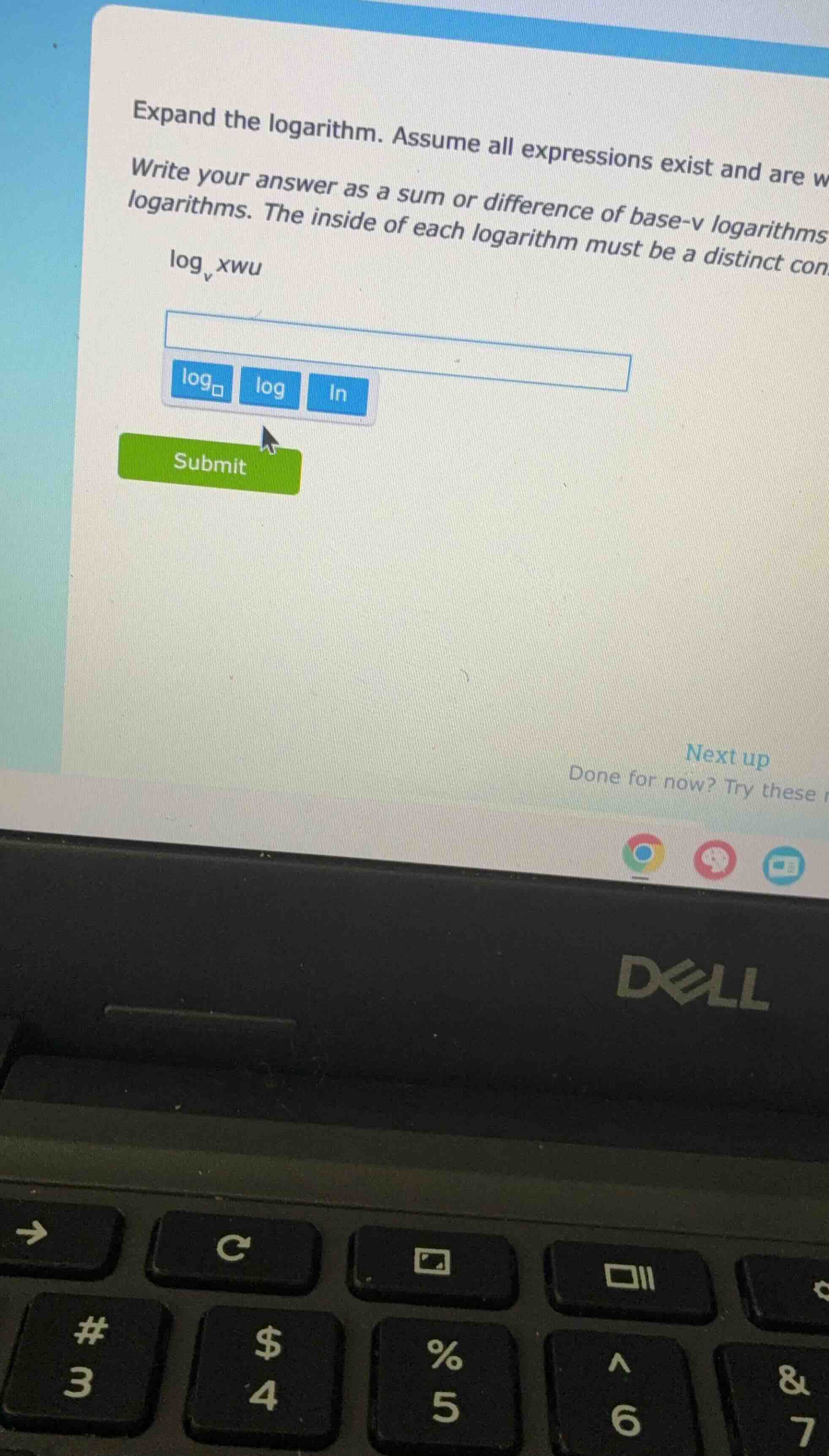
expand the logarithm. assume all expressions exist and are w write your answer as a sum or difference of base-v logarithms logarithms. the inside of each logarithm must be a distinct con\\(\log_{v} xwu\\)
Step1: Recall the logarithm product rule
The product rule for logarithms states that \(\log_b(ac) = \log_b(a) + \log_b(c)\) for any positive real numbers \(a\), \(c\), and \(b>0\), \(b
eq1\). We can apply this rule repeatedly when there are more than two factors in the argument.
Step2: Apply the product rule to \(\log_v(xwu)\)
The argument \(xwu\) is a product of three factors: \(x\), \(w\), and \(u\). First, we can group \(x\) and \(wu\) (or any two factors) and apply the product rule. Let's start by considering \(xwu = x \cdot (wu)\). Then, by the product rule:
\(\log_v(x \cdot (wu)) = \log_v(x) + \log_v(wu)\)
Step3: Apply the product rule again to \(\log_v(wu)\)
Now, we apply the product rule to \(\log_v(wu)\) since \(wu = w \cdot u\). Using the product rule:
\(\log_v(wu) = \log_v(w) + \log_v(u)\)
Step4: Combine the results
Substituting \(\log_v(wu) = \log_v(w) + \log_v(u)\) back into the equation from Step 2, we get:
\(\log_v(xwu) = \log_v(x) + \log_v(w) + \log_v(u)\)

Snap & solve any problem in the app
Get step-by-step solutions on Sovi AI
Photo-based solutions with guided steps
Explore more problems and detailed explanations
\(\log_v x + \log_v w + \log_v u\)