QUESTION IMAGE
Question
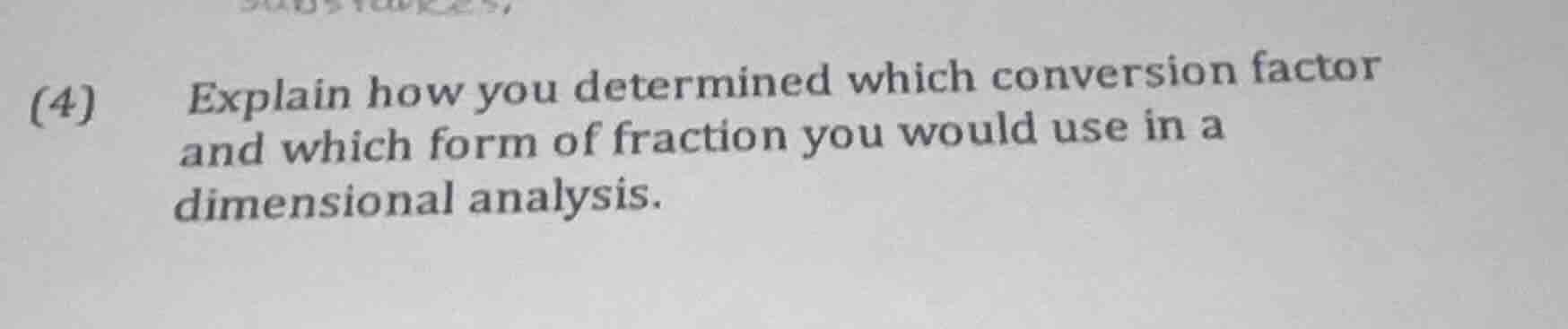
(4) explain how you determined which conversion factor and which form of fraction you would use in a dimensional analysis.
Brief Explanations
- Identify the Goal: First, determine the unit you want to end up with (the desired unit) and the unit you start with (the initial unit). For example, if converting from meters to centimeters, initial unit is meters, desired is centimeters.
- Find Conversion Factors: Recall or look up the relationship between the initial and desired units. For meters to centimeters, the conversion factor is \(1\,\text{m} = 100\,\text{cm}\).
- Set Up the Fraction (Conversion Factor Form): The conversion factor can be written as a fraction in two ways: \(\frac{1\,\text{m}}{100\,\text{cm}}\) or \(\frac{100\,\text{cm}}{1\,\text{m}}\). To cancel the initial unit, place the initial unit in the denominator of the conversion factor fraction. So, if starting with meters, use \(\frac{100\,\text{cm}}{1\,\text{m}}\) because the meter unit in the denominator will cancel with the initial meter unit.
- Check Dimensional Analysis: Multiply the initial quantity (with its unit) by the conversion factor fraction. For example, if converting \(2\,\text{m}\) to centimeters: \(2\,\text{m} \times \frac{100\,\text{cm}}{1\,\text{m}}\). The meter units cancel, leaving \(2\times100 = 200\,\text{cm}\), which is the desired unit.
- General Rule: The form of the fraction (conversion factor) is chosen such that the unit you want to eliminate (initial unit) is in the denominator, and the unit you want to keep (desired unit) is in the numerator. This ensures that when you multiply, the unwanted units cancel out, leaving the desired unit.

Snap & solve any problem in the app
Get step-by-step solutions on Sovi AI
Photo-based solutions with guided steps
Explore more problems and detailed explanations
To determine the conversion factor and its fractional form in dimensional analysis:
- Identify Units: Determine the initial unit (to convert from) and the desired unit (to convert to).
- Find Conversion Factor: Recall the relationship (e.g., \(1\,\text{m} = 100\,\text{cm}\)) between these units.
- Form the Fraction: Write the conversion factor as a fraction (\(\frac{\text{desired unit}}{\text{initial unit}}\) or \(\frac{\text{initial unit}}{\text{desired unit}}\)). Choose the fraction where the initial unit is in the denominator (to cancel the initial unit) and the desired unit is in the numerator (to retain the desired unit). For example, converting \(2\,\text{m}\) to cm: use \(\frac{100\,\text{cm}}{1\,\text{m}}\) (denominator has initial unit “m” to cancel \(2\,\text{m}\), numerator has desired unit “cm”).
- Verify: Multiply the initial quantity by the fraction—unwanted units cancel, leaving the desired unit.
This process ensures the initial unit is eliminated and the desired unit remains, allowing accurate unit conversion.