QUESTION IMAGE
Question
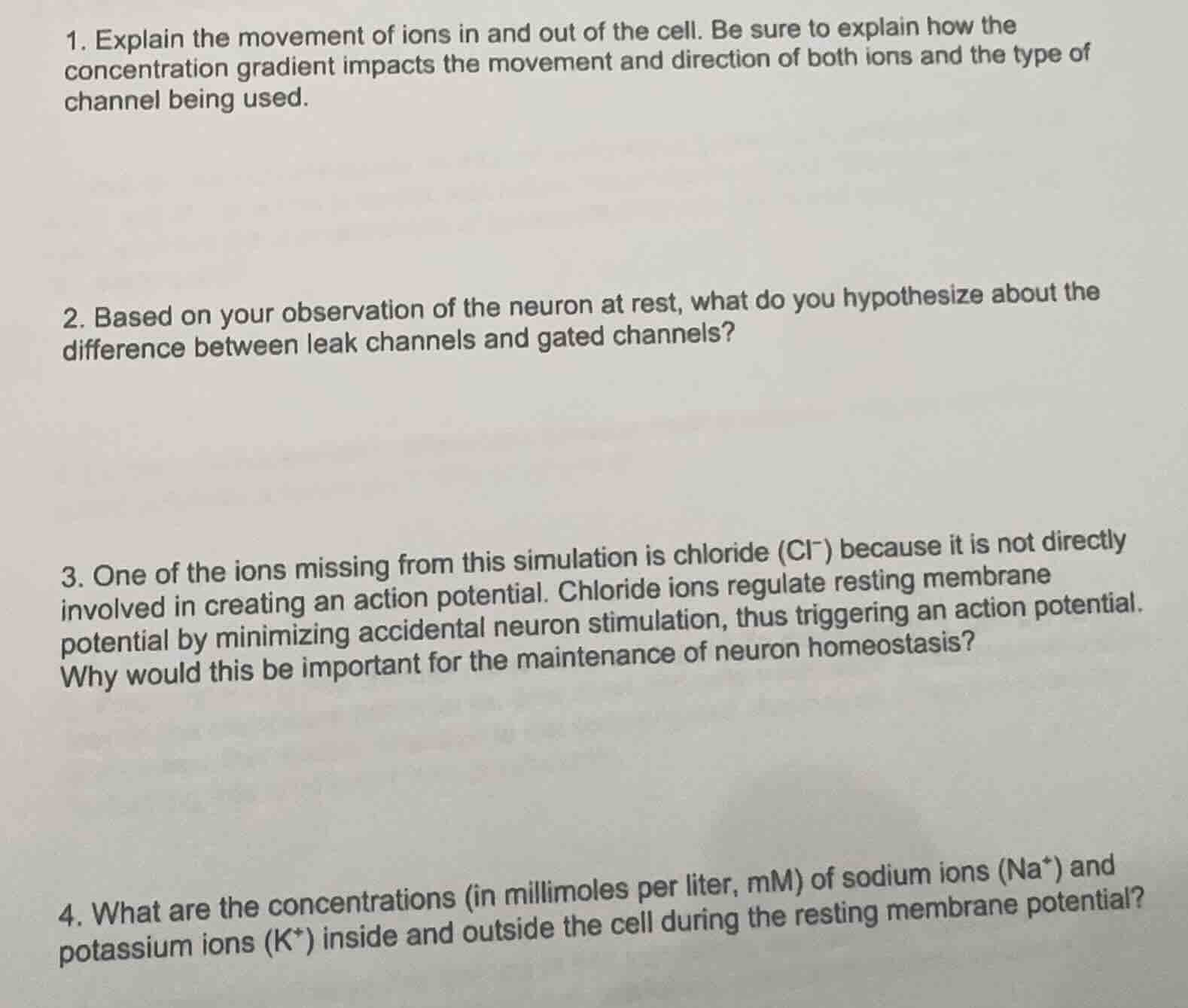
- explain the movement of ions in and out of the cell. be sure to explain how the concentration gradient impacts the movement and direction of both ions and the type of channel being used.
- based on your observation of the neuron at rest, what do you hypothesize about the difference between leak channels and gated channels?
- one of the ions missing from this simulation is chloride (cl⁻) because it is not directly involved in creating an action potential. chloride ions regulate resting membrane potential by minimizing accidental neuron stimulation, thus triggering an action potential. why would this be important for the maintenance of neuron homeostasis?
- what are the concentrations (in millimoles per liter, mm) of sodium ions (na⁺) and potassium ions (k⁺) inside and outside the cell during the resting membrane potential?
Question 1
Ions move in/out of cells via channels (leak, gated) or transporters. Concentration gradient drives passive movement (e.g., $K^+$ exits via leak channels down its gradient; $Na^+$ enters down its gradient but is limited by leak channels at rest). Gated channels (voltage, ligand - gated) open/close based on stimuli, controlling ion flow (e.g., voltage - gated $Na^+$ channels open during action potential, letting $Na^+$ in down its gradient). Concentration gradient determines direction (ions move from high to low concentration in passive transport) and rate (steeper gradient → faster movement).
Leak channels are always open, allowing constant ion flow (e.g., $K^+$ leak channels maintain resting membrane potential by letting $K^+$ out). Gated channels open/close in response to stimuli (voltage - gated channels respond to membrane potential changes; ligand - gated to chemical signals). At rest, leak channels are active, gated channels are closed (except for some leak - like activity), so leak channels provide baseline ion permeability, gated channels are for signal - induced ion flow.
Neuron homeostasis requires stable resting membrane potential and controlled action potential firing. $Cl^-$ minimizes accidental stimulation by hyperpolarizing the membrane (increasing the threshold for action potential). This prevents false action potentials, ensuring neurons fire only when appropriate stimuli occur, maintaining normal neural function (e.g., preventing seizures from excessive, unregulated firing).

Snap & solve any problem in the app
Get step-by-step solutions on Sovi AI
Photo-based solutions with guided steps
Explore more problems and detailed explanations
Ions move in/out of cells through channels (leak, gated) or transporters. The concentration gradient drives passive ion movement (e.g., $K^+$ exits via leak channels down its gradient; $Na^+$ enters down its gradient but is limited at rest). Gated channels (voltage/ligand - gated) open/close with stimuli, controlling flow (e.g., voltage - gated $Na^+$ channels open in action potential, letting $Na^+$ in down its gradient). The gradient determines direction (high to low in passive transport) and rate (steeper gradient → faster movement).