QUESTION IMAGE
Question
i can explain why a radical equation has 0 solutions or 1 solution.
show all work!!!
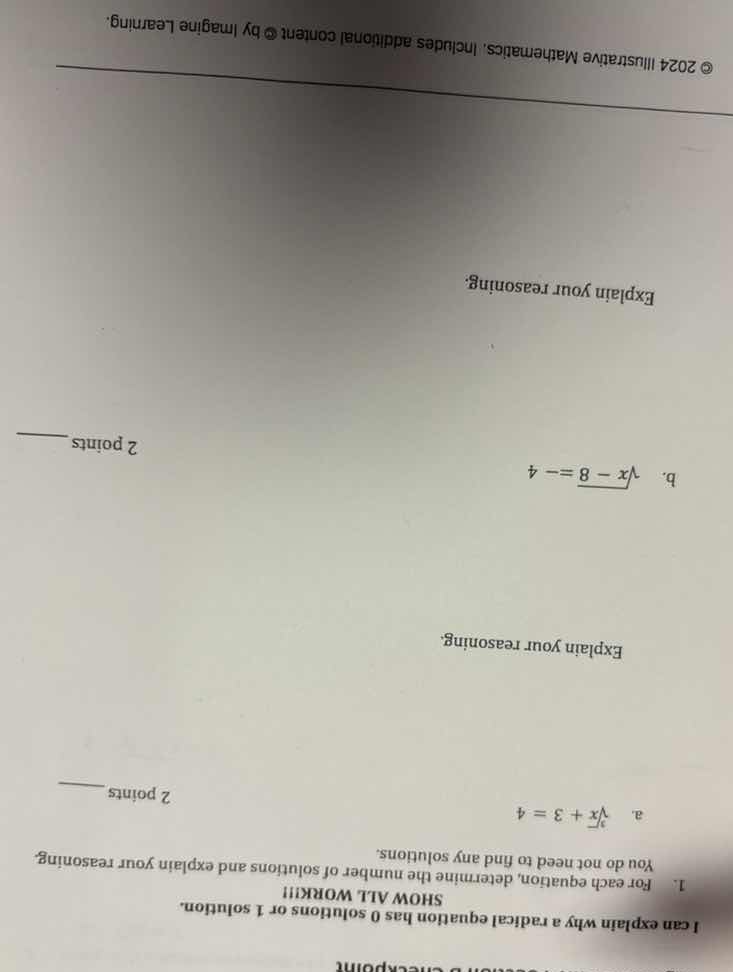
- for each equation determine the number of solutions and explain your reasoning. you do not need to find any solutions.
a. \\(\sqrt{x} + 3 = 4\\)
2 points ______
explain your reasoning:
b. \\(\sqrt{x - 8} = -4\\)
2 points ______
explain your reasoning:
© 2024 illustrative mathematics. includes additional content © by imagine learning.
Step1: Isolate the cube root
Subtract 3 from both sides.
$\sqrt[3]{x} = 4 - 3$
$\sqrt[3]{x} = 1$
Step2: Analyze cube root solutions
Cube roots can take negative/positive values.
For any real number $a$, $\sqrt[3]{a}$ has exactly one real solution. Cubing both sides gives $x = 1^3 = 1$, so there is 1 real solution.
Step1: Analyze square root range
Square roots are non-negative.
$\sqrt{x-8} \geq 0$ for all valid $x$ (where $x-8 \geq 0$)
Step2: Compare to right-hand side
The equation sets a non-negative value equal to -4, which is negative. No real number $x$ can satisfy this, so there are 0 real solutions.

Snap & solve any problem in the app
Get step-by-step solutions on Sovi AI
Photo-based solutions with guided steps
Explore more problems and detailed explanations
a. 1 real solution. A cube root has exactly one real solution for any real input, and isolating the cube root here leads to a valid real solution.
b. 0 real solutions. A square root of a real number is always non-negative, so it cannot equal a negative number like -4.