QUESTION IMAGE
Question
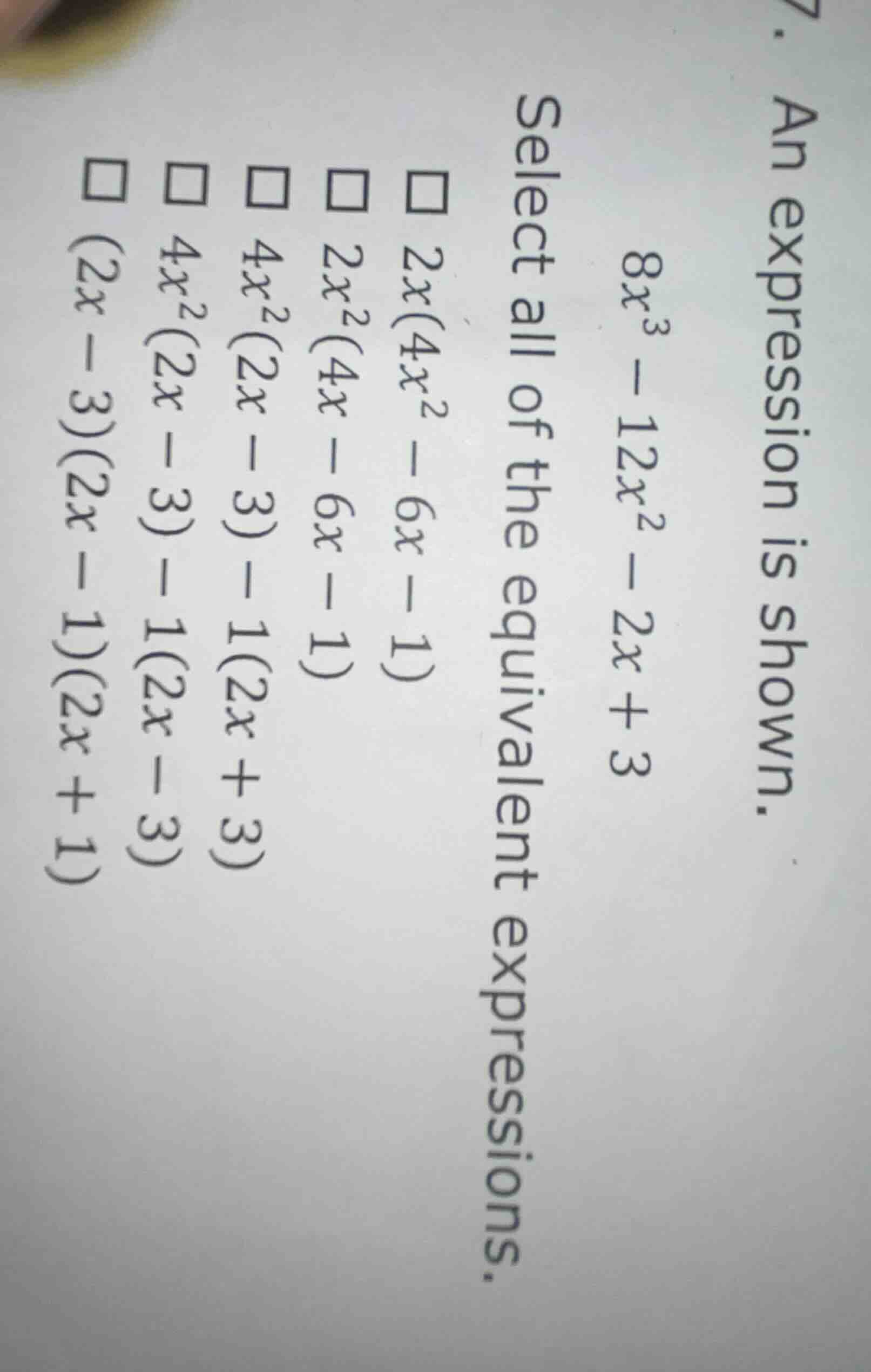
- an expression is shown. ( 8x^3 - 12x^2 - 2x + 3 ) select all of the equivalent expressions. ( square 2x(4x^2 - 6x - 1) ) ( square 2x^2(4x - 6x - 1) ) ( square 4x^2(2x - 3) - 1(2x + 3) ) ( square 4x^2(2x - 3) - 1(2x - 3) ) ( square (2x - 3)(2x - 1)(2x + 1) )
Step 1: Analyze the original expression
The original expression is \(8x^{3}-12x^{2}-2x + 3\). We can try to factor it by grouping.
Group the terms as \((8x^{3}-12x^{2})+(-2x + 3)\).
Factor out the greatest common factor (GCF) from each group:
For the first group \(8x^{3}-12x^{2}\), the GCF is \(4x^{2}\), so we get \(4x^{2}(2x - 3)\).
For the second group \(-2x + 3\), we can factor out \(-1\) to get \(-1(2x - 3)\).
Now the expression becomes \(4x^{2}(2x - 3)-1(2x - 3)\).
Factor out the common binomial factor \((2x - 3)\):
\((2x - 3)(4x^{2}-1)\)
We can also factor \(4x^{2}-1\) as a difference of squares since \(4x^{2}=(2x)^{2}\) and \(1 = 1^{2}\). Using the difference of squares formula \(a^{2}-b^{2}=(a + b)(a - b)\), we have \(4x^{2}-1=(2x + 1)(2x - 1)\). So the original expression can also be written as \((2x - 3)(2x + 1)(2x - 1)\) or \((2x - 1)(2x - 3)(2x + 1)\) (multiplication is commutative).
Let's analyze each option:
Option 1: \(2x(4x^{2}-6x - 1)\)
Expand this: \(2x\times4x^{2}-2x\times6x-2x\times1=8x^{3}-12x^{2}-2x\). This is not equal to the original expression \(8x^{3}-12x^{2}-2x + 3\) (missing the \(+3\) term). So this option is incorrect.
Option 2: \(2x^{2}(4x - 6x - 1)\)
First, simplify inside the parentheses: \(4x-6x-1=-2x - 1\). Then expand: \(2x^{2}\times(-2x)-2x^{2}\times1=-4x^{3}-2x^{2}\). This is not equal to the original expression. So this option is incorrect.
Option 3: \(4x^{2}(2x - 3)-1(2x - 3)\)
As we saw in the factoring by grouping step, this is equal to \((2x - 3)(4x^{2}-1)\) which is equal to the original expression after factoring. Wait, actually when we expand \(4x^{2}(2x - 3)-1(2x - 3)\):
\(4x^{2}\times2x-4x^{2}\times3-1\times2x + 1\times3=8x^{3}-12x^{2}-2x + 3\), which matches the original expression. Wait, maybe I made a mistake earlier. Wait, no, when we factor by grouping:
Original expression: \(8x^{3}-12x^{2}-2x + 3\)
Group as \((8x^{3}-12x^{2})+(-2x + 3)=4x^{2}(2x - 3)-1(2x - 3)\) (because \(-2x + 3=-(2x - 3)\)). Then factoring out \((2x - 3)\) gives \((2x - 3)(4x^{2}-1)\). But if we expand \(4x^{2}(2x - 3)-1(2x - 3)\), we get \(8x^{3}-12x^{2}-2x + 3\), which is the original expression. So this option is equivalent. Wait, maybe I misread the option. Wait the option is \(4x^{2}(2x - 3)-1(2x - 3)\)? Wait the third option is \(4x^{2}(2x - 3)-1(2x - 3)\)? Wait the user's options:
Wait the options are:
- \(2x(4x^{2}-6x - 1)\)
- \(2x^{2}(4x - 6x - 1)\)
- \(4x^{2}(2x - 3)-1(2x - 3)\)
- \(4x^{2}(2x - 3)-1(2x - 3)\)? No, let's re - examine the image:
The options are:
- \(2x(4x^{2}-6x - 1)\)
- \(2x^{2}(4x - 6x - 1)\)
- \(4x^{2}(2x - 3)-1(2x - 3)\)
- \(4x^{2}(2x - 3)-1(2x - 3)\)? No, the fifth option is \((2x - 3)(2x - 1)(2x + 1)\)
Wait, let's do a better expansion for each option:
Option 1: \(2x(4x^{2}-6x - 1)\)
\(=2x\times4x^{2}-2x\times6x-2x\times1\)
\(=8x^{3}-12x^{2}-2x\) (not equal to \(8x^{3}-12x^{2}-2x + 3\))
Option 2: \(2x^{2}(4x - 6x - 1)\)
First, simplify \(4x-6x-1=-2x - 1\)
Then \(2x^{2}(-2x - 1)=-4x^{3}-2x^{2}\) (not equal)
Option 3: \(4x^{2}(2x - 3)-1(2x - 3)\)
\(=4x^{2}\times2x-4x^{2}\times3-1\times2x+1\times3\)
\(=8x^{3}-12x^{2}-2x + 3\) (equal to original)
Option 4: \(4x^{2}(2x - 3)-1(2x - 3)\)? Wait, no, the fourth option is \(4x^{2}(2x - 3)-1(2x - 3)\)? Wait the fourth option in the image is \(4x^{2}(2x - 3)-1(2x - 3)\)? No, the fifth option is \((2x - 3)(2x - 1)(2x + 1)\)
Wait the fifth option: \((2x - 3)(2x - 1)(2x + 1)\)
Let's expand \((2x - 3)(2x - 1)(2x + 1)\)
First, multiply \((2x - 1)(2x + 1)=4x^{2}-1\) (difference of squa…

Snap & solve any problem in the app
Get step-by-step solutions on Sovi AI
Photo-based solutions with guided steps
Explore more problems and detailed explanations
The equivalent expressions are:
- \(4x^{2}(2x - 3)-1(2x - 3)\)
- \((2x - 3)(2x - 1)(2x + 1)\)
(Assuming the options are labeled as follows:
- \(4x^{2}(2x - 3)-1(2x - 3)\)
- \((2x - 3)(2x - 1)(2x + 1)\)
So the correct options are the third and the fifth ones (depending on the labeling in the image). If we consider the options as per the image:
- The option with \(4x^{2}(2x - 3)-1(2x - 3)\)
- The option with \((2x - 3)(2x - 1)(2x + 1)\)