QUESTION IMAGE
Question
extension questions
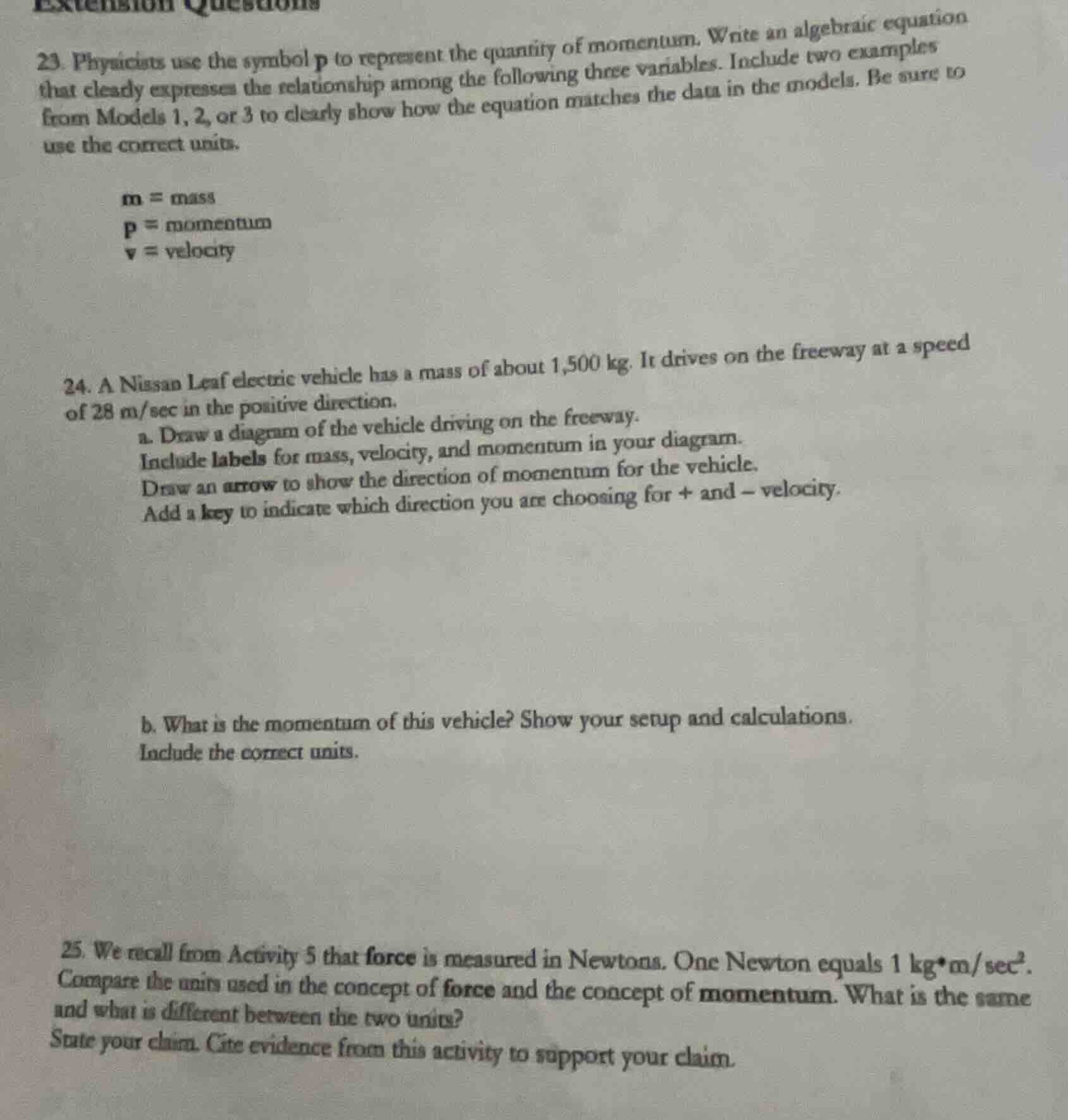
- physicists use the symbol p to represent the quantity of momentum. write an algebraic equation that clearly expresses the relationship among the following three variables. include two examples from models 1, 2, or 3 to clearly show how the equation matches the data in the models. be sure to use the correct units.
m = mass
p = momentum
v = velocity
- a nissan leaf electric vehicle has a mass of about 1,500 kg. it drives on the freeway at a speed of 28 m/sec in the positive direction.
a. draw a diagram of the vehicle driving on the freeway.
include labels for mass, velocity, and momentum in your diagram.
draw an arrow to show the direction of momentum for the vehicle.
add a key to indicate which direction you are choosing for + and – velocity.
b. what is the momentum of this vehicle? show your setup and calculations.
include the correct units.
- we recall from activity 5 that force is measured in newtons. one newton equals 1 kg·m/sec².
compare the units used in the concept of force and the concept of momentum. what is the same and what is different between the two units?
state your claim. cite evidence from this activity to support your claim.
Question 23
Step1: Recall the momentum formula
In physics, the momentum \( p \) of an object is the product of its mass \( m \) and velocity \( v \). So the algebraic equation is \( p = m \times v \) (or \( p = mv \)).
Step2: Provide examples (using hypothetical model data)
- Example 1 (Model 1: Let's say an object with mass \( m = 2\space kg \) and velocity \( v = 3\space m/s \)):
Using \( p = mv \), we substitute \( m = 2\space kg \) and \( v = 3\space m/s \). Then \( p = 2\space kg \times 3\space m/s = 6\space kg\cdot m/s \).
- Example 2 (Model 2: An object with \( m = 5\space kg \) and \( v = 4\space m/s \)):
Substitute into \( p = mv \): \( p = 5\space kg \times 4\space m/s = 20\space kg\cdot m/s \).
The units for momentum are \( kg\cdot m/s \) (kilogram - meter per second) since mass is in \( kg \) and velocity is in \( m/s \), and their product gives the unit for momentum.
To draw the diagram:
- Draw a simple representation of the Nissan Leaf (e.g., a rectangle) moving along a horizontal line (freeway).
- Label the mass: Write \( m = 1500\space kg \) near the vehicle.
- Label the velocity: Draw an arrow above the vehicle pointing in the positive direction (e.g., to the right) and label it \( v = 28\space m/s \).
- Label the momentum: Since momentum \( p = mv \), its direction is the same as velocity (because mass is a scalar with positive magnitude for the vehicle). Draw an arrow (same direction as velocity) and label it \( p \), with a note that \( p = mv \).
- Add a key: State that the right - hand direction is the positive (\( + \)) direction for velocity, and the left - hand direction is negative (\( - \)) for velocity.
Step1: Recall the momentum formula
The formula for momentum is \( p = mv \), where \( m \) is the mass of the vehicle and \( v \) is its velocity.
Step2: Substitute the given values
We know that \( m = 1500\space kg \) and \( v = 28\space m/s \). Substitute these values into the formula:
\( p = m\times v = 1500\space kg\times28\space m/s \)
Step3: Calculate the product
\( 1500\times28 = 42000 \), so \( p = 42000\space kg\cdot m/s \)

Snap & solve any problem in the app
Get step-by-step solutions on Sovi AI
Photo-based solutions with guided steps
Explore more problems and detailed explanations
The algebraic equation for momentum is \( \boldsymbol{p = mv} \) (where \( p \) is momentum in \( kg\cdot m/s \), \( m \) is mass in \( kg \), and \( v \) is velocity in \( m/s \)).
Examples:
- If \( m = 2\space kg \) and \( v = 3\space m/s \), then \( p = 2\space kg \times 3\space m/s = 6\space kg\cdot m/s \).
- If \( m = 5\space kg \) and \( v = 4\space m/s \), then \( p = 5\space kg \times 4\space m/s = 20\space kg\cdot m/s \).