QUESTION IMAGE
Question
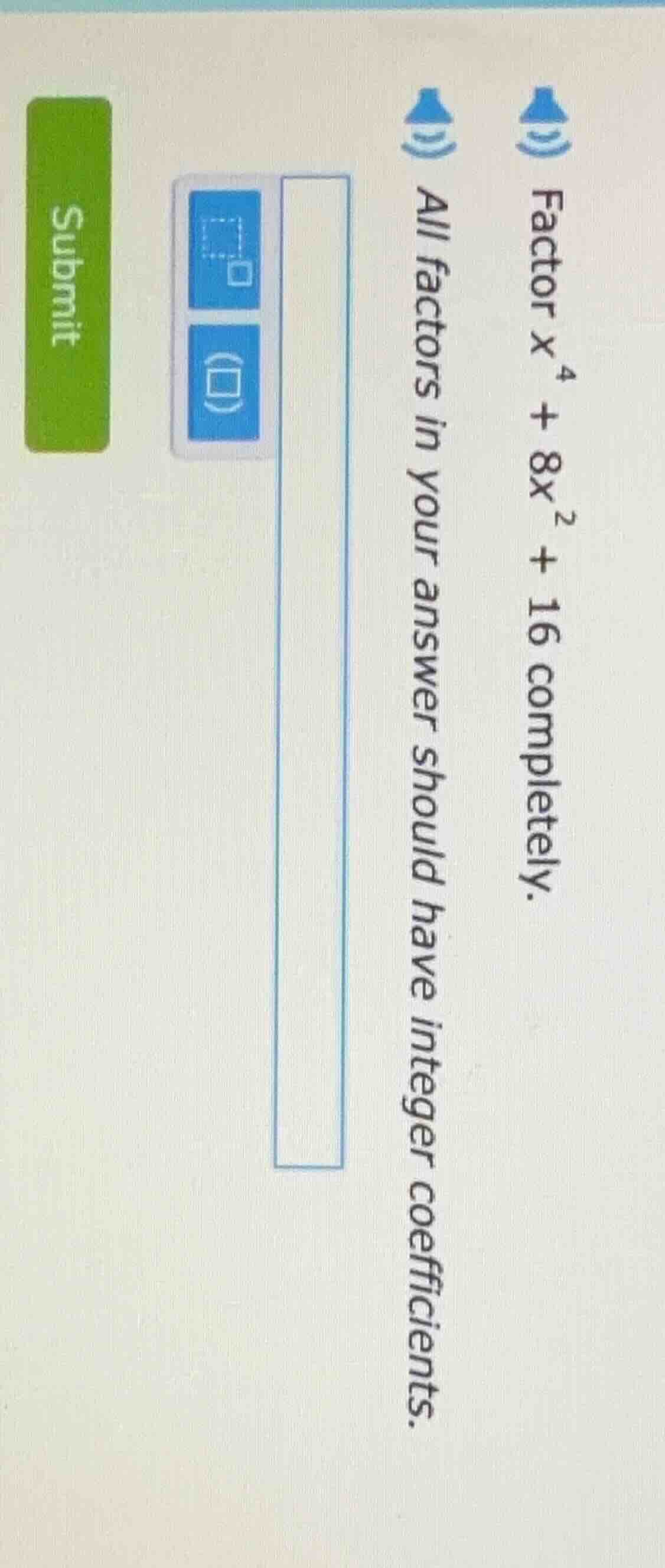
factor ( x^4 + 8x^2 + 16 ) completely. all factors in your answer should have integer coefficients.
Step1: Recognize the perfect square trinomial
The given expression is \(x^{4}+8x^{2}+16\). Let \(y = x^{2}\), then the expression becomes \(y^{2}+8y + 16\). This is a perfect square trinomial of the form \(a^{2}+2ab + b^{2}\), where \(a=y\) and \(b = 4\) (since \(2ab=2\times y\times4 = 8y\) and \(b^{2}=16\)).
So, \(y^{2}+8y + 16=(y + 4)^{2}\).
Step2: Substitute back \(y=x^{2}\)
Substituting \(y=x^{2}\) back into \((y + 4)^{2}\), we get \((x^{2}+4)^{2}\).
Step3: Check if \(x^{2}+4\) can be factored further
We can factor \(x^{2}+4\) using the sum of squares formula \(a^{2}+b^{2}=(a + bi)(a - bi)\), but since the problem asks for factors with integer coefficients, we check if it can be factored over real numbers. Wait, actually, \(x^{2}+4\) can be factored as a sum of squares in complex numbers, but the problem says "all factors in your answer should have integer coefficients". Wait, no, \(x^{2}+4\) can be factored as \((x^{2}+4)=(x + 2i)(x - 2i)\) but with integer coefficients? No, wait, maybe I made a mistake. Wait, the original expression: let's re - examine.
Wait, \(x^{4}+8x^{2}+16=(x^{2}+4)^{2}\), but \(x^{2}+4\) can be factored as \((x^{2}+4)=(x^{2}-(- 4))=(x + 2i)(x - 2i)\), but if we consider factoring over real numbers, \(x^{2}+4\) is irreducible. But wait, maybe the problem considers factoring over integers. Wait, no, the problem says "integer coefficients". Wait, maybe I misread the original expression. Wait, the original expression is \(x^{4}+8x^{2}+16\). Let's check again: \((x^{2}+4)^{2}\), and \(x^{2}+4\) can be factored as \((x^{2}+4)=(x^{2}+2^{2})\), but over the complex numbers, it's \((x + 2i)(x - 2i)\), but with integer coefficients? No, the coefficients of \(i\) are not integers. Wait, maybe the problem has a typo? Or maybe I made a mistake. Wait, no, let's check the original expression again. \(x^{4}+8x^{2}+16\): if we let \(u=x^{2}\), then \(u^{2}+8u + 16=(u + 4)^{2}=(x^{2}+4)^{2}\). And \(x^{2}+4\) can be factored as \((x^{2}+4)=(x^{2}-(-4))=(x+\sqrt{-4})(x - \sqrt{-4})=(x + 2i)(x - 2i)\), but these have complex coefficients. But the problem says "integer coefficients". Wait, maybe the original expression was \(x^{4}-8x^{2}+16\)? No, the user provided \(x^{4}+8x^{2}+16\). Wait, maybe I made a mistake in the initial step. Wait, \(a^{2}+2ab + b^{2}=(a + b)^{2}\), here \(a=x^{2}\), \(b = 4\), so \(2ab=2\times x^{2}\times4 = 8x^{2}\), which matches the middle term. So \((x^{2}+4)^{2}\) is correct. And if we consider factoring over the complex numbers, \((x^{2}+4)^{2}=(x + 2i)^{2}(x - 2i)^{2}\), but the problem says "integer coefficients". Wait, maybe the problem allows factoring as \((x^{2}+4)^{2}\), and \(x^{2}+4\) can be factored as \((x^{2}+4)=(x^{2}+2^{2})\), but with integer coefficients, the factorization of \(x^{4}+8x^{2}+16\) is \((x^{2}+4)^{2}\), and further, \(x^{2}+4=(x + 2i)(x - 2i)\), but since the problem says "integer coefficients", maybe the answer is \((x^{2}+4)^{2}\), or maybe I made a mistake. Wait, no, let's check the arithmetic: \((x^{2}+4)^{2}=x^{4}+8x^{2}+16\), which is correct. So the factored form with integer coefficients (if we consider real - valued integer coefficients, but \(x^{2}+4\) is irreducible over the reals with integer coefficients) is \((x^{2}+4)^{2}\), and over the complex numbers, it's \((x + 2i)^{2}(x - 2i)^{2}\). But the problem says "integer coefficients", so maybe the answer is \((x^{2}+4)^{2}\), and \(x^{2}+4\) can be factored as \((x^{2}+4)=(x^{2}+2^{2})\), but with integer coefficients, the factorization of the original expression is \((x^{2}+4)^{2}\).

Snap & solve any problem in the app
Get step-by-step solutions on Sovi AI
Photo-based solutions with guided steps
Explore more problems and detailed explanations
\((x^{2}+4)^{2}\) (or \((x + 2i)^{2}(x - 2i)^{2}\) if complex factors are allowed, but since the problem asks for integer coefficients, \((x^{2}+4)^{2}\) is the factorization with integer - coefficient factors for the first step, and if we consider complex factors, \((x + 2i)^{2}(x - 2i)^{2}\))